Where the buffalo roam again.

And now a feel-good story for a change. For the first time since the 19th century, when wild bison were hunted to near extinction, Parks Canada, Canada’s federal national parks agency, has released 16 adult bison, mostly pregnant females, into Banff National Park.
Banff is Canada’s oldest national park, having been established in the Rocky Mountains in 1885.

©2017 Parks Canada

©2017 Parks Canada

At 2,500 square miles (6,600 square kilometres), it remains one of the world’s most pristine wildlife areas close to a major city, just70 miles (110 kms) west of Calgary, Alberta. The terrain glaciers, ice fields, coniferous forest and — most importantly for the bison — seasonal grasslands. Resident mammals include grizzly bears, mountain lions, white-tailed deer, mule deer, elk and bighorn sheep.

This isn’t an empty-headed exercise in wishful thinking. Nor is it a rush job, the result of little forethought and next to no planning.

©2017 Parks Canada

©2017 Parks Canada

Despite Banff’s range and relative wildness, the park remains a sensitive ecosystem. Banff’s mountain passes and crested valleys experience harsh winters. Not every species survives, even with good intentions and modern-day science and technology. Just seven years ago, an avalanche is believed to have wiped out the then last-remaining family group of wild caribou.

Still, bison are tough and resilient.

The move is a throwback to a time when — it’s said — plains buffalo, as they’re more commonly known in the U.S., were so thick on the ground, they turned the plains black.

©2017 Parks Canada

©2017 Parks Canada

That’s hard to believe, of course, but hopes are high that with time and patience, a viable population may establish itself again. In their heyday, plains buffalo numbered some 30 million across the continent. The Alberta herds were long gone, though, by the time Banff was gazetted in 1885.

Reintroducing bison is liable to be less controversial to ranchers in the surrounding area than, say, reintroducing gray wolves to Yellowstone. 

The conservation team moved the bison from a protected herd in central Alberta, and transported them by truck and helicopter to the snowy passes that bisect Alberta and its western neighbour province, BC. The bison were tested for bacterial infection and have been cleared of any communicable diseases.

©2017 Parks Canada

©2017 Parks Canada

For now, they’re penned in a sprawling enclosure in Banff’s remote Panther Valley, far from the main tourist routes. The plan is to release them into the true wild by the summer of 2018, when they’ll be free to roam the 460 square miles (1,200 square kms) that encompass the Red Deer and Cascade River valleys.

If successful, project manager Karsten Heuer said, the Banff herd will be one of only four plains buffalo herds in North America that compete with other herbivores and their predators for survival.

The animals are not tame, or idle: The conservation team taped rubber hoses to the bisons’ horns to prevent them from injuring each other while in transit to their new home.

Fasten your seatbelts — this is about to get real.


Dangerous Planet: The places most likely to kill you.

The diverting survival handbook The Worst-Case Scenario Survival Handbook offers useful pointers on how to deal with runaway camels, UFO abductions, high-rise hotel fires and leeches — human and animal. There’s only so much use one can get, though, out of learning the phrase May I borrow a towel to wipe up the blood? in German (“Darf ich ein Tuch borgen, um das blut abzuwischen?)”) or this useful bit of advice for travelling to dangerous regions: “Check beforehand.” (No kidding.)

While your chances of being snatched by a UFO might not seem as likely as some other scenarios outlined in a section headed “People Skills” — not as likely as, say, “How to survive a riot,” “how to pass a bribe” or “how to foil a scam artist,” there are useful pointers nonetheless on how to find your way in unfamiliar territory in a section called “Getting Around,” which includes bonus advice on “how to jump from rooftop to rooftop,” “How to ram a barricade” (too many viewings of The Year of Living Dangerously, no doubt) and “How to escape from the trunk of a car.” You never know when that last one may come in handy, whether you took a wrong turn into Vila Cruzeiro in Rio de Janeiro or decided to windowshop at the corner of W. Mulberry and N. Fremont in Baltimore, Maryland.

Nature and the natural world poses its own risks, as a more sober — and grounded — article recently noted on BBC World News’ main website. The piece, headed “The places on Earth where nature is most likely to kill you,” doubled a kind of anti-Planet Earth. Sure, the world is full of natural hazards, writer Ella Davies noted, from volcanoes to floods and storms. But where is the risk to human life greatest?

Don’t laugh. This is every bit as topical and relevant as knowing what to do if you’re buzzed by a UFO while driving a lonely strecth of highway at night. And if you live the life of a nature photographer, it’s much more likely to, um, bite you in the ass.

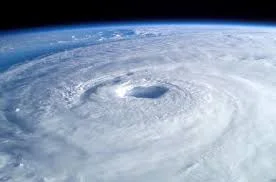
Hurricane Isaac nears Haiti. ©NASA

Hurricane Isaac nears Haiti. ©NASA

The piece breaks the subject into four basic elements, a subliminal nod, perhaps, to the ‘70s R&B soul-funk band Earth, Wind & Fire: water, air, earth and fire, in that order. 

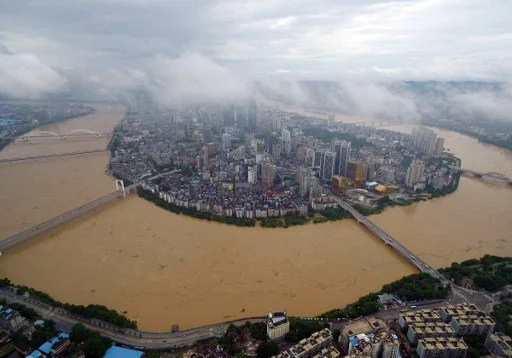
So, while little more than 1,000 deaths were recorded at sea in the year 2012, according to the International Maritime Organziation, water on dry land is a much greater force to be reckoned with, whether from rising sea levels and storm surges (the Maldives, Kiribati) or spring flooding on inland rivers. The survey found that the most likely place forcasualties are the flood plains adjacent to China’s biggest rivers. The summer flood on China’s Yangtze River in 1931 is believed to have killed countless people — literally countless, as official records at the time were incomplete. It’s believed to have been in the millions, though, in large part because of heavy concentrations of inhabitants along the river banks and unseasonally heavy snows that year, followed by sudden thawing and catastrophic rainfall.

China's Liujiang River floods in July, 2016  ©AFP

China's Liujiang River floods in July, 2016  ©AFP

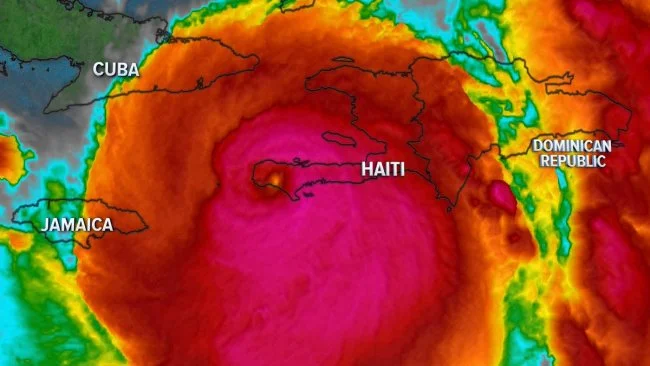
In terms of air — hurricanes, mostly — Haiti is considered to be one of the most vulnerable regions on the planet, in part because of its geographical location in the tropical Caribbean and in part because the island nation lacks the resources to properly prepare, even when given advance warning. The most intense storms are not necessarily the deadliest: Haiti is unusually vulnerable, too, because natural barriers like forests have been stripped of their natural cover and many settlements have either been built on floodplains or in coastline areas vulnerable to storm surge.

In terms of the Earth — namely, earthquakes and other kinds of land-locked seismic activity — Los Angeles gets a lot of attention for being at risk, in part because it’s the media capital of the world and in part because of its population density and the suspicion that “the Big One” hasn’t struck yet, a concern echoed in the coastal Pacific Northwest, along the I-5 Seattle-Vancouver corridor. What the two have in common is the Pacific “Ring of Fire,” an active volcanic and tectonic belt that rings the entire Pacific Ocean.

As the BBC article notes, though, the real risk of loss-of-life lies in the less affluent parts of the Ring of Fire — not Japan, the U.S. Canada or New Zealand but rather the Philippines. 

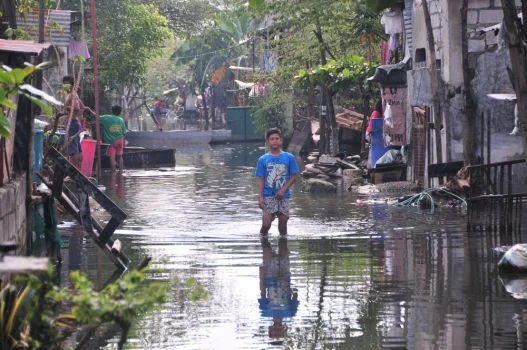
Some 81% of the world’s worst earthquakes strike along the Ring of Fire, according to the 2015 Natural Hazard Risks Atlas. Digging deeper, though, those same risk analysts found that eight of the world’s 10 cities most at risk to natural disaster are in the Philippines, in no small part because the Ring of Fire intersects and crosses over with the Pacific’s major cyclone belt. The Philippines is at risk to both earthquakes and hurricanes, in other words. 

Flooding in Sunrise Village, Philippines. ©2012 OM International

Flooding in Sunrise Village, Philippines. ©2012 OM International

In terms of fire — namely, volcanoes — Indonesia ranks near the top, in terms of both incidents and loss of life. The World Organization of Volcano Observatories (WOVO.org) recently determined that, in all, more than 200,000 people have died as a direct result of volcanoes during the past 400 years. Mount Tambora on the island of Sumbawa killed some 70,000 people in 1815, leading to a “year without summer” throughout the northern hemisphere.

Haet wave in Dubai, UAE  ©Getty Images

Haet wave in Dubai, UAE  ©Getty Images

Interestingly, in terms of fire and air combined, climate scientists are now warning that heat waves — whether or notthey’re connected to climate change — pose the largest hazard, and possibly the greatest threat to humankind yet. Call it what you will, global warming or a global warning, the result is the same.


http://www.bbc.com/earth/story/20170202-the-places-on-earth-where-nature-is-most-likely-to-kill-you


©2017 NASA International Space Station (ISS)

©2017 NASA International Space Station (ISS)

Making Planet Earth II, by the numbers.

Mike Gunton might not be the household name David Attenborough is but if there is to be a third series of Planet Earth, Gunton is likely the person who will sign off on it — just as Alastair Fothergill, a former director of the BBC’s Natural HIstory Unit, signed off on the original Planet Earth in 2003.

Gunton, the Natural History Unit’s present-day creative director and a co-producer of Planet Earth II, told UK media last December that while they would be crazy to rule out a third series, the decision is not as easy as, say, greenlightinga new sitcom or shoot-‘em-up police procedural.

Planet Earth II was timed to coincide with the original Planet Earth’s 10th anniversary, but as Gunton conceded, it was five years in the making.

©BBC One

©BBC One

If there is to be a Planet Earth III, in other words, the decision will need to be made soon. Even with new camera technology that would’ve proved impossible in 2006, filming wild animals in their natural habitat and — more importantly,  from the BBC’s point of view — capturing behaviour never seen on camera before, takes time.

Planet Earth II makes its North American debut on Feb. 18, after a successful run in the UK.

ildlife documentaries are a dime a dozen; the whole point of Planet Earth is that it be seen to be unique, something special, to stand out from the crowd.

©BBC One

©BBC One

Few wildlife programs come under such scrutiny, from casual viewers aksing themselves, ‘How did they do that?’ to dyed-in-the-wool environmentalists and animal-rights campaigners keen to spot any potential abuses and audience manipulation.

Making Planet Earth II wasn’t easy, no matter how spiffy new camera technology has become. As North American audiences prepare to see what all the fuss is about, here are half-a-dozen gee-whiz facts about the making of a documentary series some are calling the finest of its kind ever made.

1. David Attenborough doesn’t venture to far-flung locations that much anymore — he’s 90, after all — but he’s not just a mouthpiece. He phoned field producers on a regular basis throughout filming and insisted they prove his narration to be accurate, while also telling a good story.

©BBC One

©BBC One

2. Planet Earth II employed 42 camera operators, and is the first series BBC produced in ultra high-definition 4K. Filming crews had to lug 30 to 40 cases of equipment halfway around the world, but were allowed just one personal bag each.

©BBC One

©BBC One

3. Shades of Steve Irwin: During the filming of the episode “Islands,” one crew member was stung by a stingray. The team was stranded two hours from the mainland and sorequired on-site medical attention before getting the crew member to safety. On the episode “Mountains,” another crew member narrowly avoided falling into a rock crevasse while filming in the Himalayas.

4. Misadventure dogged the “Islands” team from the outset. Returning to camp after one shoot, the crew found a boa constrictor eating their supply of eggs.

5. The “Islands” episode alone was three and a half years in the making; it required 12 separate location shoots, which ranged from two to six weeks at a time. Planning and preparation alone took a full year, before a single camera was powered up.

6. Although crews filming in the tropics were bitten by mosquitoes by day and centipedes by night, they were restricted from using insect repellent as animals might smell it and avoid the camera positions. One producer of the “Islands” episode lived in the same clothes for two weeks, despite being pooped on by one penguin and vomited on by another.

©BBC One

©BBC One

7. The new series’ signature theme was composed by noted film composer Hans Zimmer. That fact is well known. Less well known is that the Icelandic alt-rock band Sigur Ros recorded a new version of their single Hoppipolla, which was first used in the original Planet Earth. It took some doing but after rummaging through their old recordings, Sigur Ros managed to find the original track stems and crafted a new version for Planet Earth II.

8. In all, Planet Earth II took six years to film. The trap cameras used to capture rare footage of snow leopards in the wild in the Himalayas were set up for a year before they achieved the desired result. The lions-vs.-buffalo sequence in the episode “Grasslands” took three months to achieve.

Attaining a legal permit for the peregrine falcon sequence in New York City, for the final episode “Cities,” alone took nine months.

9. The widely seen — and much talked-about —  iguana-vs.-snakes sequence, which took two weeks of sunrise-to-sunset monitoring of a tropical beach, has clocked more than seven million views on YouTube.

©BBC One

©BBC One

10. Planet Earth II filmed in 40 countries, and required 117 separate filming expeditions. In all, the production recorded 400 terabytes of material, enough to fill 82,000 DVDs. Now you know.

http://www.bbc.co.uk/programmes/articles/1KQms2z3Gnk8ZLfYMPHxfBg/planet-earth-ii-in-numbers


How satellite technology is helping save the chimpanzee.

Fewer than 350,000 chimpanzees remain in the wild, down sharply from the two million believed to have roamed the rainforests of central Africa only a century ago.

These are estimates only, of course, but one doesn’t need a degree in earth science — or statistics — to know that habitat loss, illegal logging and the bushmeat trade are a continuing threat to one of humankind’s closest genetic relatives.

©Michael "Nick" Nichols for National Geographic

©Michael "Nick" Nichols for National Geographic

What is less known — until now — is that a recent, unique collaboration between the Jane Goodall Institute and NASA is boosting knowledge of what’s happening and, more importantly, how and where it’s happening.

Behavioural scientists with the International Union for the Conservation of Nature (IUCN) and other groups have being doing a credible job of tracking known family groups of chimpanzees, ever since Jane Goodall made her first visit to Tanzania’s Gombe region in 1960. Conservationists have mapped both chimpanzees’ territories — a family group’s immediate neighbhourhood — and their home ranges, the area chimpanzees roam outside their territories in their search for food, potential mates and other family groups.

In orbit, meanwhile, NASA has recorded the hour-by-hour, minute-by-minute changes to the earth’s surface for the past 44 years. Some of the most technologically advanced satellites have been placed in orbit in just the past two years.

Until recently, conservation groups and NASA worked at cross purproses. Information was gathered, but not shared. Thanks to the Goodall Institute, a new program of cooperation now makes it possible for primate researchers to monitor the environmental effects of habitat loss on individual family groups on a day-by-day basis.

©NASA/Goddard Scientific Visualization Studio/Cindy Starr

©NASA/Goddard Scientific Visualization Studio/Cindy Starr

This is important to chimpanzees’ future survival in the wild because behavioural scientists can now predict with a degree of certainty which family groups will be affected by proposed development projects, and how. The shared information can also be used as evidence in court cases brought against illegal loggers and rogue mining operations.

©NASA/Goddard Scientific Visualization Studio/Cindy Starr

©NASA/Goddard Scientific Visualization Studio/Cindy Starr

The bad news is that habitat loss is visible from space. The good news is that, by knowing how, when and where and environmental destruction is taking place, law-enforcement agencies and regulators now have real, tangible information on which to act.

The Landsat series of satellites, a joint mission of NASA and the U.S. Geological Survey (USGS), has been providing a continuous record of earth’s land use for more than four decades now. Images taken from orbit have been made available cost-free to the public: the Landsat program is a truly democratic, people-driven program.

“NASA satellite data helps us understand what it means to be a chimp by overlaying distribution of the habitat with chimpanzee behaviuor and ranging data," Lilian Pintea, vice-president of conservation science for the Goodall Institute, said in a statement for the NASA-Goddard Space Flight Center.

©Michael "Nick" Nichols for National Geographic

©Michael "Nick" Nichols for National Geographic

Chimpanzees once lived in an uninterrupted belt of woodland rain forests from Lake Tanganyika westward through Uganda and the Congo Basin.

In the 1970s, little more than a decade after Goodall first arrived in the region, the forest started to be cut down.

Increased population growth, driven in part by rural poverty, has exacerbated forest clearing for farmland and charcoal production.

The Goodall Institute is using the Landsat images to convince villagers in the area that conservation is in their best interests.

Goodall, now in her 80s, is still active with her namesake institute, though her primary role is now focused on education, fundraising and lecture tours around the world. She still tries to return to Gombe once a year, though. She’s noticed a direct effect the Landsat program has had on local opinion.

©Michael "Nick" Nichols for National Geographic

©Michael "Nick" Nichols for National Geographic

“It was exciting to see the impact of these images on the villagers,” Goodall said in a statement for the NASA-Goddard Space Flight Center.

Villagers could identify landmarks and sacred places in the satellite imagery, she added.

“It was like a piece of reality dropped magically from the sky.”

If the chimpanzee is to be saved in the wild, it will require concerted efforts on the ground, not just from space.

For now, though, the satellite images are proving to be a game changer for improving local conservation efforts.

A time travel tour through a forgotten era.

The Hungarian explorer Lászlo Almásy was the first European traveller to find the Cave of Swimmers cave paintings, made famous in Michael Ondaatje’s The English Patient. Almásy found the cave on the Gilf Kebir limsetone plateau of southwestern Egyot, some 960 kilometres south of the Mediterranean and 720 kilometres east of the Nile, in 1933.

©Library of Congress

©Library of Congress

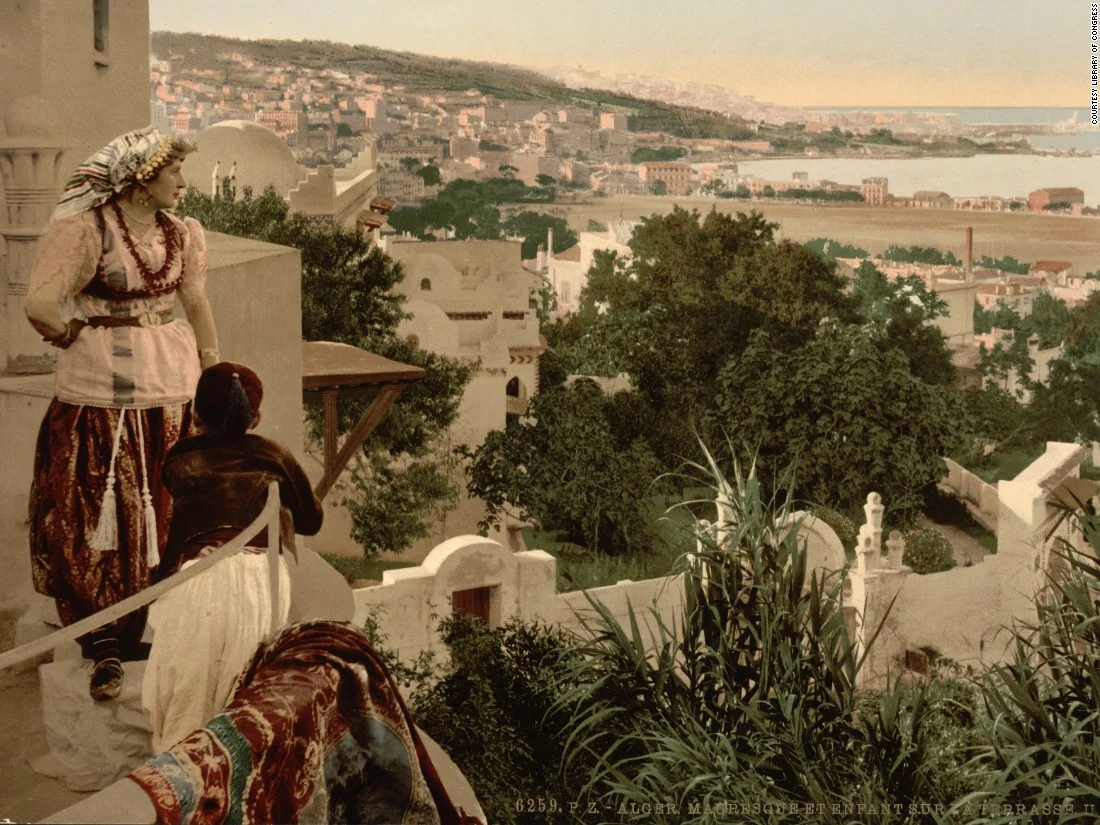
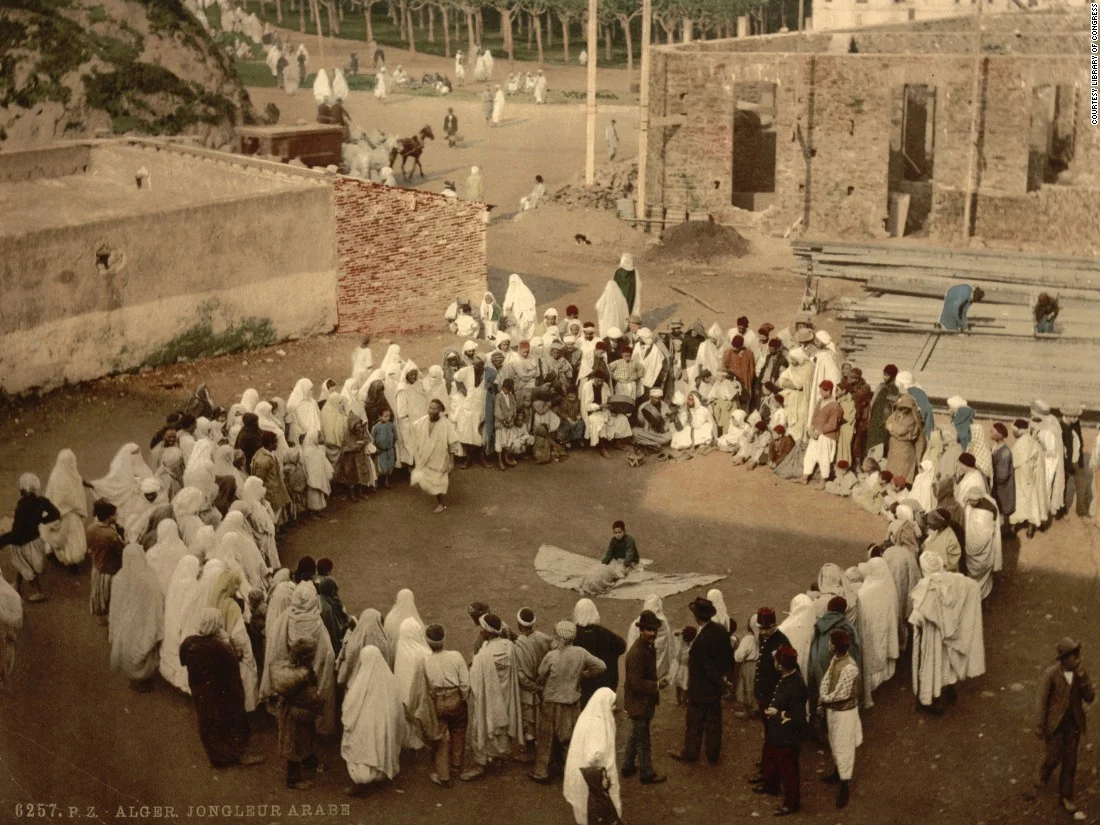
That makes the recent discovery of extraordinary images of 19th century North Africa buried deep within the archives of the U.S. Library of Congress all the more remarkable. Not photographs exactly and not lithographs but something in between, the faded colour impressions of everyday life in a land of neo-classical columns, rococo arches and desert-scorched minarets date from roughly 1899. some 25 years before Almásy, played by Ralph Fiennes in the film, made his discovery of the ages.

©Library of Congress

©Library of Congress

The authors are unknown. The photocroms, as the images are called, are a form of photolithography that has long fallen out of fashion. They were the Kodachromes of their time. The Library of Congress images provide a unique and evocative record of life in colonial North Africa — as London-based CNN writer-producer Thomas Page described them recently, “a time travel tour through a forgotten era . . . and not always the innocent postcards they may seem.”

©Library of Congress

©Library of Congress

The photocrom process was originally developed in Switzerland, in 1890, following 10 years of often painstaking trial and error. Photocroms stood out because they were some of the earliest known images in colour; nearly all photography at the time was black and white.

The process involves taking a negative from a camera and exposing it on a flat surface of stone or zinc which has been treated with a coating of light-sensitive chemicals. The chemicals harden as light is filtered through the negative, creating a print.

©Library of Congress

©Library of Congress

Photocrom images are distinctive, even today, because each print required up to 24 separate colour plates. Each plate was ascribed with a different colour; printed on top of one another, the ink would bleed and create the photocroms’ distinctive earth-tone effect. 

The North African photocroms appear to be designed for a captive audience in Europe, an early form of marketing Egypt, Tunisia, Algeria, Libya and Morocco to would-be travelers — the 19th century equivalent of a tourist brochure, rather than a way for local people to record history at the time.

©Library of Congress

©Library of Congress

Inadvertently, the photocroms recorded the end of an era. The First World War changed photography as it changed society, even in regions as far-flung as the outer edges of the Sahara Desert. “These images,” Page wrote, “nostalgic but containing a rich and sometimes dark subtext, were now objects of a past epoch.”

©Library of Congress

©Library of Congress


Cats v. dogs: Which is smarter? The ages-old question answered — sort of.

Science has spoken, after a fashion. Cats are just as proficient on certain memory tests as dogs, according to a new study by scientists in Japan.

That’s telling because, a number of years back,  when I asked noted dog expert Stanley Coren the ages-old question  — are dogs smarter than cats? — he gave a cagey but nonetheless accurate answer.

© BBC 2017

© BBC 2017

Dogs perform better on those tests we humans have devised to measure intelligence, he said. Dogs are not necessarily smarter, in other words; they simply think differently from cats.

The new study from Japan’s Koyoto University was based on a control group of 49 cats, if “control” is the right word.

Kyoto psychologist Saho Takagi found that cats, like dogs, often rely on memories from a single past expertience to modify their behaviour. That suggests they have episodic memory similar to that of humans, and dogs.

Dogs may or may not be smarter overall, but their social skills make them seem to be the personable companions, Coren said. Cats tend to be more aloof, which doesn’t go over well with most people. Dogs are more needy, but that implies a certain intelligence, too, Coren said: Dogs understand that any relationship is based on mutual trust and reciprocity.

© Stanley Coren

© Stanley Coren

Coren is not just another dog fancier and canine know-it-all. He earned a doctorate in psychology from Stanford University. He served as a professor of psychology and a neuropsychological researcher at Vancouver’s University of British Columbia (UBC) until retiring in 2007, and was director of the school’s Human Neuropsychology and Perception Laboratory for several years. He continues to lecture and conduct occasional research as a professor emeritus at UBC, and moonlights as an instructor at Vancouver’s Dog Obedience Training Club.

So far, no one has had a burning desire to establish a Cat Obedience Training Club, but that doesn’t mean cats are hopeless.

It’s just that, on a fundamental, personal level, they probably perceive obedience training as being beneath them.

Of cats, Coren did say — and this says as much about us and our own biases about our fellow creatures — that because cats have a lithe, lissome way of moving and are supple, graceful and physically adept, they may appear to some onlookers as being brighter than they really are. Pre-judging intelligence by the way an animal moves is a very human concept, Coren said.

Coren has little doubt that cats are very, very smart. It’s just that we haven’t yet figured them out the way we have dogs.

The Japan study isn’t just another an exercise in alternative facts: BBC News reports that the original research has been published in the peer journal Behavioural Processes.

Cats are the Kate Moss pf the animal world, UK Daily Mirror writer Polly Hudson insisted — “aloof, laid-back, nonchalant. They never complain or explain, as they couldn’t care less what anyone thinks of them.”

Then again, dog boosters would argue that caring what your benefactor thinks about you is a mark of intelligence in itself.

Either way, one thing is now certain, thanks to the research. Cats have been proven to have just as long memories as dogs.


http://www.bbc.com/news/science-environment-38665057

https://www.journals.elsevier.com/behavioural-processes/


Murky waters: It’s whaling season. Again.

Why is Japan still whaling in the Southern Ocean? It’s a rhetorical question, of course. The answer is: because they can, despite a 2014 ruling by the toothless International Court of Justice that the then newly modified Japanese whaling program was illegal. Japan’s original whaling program claimed some 6,800 whales over an 18-year period, ostensibly for “scientific research.” Japan rewrote and resubmitted its program in 2014; the International Court rejected it, and Japan ignored the court’s ruling.

©Sea Shepherd Conservation Society

©Sea Shepherd Conservation Society

It’s the Antarctic summer right now, and once again the Sea Shepherd Conservation Society is doing its best to harrass, interfere and do what little it can to prevent the whale slaughter — no thanks to Australia and New Zealand, who, if you choose to believe Sea Shepherd founder Paul Watson on his Facebook page, have chosen to stand by while the Japanese whaling fleet sails unimpeded through the southern nations’ territorial waters.

None of this is new, of course. Anyone who has seen even a few minutes of Animal Planet’s Whale Wars program knows the drill by now: the ships Nisshin Maru, Ocean Warrior and Steve Irwin have practically become household names.

@Animal Planet, Whale Wars

@Animal Planet, Whale Wars

What is new this time is that the bottom may be about to fall out of the whale-meat market in Japan and other Asian countries. That’s because — cue irony klaxon — the toxins in whale meat have now reached a point where the meat may no longer pass inspection in many countrues. Iceland’s largest whaling fleet did not leave port this past summer because the market has dried up.

Commercial whaling was banned in 1986 — some 30 years ago — but Japan’s whalers continue to exploit a loophole that allows whaling for scientific research purposes. (If you’re wondering why countries like Iceland, Norway and the Faroe Islands are still whaling, that’s because another loophole allows a certain amount of whaling for indigenous subsistence. Mind you, if toxicity levels are so high that many people won't eat whale meat, the whole subsistence argument becomes moot.)

Interestingly, the whalers of the mid-19th century kept copious notes — you might even say “research” — of their activities and whale behaviour, as evidenced by the historical records at whaling.oldweather.org.

Moby-Dick illustration by Everett Henry

Moby-Dick illustration by Everett Henry

For now, the whale wars go on — though now it’s as much a PR war as anything else. Earlier this month, in a confrontation with the makings of an international incident, Sea Shepherd  spotted — and photographed — a Japanese ship with a dead whale on board, in violation of international law.

Photos taken from a  helicopter show the crew of the ship in question, the Nisshin Maru, trying to cover up a dead minke whale with a blue tarp as the whirlybird flies overhead.

©Sea Shepherd

©Sea Shepherd

CNN reported that the whaling division of Japan’s official Fishery Agency was withholding comment until it received  a report of its own from the Nisshin Maru. So far, no word.

Japan inssts it’s allowed to cull roughly 330 Antarctic minke whales a year as part of a research program to “study the best methods of managing minke populations.”

Australia has a keen stake in this. Australia’s Ministry for the Environment and Energy released a statement just days after the Sea Shepherd photos were made public expressing “deep disappointment” at Japan’s decision to return to the Southern Ocean to undertake so-called scientific whaling.

“Australia is opposed to all forms of commercial and so-called ‘scientific’ whaling,” the statement read in part. “It is not necessary to kill whales in order to study them.”

Japan Fisheries Agency

Japan Fisheries Agency

Australia has established a whale sanctuary of its own. The sanctuary covers Australia’s Excclusive Economic Zone, which extends 200 nautical miles (370 kilometres) from the country’s coast.

As Watson has pointed out on his Facebook page, though, enforcement is everything. Sea Shepherd can’t be expected to save the whales on its own.

Then again, if the bottom falls out of the market, it will no longer be financially feasible for Japan, Iceland — or anyone — to hunt whales, for meat, sport or any other reason. We can hope. 

The Photo Ark: critically endangered species’ last stand?

Joel Sartore, born June 16, 1962 in Ponca City, Oklahoma near the Arkansas River, is a 20-year contributor to National Geographic magazine. 

Arguably, though, none of his projects — not his 1993 story on the trail of ruin left by Hurricane Andrew, not his 2003 story on B.C.’s embattled Clayoquot Sound, not even his self-explanatory 2009 story “Vanishing Amphibians” — can hold a candle to the substance, scope and potential significance of the Photo Ark, an A-to-Z portrait record of critically endangered species that are still with us. 

©National Geographic, Joel Sartore

©National Geographic, Joel Sartore


Since October, 2013 Sartore has labouriously tracked down living specimens of critically endangered animals — sadly, nearly all of them in zoos, aviaries and botanical gardens — and photographed them the way Annie Liebovitz might, in solo poses, against a plain backdrop that forces the eye to focus on the subject and nothing else.

© Joel Sartore

© Joel Sartore

Sartore’s passion for nature was kindled when he was a child, when he learned about the last passenger pigeon from one of his parent’s Time-Life photography books. Last year, he had a brief cameo in the film Racing Extinction, photographing the last known Rabb’s fringe-limbed tree frog (Ecnomiohcyla rabborum) at the Atlanta Botanical Grounds in January, 2013.

That frog, which Sartore dubbed “Toughie,” has since passed away. It was the last of its kind.

Over a lifelong career in journalism and nature photography, Sartore has contributed to Audobon Magazine, GEO, Sports Illutsrated, Newsweek, and, bringing his life’s calling full circle, Time-Life, but it’s his National Geographic work that has made his name.

And it’s the Photo Ark, for all the right reasons — and wrong reasons — that will stand the test of time. “No matter its size, each animal is treated with the same amount of respect and affection,” Sartore explains on the National Geographic Society’s main web site. “The results are portraits that that are not just stunningly beautiful, but also intimate and moving.”

Sartore’s efforts have seemed especially relevant in recent days with the discovery — and concerns — that snow leopards and common leopards have been found sharing the same territory for the first time, owing to pressures from climate change and human expansion. 

In North America, red foxes are now commonly seen in territories previously occupied by Arctic foxes. Rival predators don’t get along: They compete for food and so invariably the less adaptive of the two dies out. By definition, that favours the invasive species, not the endemic species. It’s an invasion that snow leopards, like Arctic foxes, may not be able to stop.

© Joel Sartore

© Joel Sartore

The snow leopard report was followed just hours later by a New York Times story that suggests most of the world’s remaining primates are threatened by extinction in the wild, according to a recent scientific study by 31 primatoglosists that, like the Photo Ark, is unprecedented in its scope.

“The typical nature photograph shows a butterfly on a pretty flower,” Sartore has said. “The conservation photograph shows the same thing, but with a bulldozer coming at it in the background.”

Sartore made that comment to conservation writer Jaymi Heimbuch on the Mother Nature Network’s web site (www.mnn.com) in 2014, in a story headed, “How One Photographer’s Foolishness is Saving Endangered Wildlife.”

The world could use a little more foolishness like that.


http://www.nationalgeographic.org/projects/photo-ark/


Circus’ closure a sign of changing times

Forlorn-looking lions and tigers with dead eyes will no doubt still pace in tiny cages in roadside attractions in many countries around the world, off-the-books and in many cases illegally.

Still, Ringling Brothers and Barnum & Bailey’s begrudging announcement this past weekend that the Ringling Bros circus is to close the “Greatest Show on Earth” after 146 years in business is big news.

Coupled with the closing last year of Thailand’s so-called “Tiger Temple” and the more recent decision by SeaWorld to phase out its increasingly controversial killer whale shows, it means the institutionalization of animals performing before a “captive” audience on an industrial scale is no longer a going concern.

Barnum & Bailey’s decision is not universally popular. A CBS News report earlier today blamed the internet” and “animal rights activists” for the move, labelling them “culprits” in the call to close the world’s most famous circus. There are more diplomatic — not to mention accurate — words that could have been used.

Ringling Bros and Barnum & Bailey itself cited declining ticket sales and high operating costs as the real reason behind the move. Kenneth Feld, CEO of Feld Entertainment, the family business which has run the circus since the late 1960s, said in a statement that the Branum & Bailey circus will stage its final performance in May.

Activists who have campaigned for decades against the travelling circus’ animal acts from welcomed the news, regardless of the reasons behind the decision.,

After all, for many people, the closing of an international entertainment industry that uses performing tigers, acrobatic elephants and dancing bears to make money is simply part of a larger trend against the forced use of animals to, quite literally, perform for their supper.

Ringling Bros already stopped its elephant shows last May, following a string of legal battles with activists; the circus’ remaining elephants were sent to a conservation centre in central Florida to live out their remaining years.

With endangered species facing an increasingly uncertain future in the wild, the focus of late has been more on captive breeding programs, especially for large, familiar predators like lions, tigers, leopards, cheetahs, polar bears — and elephants.

Circuses long ago dispensed with any pretence of being part of largescale captive breeding programs, however. New investigations have shown quite the opposite: that for every animal performing in captivity, many animals died along the way so that that one individual might reach its final destination, whether it be a zoo, a private owner or a circus. The exotic animal trade and illegal trafficking of critically endangered cheetah cubs has been shown to be the single biggest threat facing the world’s fastest land animal today.

Zoos may be the last stand for many of our most recognizeable and iconic animal species — heaven only knows what future faces polar bears, for example, given the catastrophic, and accelerating, loss of sea ice in the high Arctic. Zoos are not immune from criticism, though. Not all animals in zoos came from other zoos, or were bred in captitivity. For that reason, some more nelightened countries around the world, Namibia being a most notable example, have banned the export of its wild animals, particularly those on the IUCN endangered species list.

Circuses are on a whole different level ofresponsibility, though. Wildlife trafficking is now a multi-billion dollar business that rivals the drug trade in some countries. Barnum & Bailey’s decision means one less arena that caged lions and tigers will perform in for profit. The days of using big cats as cash cows are clearly numbered. Good riddance.


http://www.bbc.com/news/world-us-canada-38627073


Planet Earth II: A clarion call to action, or a threat to wildlife in its own right? You decide.

By most accounts, David Attenborough’s Planet Earth II was a resounding success. Viewers watched in droves. The critics hailed the program’s never-before-seen footage of animals in the wild and wrote rapturously of Planet Earth’s depiction of a prsitine, untamed wilderness few will hve the privilege of actually seeing with their own eyes.

©BBC

©BBC

Despite that — and not for the first time — a handful of ardent conservationists have sounded a note of alarm. Anger, even. Planet Earth and programs like it — Blue Planet, Life on Earth, The Hunt and others —  do little to help the natural world, these detractors say, because they breed a sense of complacency about the ongoing destruction of our planet. If Attenborough’s filmmakers can capture such beauty, the argument goes, it implies there’s nothing wrong with planet Earth, when the truth is that the natural world has never been more in trouble.

©BBC

©BBC

Even as Planet Earth aired in the UK, a survey found that the world’s remaining population of giraffes has crashed, this on the heels of similar surveys that found that elephants, rhinos and lions face an ever-increasing threat. As Planet Earth prepares to premiere in the US (BBC America, starting Jan. 28), a revent survey has found that the world’s remaining cheetahs now number no more than 7,000, despite efforts to save them. Less than a decade ago, there were thought to be 10,000 wild cheetahs remaining.

You won’t see anything about that in Planet Earth, though, veteran BBC Springwatch presenter Martin Hughes-Games wrote in an op-ed piece this past weekend in The Guardian.

©BBC

©BBC

“No hint of the ongoing disaster is ever allowed to shatter the illusion,” Hughes-Games wrote. The pretty pictures are there just for pretty pictures’ sake, in other words.

Attenborough himself has faced these criticisms before, and at age 90 he’s probably grown a tad tired of constantly having to face them down.

By showing the natural world as it is, Attenborough argues, the audience will become interested in the natural world. If viewers are interested enough, they will eventually care enough to do something about it.

©BBC

©BBC

There’s little proof to show that’s actually what happens, though, Hughes-Games insists.

Actually, he put it a little more harshly than that. “Unfortunately,” he wrote in The Guardian, “the scientific evidence shows this is nonsense.”

Planet Earth and programs like it are entertainment, pure and simple, he says.

Meanwhile, even as Planet Earth was airing in the UK, the Zoologicial Society of London and the World Wide Fund for Nature’s 2016 Living Wildlife Report found that there was a 60 percent decline in veterbrate population abundance from 1970 to 2012, roughly encompassing the time Attenborough’s natural history programs have been on the air. (Life on Earth bowed in 1979.)

That alone suggests Attenborough’s programs have done little to stem the tide, Hughes-Games insists.

At first glace, it looks as if he has a point — though probably no one was churlish enough to point out that while Jacques Cousteau was encouraging a worldwide fascination with sea life with his nature programs, the world’s oceans were taking a battering.

No one questions that the decline in the world’s veterbrates is due to ourinsatiable need for space, humankind’s habit of destroying and degrading wilderness at a perilous pace, not to mention the threats posed by over-exploitation, climate change, pollution, invasive species and illegal hunting and trafficking of wild animals — none of which is mentioned in Planet Earth.

Attenborough himself, though, has said this is by design.

©BBC

©BBC

In a feature interview several years ago for 60 Minutes, Attenborough said he conciously avoids lectures in his films because, “no one wants to be told the natural world is going to hell in a hand basket, and it’s all your fault.”

©BBC

©BBC

Far better, he said, to show the natural world as it is, and still remains, in some untouched pockets of the world, untouched and unaffected by human hands. His idea, he said, is to show viewers the bigger picture and let them decide on their own what,if anything, they want to do about it. If they don’t care enough to do anything, Attenborough said, then he judges that his life’s work has failed.

Hughes-Games argues that programs like Planet Earth reflect a deceptively simplistic view of nature. They’re filmed in rapidly shrinking parks and game reserves, isolated green spots that don’t reflect the planet as it really is in the 21st century. The result is a portrait of a beautiful, beguiling fantasy world, “a utopia where tigers still roam free and untroubled, where the natural world exists as if man had never been.”

Hughes-Games is not arguing that these programs shouldn’t be made, he says, but rather that their fantasy should be balanced with a healthy dosereality, as hard as that may be to take.

Attenborough argues — and I happen to think he’s right — that we already know the natural world is in trouble. We don’t need to be constantly reminded, not if we have eyes to see with and brains to think with. By showing the natural world in its original, idealized state, Attenborough isshowing us not just the present but a possible future — what the future could be. He’s challenging us to do what we can to ensure that what little remains of the natural world stays that way. He says as much, in the closing moments of Planet’s Earth’s final episode, “Cities,” imploring viewers to be vigilant, to be aware, to plug in and get actively involved.

©BBC

©BBC

Attenborough is doing what few other program producers have even tried, by creating a visual record that may one day be all we have to remember earth’s heavenly creatures by.

There are many Racing Extinctions out there, after all, but there is only one Planet Earth.


https://www.theguardian.com/tv-and-radio/2017/jan/01/planet-earth-ii-david-attenborough-martin-hughes-games-bbc-springwatch

https://www.theguardian.com/commentisfree/2017/jan/01/bbc-planet-earth-not-help-natural-world


2016’s finest hour for the environment

And now for something completely different: a feel-good enviro story.

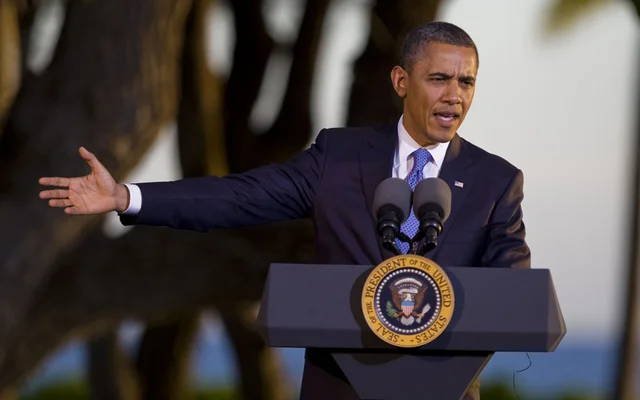
Buried in all the doom and gloom of 2016 year-end summaries is one undeniable success story — U.S. President Barack Obama’s unilateral decision in August to create the world’s largest marine sanctuary.

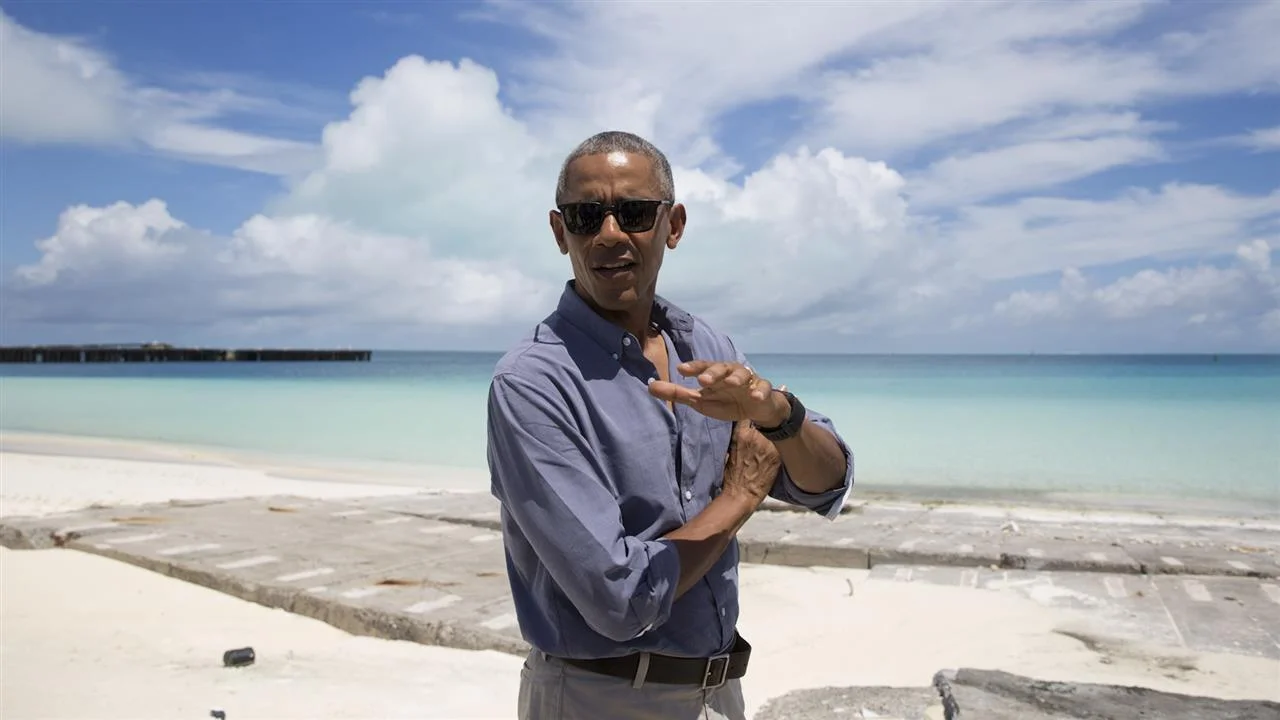
I’m filing this post from the Kapaa coast of Kauai, Hawaii’s oldest island, geologically speaking, and one of its least visited, owing to a reputation for rain and a quirk of geography that placed it on the “wrong” side of the Hawaiian chain, alone to the northwest of Honolulu and Oahu.

Coincidentally, Obama is in Honolulu right now, meeting Shinzö Abe, Prime Minister of Japan, at the site of the USS Arizona Memorial, the spiritual and literal memorial to the Pearl Harbor attack on Dec. 7, 1941.

Obama is taking a break in Hawaii with his family , where he grew up. It’s an annual tradition for the Obama family, but it will be his last Christmas as U.S. president.

The ocean reserve he established in August is twice the size of Texas. It sprawls across the Pacific to the northwest of Kauai, this very island, and the legal protection language has been written in such a way that — perhaps — not even “In Trump We Trust” and Trump’s incoming cabinet of climate deniers will be able to dismantle it.

Hawaii is firmly Democrat, in any event, thanks in no small part to the late Sen. Daniel Inouye, a Hawaiian of Japanese descent — there’s that connection, again — who represented the state of Hawaii from 1963 to 2012. Inouye fought in the Second World War as part of the 442nd Infantry Regiment. While in combat, he lost his right arm to a grenade. He didn’t let it end there. Upon his return to civilian life in Hawaii, he earned a law degree and was elected to Hawaii's territorial House of Representatives in 1953, and to the territorial Senate in 1957.

Obama himself grew up in Hawaii, and always felt a strong attachment for the sea and environmental protection. Growing up in Hawaii, he could scarcely know he would one day be in a position to actually do something about it. Last August, though, he did exactly that.

The Pacific reserve is a 583,000 square mile “no-take” zone that effectively quadruples a pre-existing marine reserve.

It’s important because, as climate change wreaks havoc with the jet stream, causing erratic bulges and shifts in weather patterns that can result in sudden, unexpected deep freezes in southern U.S. states and southern Europe, followed by unseasonal warming periods and an unpredictable wave of floods intermingled with droughts, the equatorial Pacific is one of the world’s few remaining potentially stabilizing influences.

The equatorial Pacific is home, too, to some of the sea’s most critically endangered — and iconic — species, from Hawaiian monk seals to blue whales and numerous species of sea turtles.

Hawaii itself is ironically home to one of the world’s most serious mass extinctions: rats, mongooses and mynah birds imported by visiting whalers and other seafarers of the 19th century wiped out many of Hawaii’s indigenous bird species — and yet, spread on remote atolls scattered across the western equatorial and southern Pacific, indigenous, one-of-a-kind seabirds still cling to a precarious existence, far from human interference, despite 21st-century development and an ever-expanding world population.

And while the Arctic ice blackens and melts, and sea levels rise ominously in various corners of the globe, the central Pacific has remained relatively unaffected. So far.

©Alex Strachan 2016

©Alex Strachan 2016

The most encouraging thing about being on Kauai — quite apart from the proximity of the new marine reserve — is the seemingly fierce determination of the local people who live here to protect the oceans and environment at all costs. The feeling is intense, and palpable, from state and county officials all the way down to local streetstand sellers and working class Hawaiian-born families whose idea of a Christmas get-together is a frolic in the surf followed by a beach picnic — or, for the older, more actively inclined, a hike into some of the world’s oldest known jungles, and along vine-choked sea cliffs that rise 4,000 feet (1,200 metres) above the sea in some places.

Obama’s decree was timed to coincide with the 100th anniversary of the U.S. National Park Service, but it has the potential to be a lot more meaningful than that.

The Papahānaumokuākea Marine National Monument — the reserve’s official handle — is unlikely to become a household name, now or ever.

The reserve is important, though, because it contains many of the world’s northernmost species considered most likely to survive in an ocean warmed by climate change. According to a National Geographic survey, these waters are believed to be home to some 7,000 species in all, including sea creatures believed to have lived for more than 4,000 years. A quarter of all living creatures in the reserve are found nowhere else on the planet, including the white ghost octopus and the Laysian albatross.

The marine reserve has not proved popular with everyone. Local fishermen note that they’re being asked to sacrifice their day-to-day livelihood for the long-term benefit of humanity as a whole. Ironically, despite the bounty and proximity of fishing resources, Hawaiian fishermen say it’s becoming increasingly difficult — impossible even — to earn a decent living from a centuries-old tradition.

Historian Douglas Brinkley, author of a biograpphy of Theodore Roosevelt and Franklin D. Roosevelt, told National Geographic that, on one level, he was not surprised Obama did what he did. Presidents facing their final weeks in office often think about their legacy, Brinkley said. “It’s no longer about ‘what I can get in the last year.’ It’s about the long term view.” The very definition, in other words, of conservation.


https://www.theguardian.com/environment/2016/aug/26/obama-to-create-worlds-largest-protected-marine-area-off-coast-of-hawaii-papahanaumokuakea

http://www.telegraph.co.uk/news/2016/08/26/looking-to-his-legacy-barack-obama-creates-largest-protected-nat/


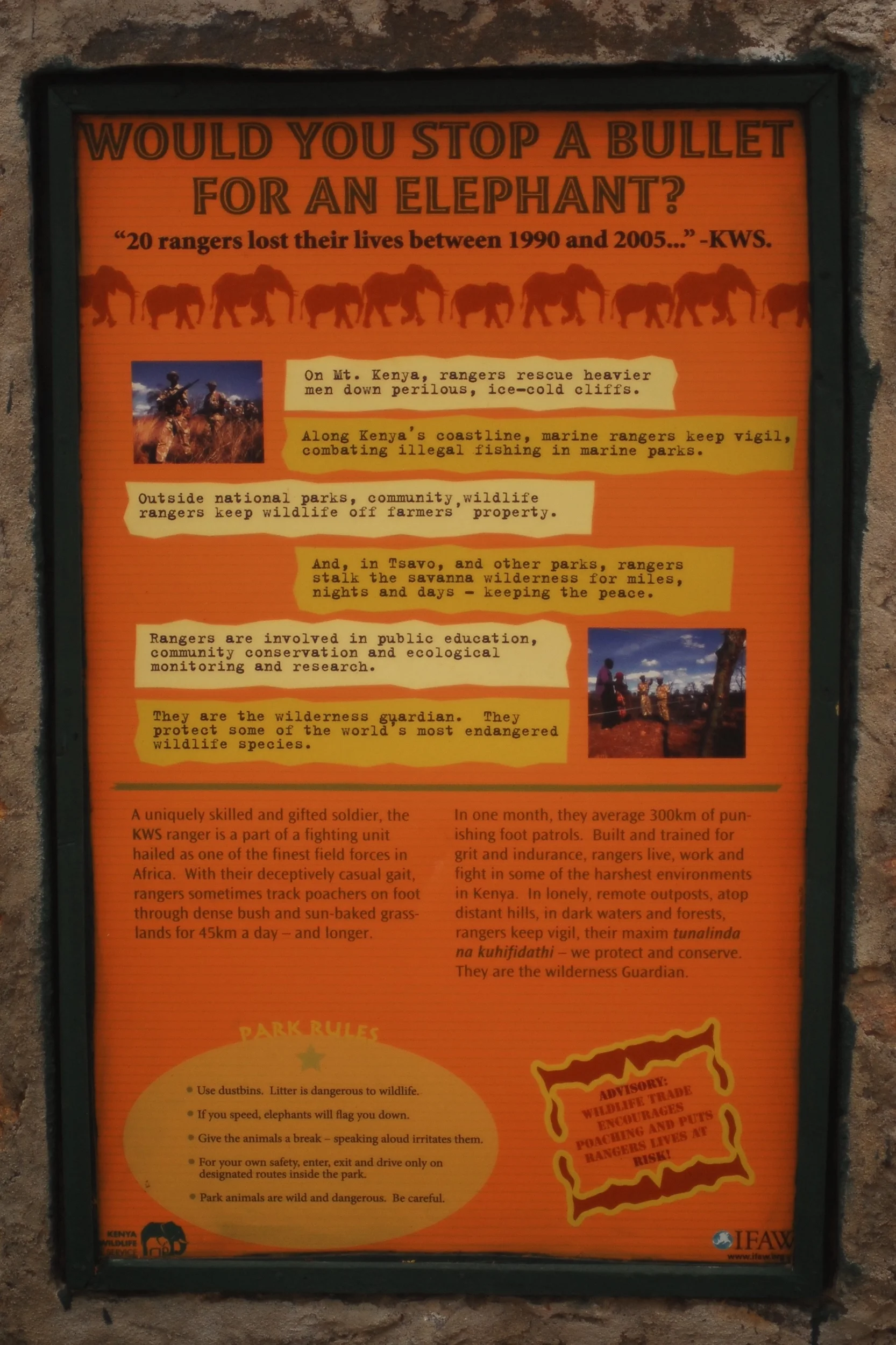
Would you stop a bullet for an elephant?

Would you stop a bullet for an elephant, asks a modest sign placed offroad,  deep inside Tsavo East National Park, a stone’s throw from Kenya’s Galana River. The sign is not too far from where a pair of lions, the infamous “Maneaters of Tsavo,” stopped construction on the Kenya-Uganda railroad dead in its tracks, around the turn of the 20th century.

This is wild Africa — and the sign is a reminder that, the romanticism of colonial days aside, protecting the continent’s threatened wildlife is a dangerous, sometimes deadly job.

That was thrown into relief yet again little more than a week ago, after a park ranger was killed by poachers and another seriously injured in Democratic Republic of the Congo’s Virunga National Park while protecting one of the last surviving family groups of the world’s few remaining mountain gorillas.

The attack underscores the threats that those on the front lines of conservation face every day, often for little pay, far away from the world’s media centres. When a park ranger is killed, he — and, increasingly, she — often leaves behind a family to support.

The name Patrick Prince Muhayirwa is not as easy to remember as George Adamson or Richard Leakey, but perhaps it should be. 

© Brent Stirton, Getty Images, for National Geographic Special Investigations Unit.

© Brent Stirton, Getty Images, for National Geographic Special Investigations Unit.

As one can see from the links here, once again it was left to The Guardian and National Geographic to report the inconvenient truth that wildlife conservation isn’t all glamour and starry nights.

This isn’t meant as a downer, but rather a reality check. This is a time of year for reflection as much as it is anything else.

© Brent Stirton, Getty Images, for National Geographic Special Investigations Unit.

© Brent Stirton, Getty Images, for National Geographic Special Investigations Unit.

A small but growing trend in gift-giving is support, in a family member or friend’s name, for the efforts of nongovernmental groups doing good works in parts ofr the world that resemble and occasionally are, as these articles suggest, actual war zones.

Would you stop a bullet for an elephant? Probably not, if you’re like pretty much anyone else.

Fortunately, though, for what remains of our living planet, there are those who would. And they’re on the front lines every day.


The year that was: Google searches for the year 2016

Often, one can't see the forest for the trees. Seeing the year flash by like this has an eerie, unsettling effect. It's surface detail only, of course, and yet there's something to be said for big, complicated events being compressed into little more than two minutes.

YouTube has archived Google video of users' annual Google searches dating back to 2010, so now — if one is so inclined — you can revisit seven years of history in little more than 10 minutes.

Magnificent seven cross finish line

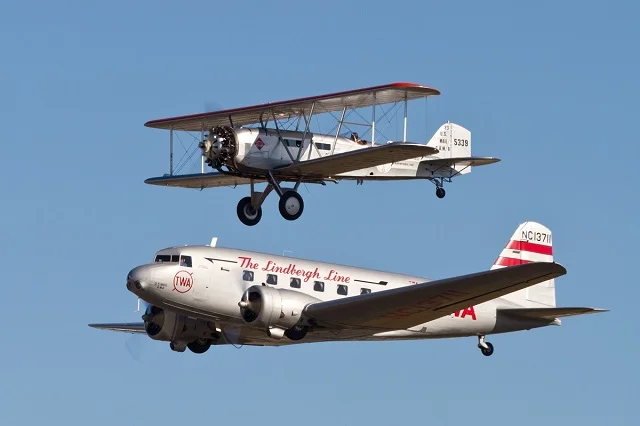
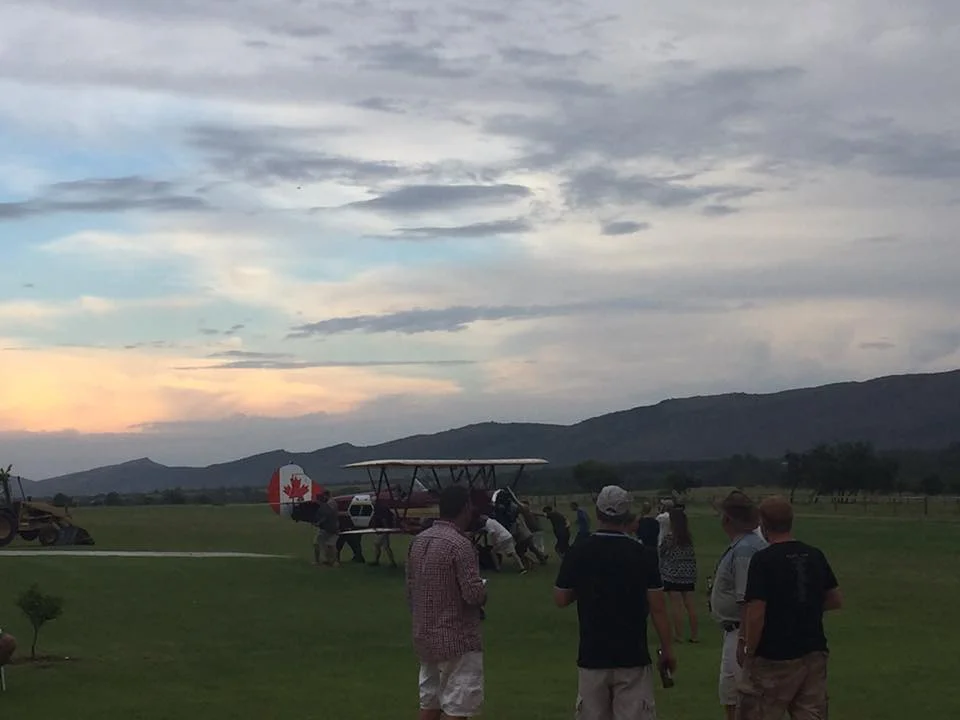
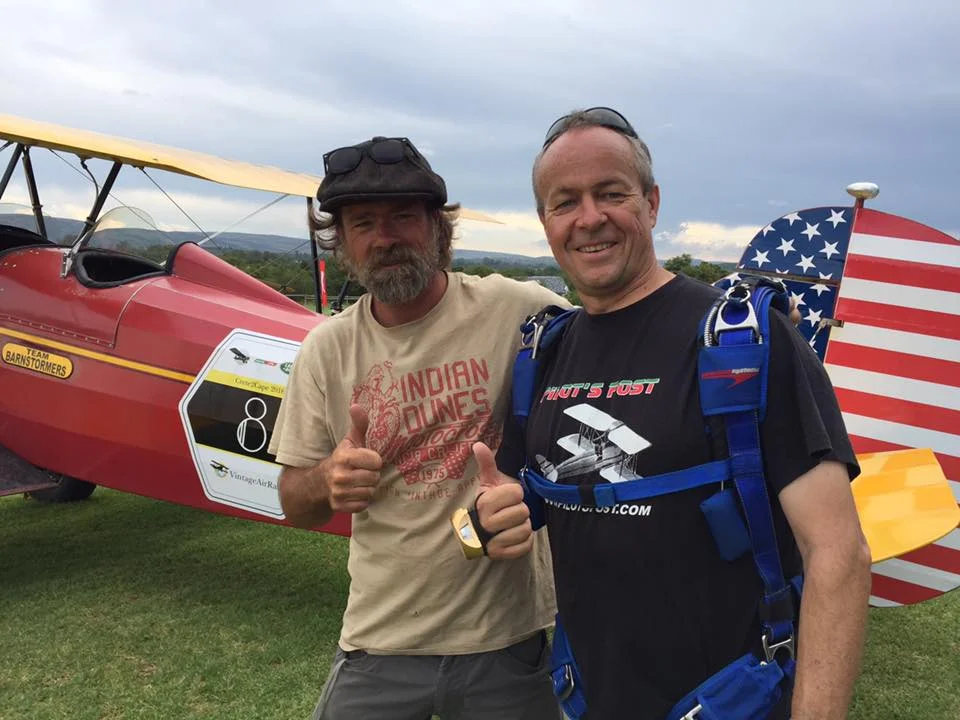
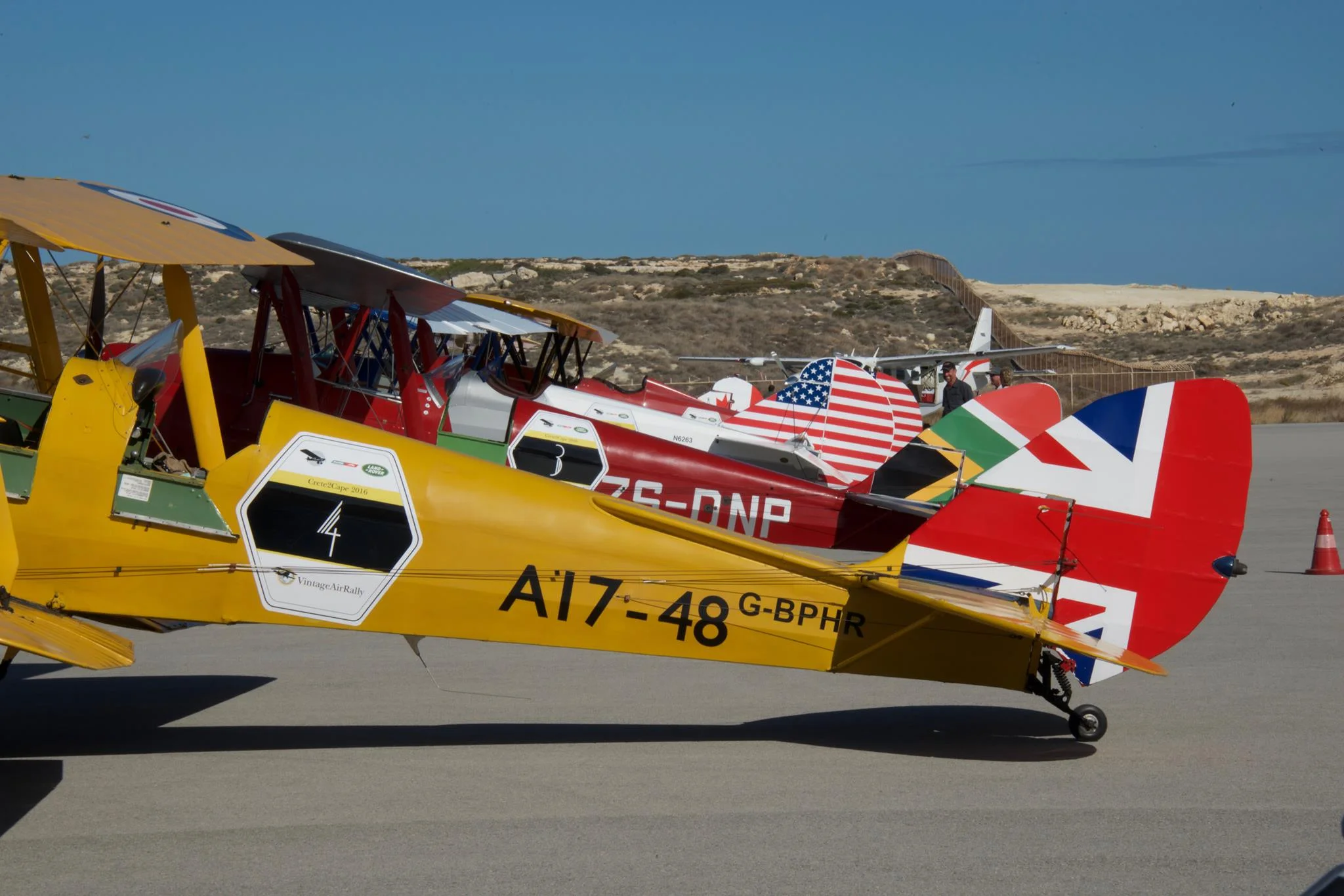
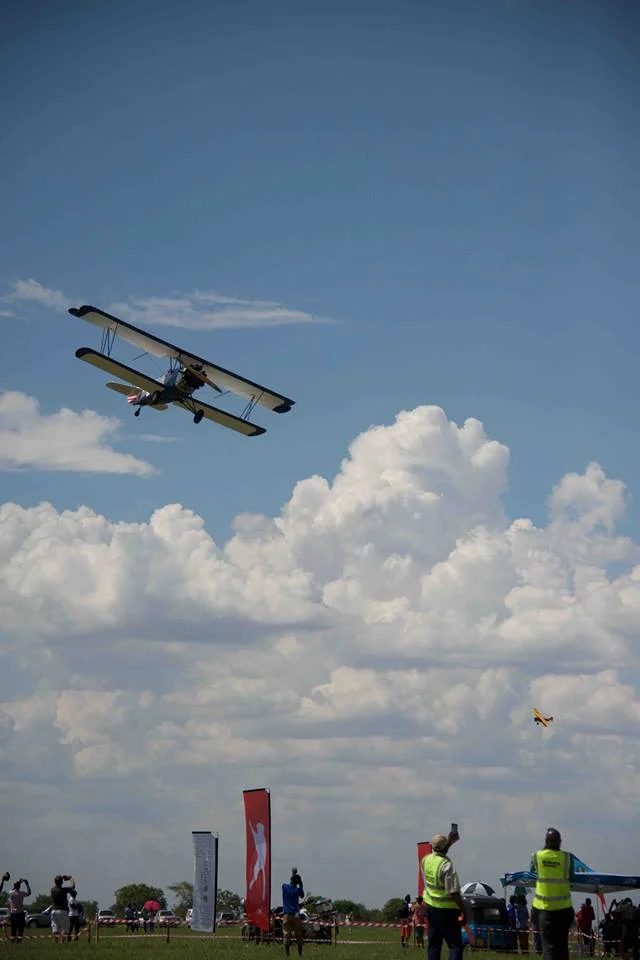
The Vintage Air Rally is over. Twelve started. Seven finished.

The successful flyers in their vintage 1930s-era biplanes crossed the finish line in Stellenbosch, about 50 kilometres (30 miles) east of Cape Town midday Friday, South African time.

Pedro Langdon, the never-say-die Canadian, made it, and in one piece, too.

Maurice Kirk, the eccentric Pom, was not so lucky.

After being detained briefly in Ethiopia, Kirk, 72, took off for Kenya but somehow made a wrong turn in midair and ended up in South Sudan instead. Not cool. On landing, Kirk was apprehended, robbed, beaten, jailed and, for his troubles, came down with malaria and sepsis.

Kirk, sadly, was not among Friday’s finishers, but he is alive.

The intitial 12 flying teams began the Vintage Air Rally trek on Nov. 12, on the Mediterranean island of Crete.

Rally participants represented numerous countries, from usual suspects like Germany, the United Kingdom and the U.S. to less usual suspects like Cyprus, Egypt, Botswana and Zimbabwe.

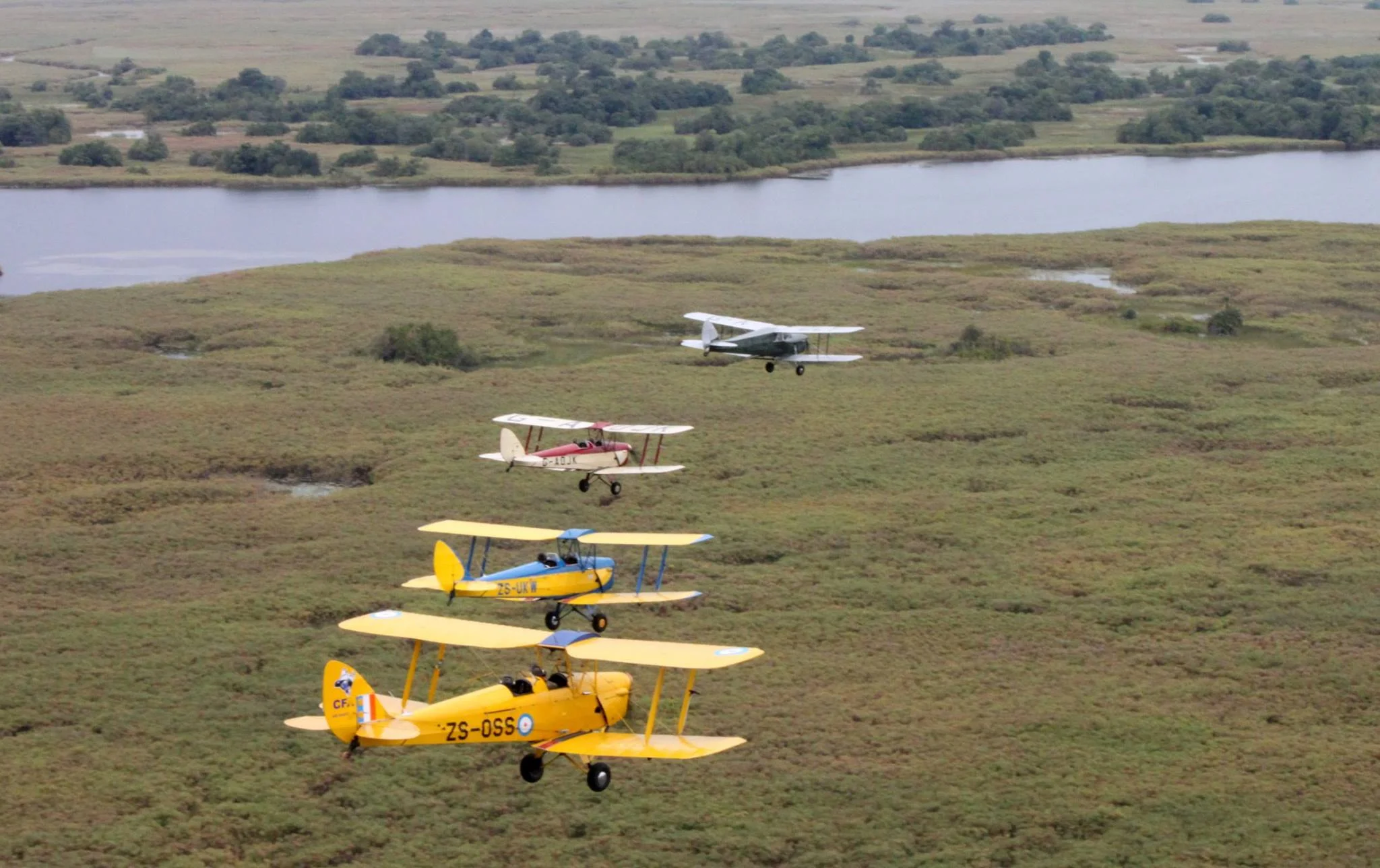
The motley crew of DH82 Tiger Moths, Travel Air 4000s — first manufactured in 1928 — Antonov AN2s and Boeing Stearmans tracked down the length of Africa from Cairo to Cape Town in 35 days — flying, as South Africa’s Mail & Guardian put it, somewhat uncharitably, “very slowly.”

This race was never about speed, though.

Nor was it really a race, not in the true sense of the word.

This was a flying exhibition, an air show in the purest sense of the expression — a meeting of early-20th-century derring-do and 21st-century aviation knowledge.

The idea was to recreate the famous 1930s Imperial Airways Africa Route that linked Cairo with sub-Saharan Africa and the emerging economy on the continent’s southern tip.

And while most present-day Africans can be forgiven for shrugging at a nostalgic throwback to colonial times, it was the kind of flying adventureAntoine de Saint-Exupéry dreams were made of.

A bureaucratic tangle on Ethiopia’s border with South Sudan — a “miusunderstanding” over paperwork and the required legal documentation — momentarily grounded the entire fleet, with a couple of flyers, Kirk among them, provided mandatory room-and-board as guests of local border authorities.

All in all, though, despite the occasional engine failure and “navigational misunderstandings,” the Vintage Air Rally proved a success. The flight crews who made it to the end say the memories — low-level flybys of the Egyptian pyramids, Ngorongoro Crater, Mt. Kilimanjaro, the Maasai Steppe, Zanzibar and Victoria Falls — will last a lifetime.

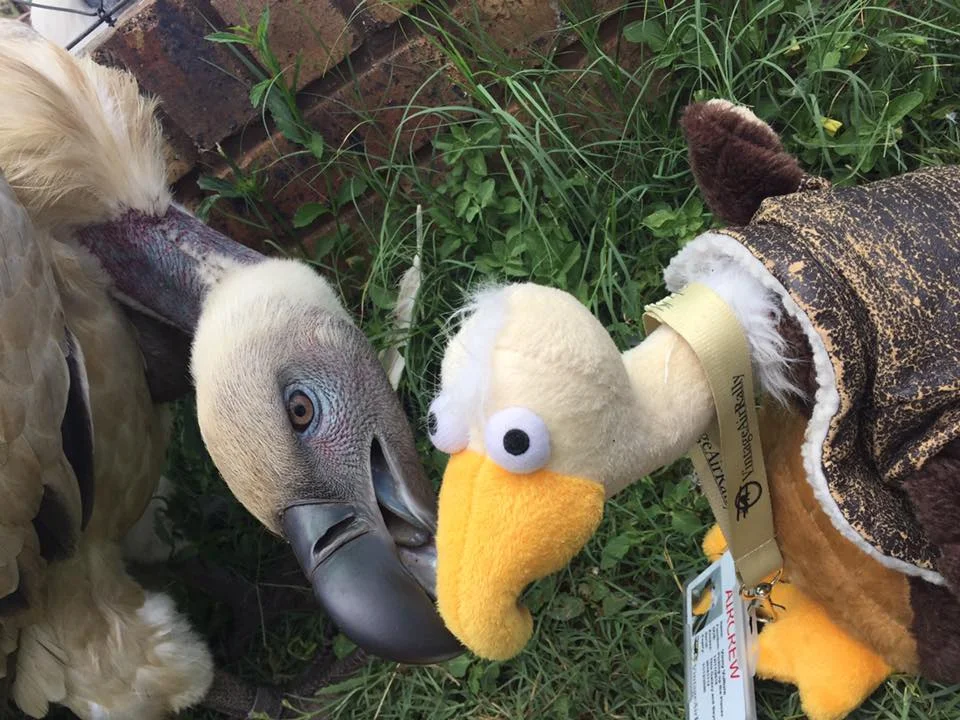
No vultures were injured during filming of the Vintage Air Rally, which is just as well as one of the charities supported by rally organizers was the South Africa-based conservation group Birdlife, backers of the #SaveTheVultures campaign.

The African vulture — arguably the continent’s most familiar and widely recognized bird — is in serious trouble, owing to indiscriminate use of poisoned bait (to kill jackals) and elephant poachers, who know that circling vultures can alert passing game rangers to the scene of their crimes.

Vintage Air Rally flying crews will be able to dine out on their tales of adventure for years to come.

It’s not often, after all, that dinner conversation includes anecdotes that begin: “As soon as we landed, these guys with military uniforms and big guns surrounded our plane.”

The misunderstanding in Ethiopia required the intervention of U.S. Secretary of State John Kerry, according to the Mail & Guardian —  though a sceptic can be forgiven for thinking Sec. Kerry might have had more important things on his mind at the end of November, not least being the imminent handover of his job to a former executive from ExxonMobil.

In the end, though, it proved a smooth landing for more than half the flying teams to take off in Crete. As The Amazing Race’s Phil Keoghan would say: “Two continents, 10 countries, 13,000 kilometres, 8,000 miles in 35 days.”

Lita Oppergard, 68, from the great state of Alaska, told Agence-France Presse (AFP): “I thought Alaska is huge.

“But flying through much of Africa, like we’ve been through, I cannot even begin to get into my head how vast this continent is. It is just sheer, utter wilderness . . . beautiful.”


The familiar, seen in new, unfamiliar ways

Memories are short, attention spans even shorter. 

With competition about to close in the 2016 Natural History Museum Wildlife Photographer of the Year Awards, it’s worth taking another look at last year’s winner, announced this past October. (Yes, unlike some outfits, the NHM judges take their time before picking the winner from thousands of entries.)

Contest rules state that the judges are looking for an image that is not only technically proficient and emotionally moving but that reflects our changing environment in some way. It must be a picture with a message, in other words.

That’s why American ornithologist Tim Laman’s point-of-view image of an orangutan climbing a tree in Borneo to find figs struck such a chord with the judges. Orangutans are critically endangered throughout their once extensive range across Indonesia and Southeast Asia, for reasons both short-term (jungle clearing for palm-oil plantations) and long-term (deforestation and habitat loss due to climate change).

©Tim Laman WPOTY

©Tim Laman WPOTY

Laman first came to public prominence in 2007 when, as Harvard-trained ornithologist, he published an article in National Geographic about birds of paradise; he’s believed to be the first known photographer to have captured images of each and every species of birds of paradise in their natural habitat.

©Tim Laman

©Tim Laman

Laman is not just a wildlife photographer; he’s a doctoral research associate with Harvard Univeristy’s ornithology department, and has published numerous scientific papers in peer-reviewed periodicals.

Laman specializes in offbeat and hard-to-get subjects, including critically endangered — and so by definition hard-to-find — birds such as the Visayan hornbill and Nuku Hiva pigeon, as well as finding unusual ways to capture the image of oft-photographed primates like the orangutan.

©Tim Laman

©Tim Laman

For his WPOTY winning image, titled ‘Entwined Lives,’ Laman rugged a camera set-up more than 30 metres off the ground — this, after thinking for weeks at a time how he might get a unqiue vantage point from which to photograph people have seen countless times in other images.

As an occasional guide and advisor for tour groups of amateur photographers, he tries to get shutterbugs to get beyond the basics of how to use a camera to looking at the world in new, different ways.


A hero for the planet

Today is Human Rights Day, so it seems only appropriate to recognize some of the unsung heroes of photography, the combat photographers who risk their lives to capture what’s happening on the ground, at eye level, in many of the world’s conflict zones.

They are not stars. Many of them are local stringers, hired by North Anmerican and European editors at the big news agencies — editors as often as not cocooned in the comfort and safety of well appointed, air-conditioned offices in skyscrapers in the major media centres of London, New York and Washington, D.C.

Mohammed Badra is one of those unsung heroes. You probably do not know his name, and you may well forget it the moment you stop reading this. For one brief moment, though, Badra has had a flash of flame — this past week he was named Time’s Wire Photographer of the Year.

News, critical and trivial, has become jumbled into one giant digital heap. Competition for attention spans has had the (perhaps intended) side effect of making coverage more emotional.

Wire photographers, often the first journalist on the scene and often the last to depart, are not just witness to the scene but are often subject to the same forces as they happen.

Any empathy they feel is uncalculated, but rather visceral and real. There is no time for reflection, let alone gravitas, until afterwards, when the photographer — and viewer — looks back at what just happened. In the moment, in that frenzied moment when things are actually happening, the wire photographer has no such luxury. For him — and, increasingly, for her — the big picture is the small picture.

Mohammed Badra, Syria.

Time Wire Photographer of the Year for 2016.


Mohammed Badra

European Pressphoto Agency (EPA) official bio:

Mohammed Badra

Mohammed Badra

Mohammed Badra was born in Douma, Syria. He studied architecture at Damascus University but had to abandon his studies in his third year due to the war. After working for other news agencies he joined epa in October, 2015 as staff photographer. Mohammed has also worked with the Syrian Red Crescent as a first-aider, psychological supporter and photographer. His strong desire is that his photography contribute to a better awareness of the ongoing crisis in Syria.

http://time.com/mohammed-badra-wire-photographer-2016-time/

Google images ©Mohammed Badra, EPA


‘We have clearance, Clarence. Roger, Roger. What's our vector, Victor?’

Well, that was that, then. Maurice Kirk, septuagenarian adventurer and unapologetic eccentric, is no longer an official flying member of the Vintage Air Rally. 

As you read this, nearly 20 teams flying 1930s-era biplanes the length of Africa are nearing Victoria Falls on their final approach to Cape Town, but Kirk, aka the Flying Vet, is no longer one of them.

Kirk struggled to stay on course throughout the rally, and was finally done in by engine failure — this, after a brief stint as an unscheduled guest of Ethiopian authorities in the dusty border town of Gambela after he developed “engine trouble” over Sudan and aimed for the border in his 1943 Piper Club.

The Vintage Air Rally got underway in Crete early last month, in a bid to fly to Cape Town, some 8,000 miles (12,800 km) in all, over the Mediterranean, Egypt, Sudan, Ethiopia, Kenya, Tanzania, Zambia, Botswana and now, hopefully,  Zimbabwe. All going well, the crews are expected to touch down in Cape Town on Dec. 17.

A second team was also forced to bail following a forced landing near Nakuru, Kenya. Both pilots emerged in one piece, despite the plane flipping over on its nose while screeching to a halt, rally spokesman Alan Evan-Hanes told reporters in Joburg earlier this week.

“(The) occupants are okay,” Evan-Hanes said, according to South Africa’s Times newspaper. “The plane is not flyable.”

Kirk’s 1943 Piper Club, developed in the U.S. in the late 1930s, was designed to fly at about 120k/mh, Evan-Hanes noted. It’s easy to get blown off track when flying against the wind. Kirk also had issues with his fuel supply, Evan-Hanes added.

Refueling the planes along the way proved to be harder than many expected. Fuel had to be transported in drums into hard-to-reach areas north of Zambia.

Finding a safe place to land got gnarly at times. A spokeswoman for the Dutch-Angolan owned fuel supply company Puma Energy told The Times crews were forced to land on a farm at one point, just south of the Tanzania border.

The flying teams want to recreate the so-called 1930’s “Imperial Flying Route” down the length of Africa, in a real-life version of the 1965 madcap caper film Those Magnificent Men in Their Flying Machines, Or How I Flew from London to Paris in 25 Hours 11 Minutes. (Don’t knock it; that’s the film’s official title.)

Only, in this case, 25 hours is more like 35 days.

There’s a wildlife conservation element to the rally. Rally organizers are supporting Bird Life International (BLI) in its efforts to draw attention to the plight of Africa’s vultures, which have plummeted alarmingly in number in the past 10 years, owing to poisoned bait left to kill jackals, and by elephant poachers wanting to elude detection.

“There’s a certain romance to flying vintage aircraft, covered in oil, wearing goggles, suffering from wind burn,” Evan-Hanes explained. “[Nothing beats] the spectacular scenery of the setting sun.”

Except, perhaps, landing in one piece.


Photography: People's Choice Award finalists

In the beginning, some 50 years ago, the inaugural Wildlife Photographer of the Year Awards featured just three categories and 500 entries. BBC Wildlife Magazine was known simply as Animals, and a young David Attenborough was on hand to present the first award, to C.V.R. Dowdeswell, for a portrait of an owl.

C.V.R. Dowdeswell (right) accepts inaugural Wildlife Photographer of the Year Award from David Attenborough in 1965.

C.V.R. Dowdeswell (right) accepts inaugural Wildlife Photographer of the Year Award from David Attenborough in 1965.

London’s Natural History Museum signed on in 1984, and that’s where the competition stands today — just 10 days before the entry deadline expires for the 2017 edition.

The winning photographers — plural — are awarded pride of place in a museum exhibition. Perhaps more important, the museum sponsors a travelling exhibition that tours the world throughout the year, providing the kind of exposure most nature photographers can only dream about.

Today, there are tens of thousands of entries in numerous categories, submitted from some 95 countries worldwide.

Judging is subjective, of course, which is why one of the most high-profile, sought-after categories is the self-explanatory People’s Choice Award, in which everyday shutterbugs and nature buffs — you, for example — have a say.

The London Natural History Museum recently shortlisted 25 finalists from some 50,000 entries.  The winning image will appear on BBC’s web site, and in an upcoming issue of BBC Wildlife.

Here are a handful that jumped out at me — my personal Top 10, if you will.

Your choices may be quite different, of course — that’s why they call it the People’s Choice Award — but these are the ones that touched me personally. It wouldn’t surprise me if one of these takes the top award  when voting closes in January.


A Mother’s Hand

Alain Mafart Renodier, France

©Alain Mafart Renodier

Mafart Renodier was on a winter visit to Japan's Jigokudani Snow Monkey Park when he took this photograph of a sleeping baby Japanese macaque, its mother's hand covering its head protectively. (BBC)


Hitching a Ride

Daisy Gilardini, Canada-Switzerland

©Daisy Gillardini

Gilardini took this image of a polar bear cub escaping deep snow by hitching a ride on its mother’s back in Manitboa’s Wapusk National Park, last March, during the early spring thaw — if minus 50 can be called a thaw.


Opportunistic Croc

Bence Mate, Hungary

©Bence Mate

Though this image was taken from the relative safety of a hide, Mate told BBC it was chilling to see the deadly focused eyes of this four metre (13 foot) Nile crocodile. This croc image was captured in the Zimanga Private Game Reserve, South Africa.


The Stare of Death

Johan Kloppers, South Africa

©Johan Kloppers

Kloppers spotted a wildebeest calf shortly after it was born in the Kgalagadi Transfrontier Park, South Africa. He did not known it then but he would witness its death later that same day, after the wildebeest herd walked past a pride of lions and was taken unawares.


Monkey Ball

Thomas Kokta, Germany

©Thomas Kokta

Cold temperatures on Shodoshima Island, Japan, can prompt snow monkeys to gather together in balls, for warmth. Kokta snapped this image from a tree.


Sisters

Bernd Wasiolka, Germany

©Bernd Wasiolka

Wasiolka encountered a large lion pride at a waterhole in the Kgalagadi Transfrontier Park, South Africa. One of the two males spray-marked the branches of a nearby tree. Later, Wasiolka told BBC, two females sniffed the markings and for a brief moment adopted a near identical posture.


Colorado Red

Annie Katz, United States

©Annie Katz

Katz spotted this Colorado red fox in her neighbour's field on a clear January day in Aspen, Colorado. The light was perfect, she recalled. She took the photo as the fox approached her, seemingly looking right into her camera.


Confusion

Rudi Hulshof, South Africa

©Rudi Hulshof

Hulshof wanted a way capture the uncertain future of the southern white rhino, due to poaching. He anticipated this moment, he told BBC, when two rhinos would walk past each other in Welgevonden Game Reserve, South Africa. Their passing close together in opposite directions created this silhouette effect and the illusion of a two-headed rhino.


Breakfast Time

Cari Hill, New Zealand

©Cari Hill

Shortly after purchasing the Giraffe Manor in Nairobi, Kenya, the owners learned the only remaining Rothschild's giraffes in the country were at risk, as their sole habitat was being subdivided into smallholdings. Thery established a breeding programme to reintroduce the Rothschild's giraffe back into the wild. Today, guests can enjoy visits from resident giraffes in search of a breakfast treat.


Rainbow Wings

Victor Tyakht, Russia

©Victor Tyakht

From the museum notes: The bird's wing acts as a diffraction grating — a surface structure with a repeating pattern of ridges or slits. The structure causes the incoming light rays to spread out, bend and split into spectral colours, producing this shimmering rainbow effect.


The Wildlife Photographer of the Year awards are co-sponsored and produced by the Natural History Museum, in London. 

Voting for the People's Choice Award closes Jan. 10. You can cast your own vote here, by following this link:

http://www.nhm.ac.uk/visit/wpy/community/peoples-choice/2016/index.html?utm_campaign=wpy52-peopleschoice

An exhibition of this year’s winners will be on display at London's Natural History Museum until Sept. 10.


World’s fastest cat still running for its life

A recent article by a renowned field biologist in a mainstream, glossy magazine about travel in Africa began with the words: “Everyone knows the story about the cheetahs’ genetic predicament.”

Well, not everyone.

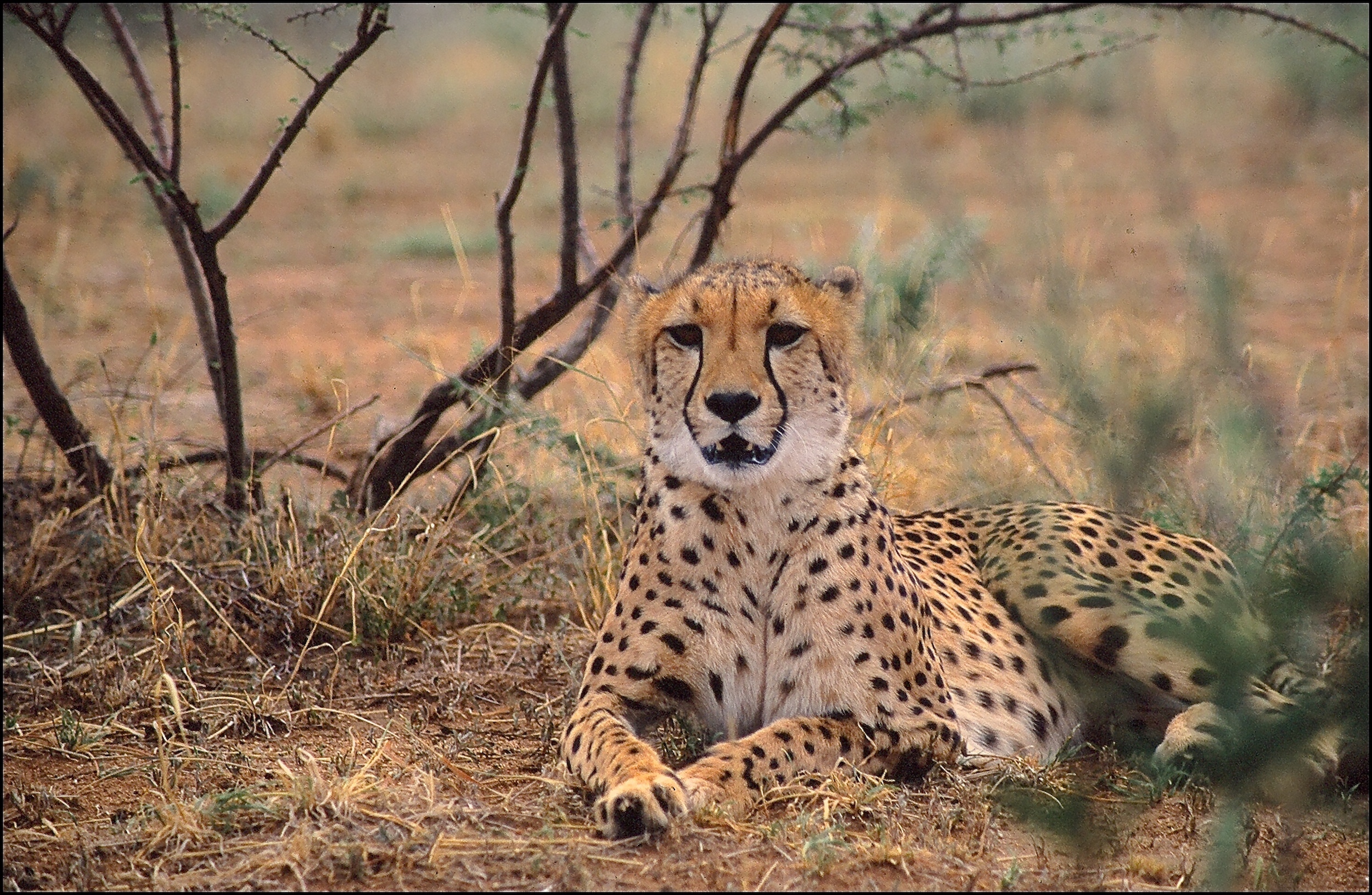
Cheetah tree, used for marking territory. All photos ©Alex Strachan

Cheetah tree, used for marking territory. All photos ©Alex Strachan

In fact it’s more likely that ordinary, everyday people — people who know the cheetah is the world’s fastest land animal, and who know this sleek, fast cat is running a race for survival — have no idea about the cheetahs’ genetic bottleneck.

International Cheetah Day, Sunday. Dec. 4, is as good a time as any to take stock of exactly where the cheetah is in its race against time. 

It’s also a good day to acknowledge the good works being done by conservation groups such as Dr. Laurie Marker’s Cheetah Conserrvation Fund, better known by its acronym CCF, a 45-minute drive northeast of the cattle town of Otjiwarongo, Namibia.

Dr. Laurie Marker, founder and director of the Cheetah Conservation Fund (CCF), Namibia.

Dr. Laurie Marker, founder and director of the Cheetah Conservation Fund (CCF), Namibia.

Marker, originally from Oregon, earned her doctorate in zoology from Oxford University in a thesis based largely on cheetah genetics.

Marker’s subsequent studies of genetics and her founding of CCF in Namibia, coupled with her position as the bookkeeper for genetics of all cheetahs in captivity, makes her uniquely qualified to be both a conservationist and a field biologist.

All that biographical detail may sound a bit dry — and it is — but it opens a window onto what’s really interesting about cheetah survival. It’s the part that virtually anyone with even a vague interest in wildlife conservation will be curious to know.

In 1977 Marker was involved in one of the first known attempted relocations of a captive-bred cheetah into the wild in Africa. What the team accomplished then, in the relatively obscure, little-known country of Namibia on Africa’s southwest coast, would provide the template for countless conservation efforts to come.

Marker settled in Namibia because the dry, arid, relatively sparsely populated country is — oddly enough — home to the largest known population of wild-surviving cheetahs. Marker discovered that cheetahs, unlike other predators, have been conditioned to survive in areas where there is relatively little water. That, and a penchant for fast running, are one of the few reasons the cheetah has survived as long as it has.

That was then, this is now. Today, Namibia’s cheetahs live in uneasy proximity to human settlement. Cheetahs don’t fare well where there are large populations of lions and hyenas, which rules out many of Africa’s ever-shrinking national parks and nature reserves. Lions and hyenas will kill cheetah cubs, and even adult cheetahs, whenever they can, as evolution has conditioned the larger, stronger cats to view their faster, smaller, more nimble cousins as competition for food.

Much of Namibia’s semi-arid land has been set aside for cattle ranches, which are larger in size than those in North America, because the ground is so dry more acreage is needed to sustain even a relatively small herd of cattle.

That means nearly all the cattle ranchland in Namibia is shared with wild gazelles, wart hogs, bush hares and the like — cheetahs’ favored food.

Inevitably, when small antelopes are hard to find, cheetahs will try their luck with the occasional goat or stray calf. Inevitably, that brings into inevitable conflict with ranchers and communal farmers.

CCF has established a dog-breeding program for Anatolian shepherd dogs, which serve as guard dogs for sheep and cattle herds. Anatolians were originally bred in Turkey to ward off wolves; Marker discovered that cheetahs, because of their fragile bone structure — designed for speed while running — and nervous disposition, will always back down when confronted by an apparently dangerous animal, like an Anatolian shepherd. CCF’s breeding program has been a success on a micro-level — the conservation agency provides adult dogs to farmers gratis, thanks largely to donations from overseas supporters.

It’s worth noting on International Cheetah Day that CCF is about more than just cheetahs — lessons learned and applied on the ground in Namibia are showing the way for environmental agencies across the world, in all countries, for nearly all endangered species where human-animal conflict is a factor.

Studies in the national parks in East Africa — Maasai Mara and Serengeti jump to the fore — show that cheetahs have large litters compared with other big cats, even lions, because the infant mortality rate is so high. A cheetah may often have five or six cubs, but only one or two will survive to reach maturity. Evolution, again. It’s not only about survival of the fittest; it’s about adapting to the environment and life situation.

As for that genetic bottleneck: Researchers believe that, around 10,000 years ago, cheetahs, one of the first-known cats to evolve, were reduced to a handful of individuals. It’s believed that a tiny, pocket population of cheetahs bred over time, to the extent that 10,000 cheetahs remain today. (That sounds like a large number. It isn’t, if you consider there are believed to be 400,000 elephants remaining in the wild today, despite a poaching epidemic and habitat loss.)

Genetically speaking, virtually every cheetah alive today is more closely related than scientists would like. Dr. Luke Hunter, a wildlife biologist, president of the New York-based conservation group Panthera and considered one of the world’s leading authorities on big cat behaviour, has said cheetahs are as inbred as lab mice.

Even so, they have outlasted many other animals in the race against extinction. With a little luck, and a little more human awareness, they will survive a few more generations yet.

http://cheetah.org/

#SaveTheCheetah

#IntlCheetahDay

http://internationalcheetahday.com/

Elephant rescue shows good, bad side of human intervention

It’s one of those increasingly rare feel-good news stories: A baby elephant baby is trapped in a waterhole, and game rangers with the Kenya Wildlife Service and the good people of  the David Sheldrick Wildlife Trust set it  free it so it can be reunited with its mom.

All ends well. In a part of Africa rife with poaching and human-wildlife conflict this is one story, at least, with a happy ending.
The Daily Mail’s online video has gone viral, and small wonder.

The problem with the constant litany of climate-change warnings and disaster stories is that, after a while, the average person feels numbed.

Numbness can lead to a kind of fatalism: I can’t do anything, so why should I bother? If another mass extinction is inevitable, as some scientists are now saying, why even try to stop it?

Ele orphans follow their minder into Nairobi National Park for the day at the David Sheldrick Wildlife Trust. Photo ©Alex Strachan

Ele orphans follow their minder into Nairobi National Park for the day at the David Sheldrick Wildlife Trust. Photo ©Alex Strachan

Except that, as the Sheldrick elephant trust and orphanage inside  Nairobi National Park prove every day, small, individual battles can be won along the way.

If you can look past the low-res, grainy image of this video — and if you can overlook the typically trite music (silence would've been better) — there’s much here’s that’s instructive. The elephants are clearly distressed by the helicopter’s rotor blades and clouds of dust kicked up. The mother ele has no way of knowing the rescuers are there to help. The baby is terrified, not least because it’s trapped and can’t get away from the noise.

The rescue is hard on the rescuers, too, because they know the stress they’re creating, even though it’s in a good cause.

The truth is that helicopters are expensive to fly and even more expensive to maintain. The reality, though, is that large stretches of wild Africa are vast, so vast that the only effective way to see what’s going on — and counter poaching — is from the air. It’s sheer luck that the game rangers happened on the trapped baby, and even more lucky, for the elephants, that these human intruders know what they’re doing. The Kenya Wildlife Service has done this before and will probably have to do it again.

A lot can go wrong — but it doesn’t.

At the end of the day, this was one for the victory column.

A cynic might say the baby elephant will fall down an actual well the next time, or get nailed by lions or, worse, witness its mom fall to a poacher.

It's  just as possible it will live to a long, ripe old age, though, and pass along its experience to younger elephants in later years. Elephants have long memories, after all.

http://www.sheldrickwildlifetrust.org/