• Entr'acte
  • Living Landscapes
  • Dispatches
  • Natural History
  • Panthera
  • Elephantidae
  • Bibliothèque
  • About
  • Menu

Strachan Photography

  • Entr'acte
  • Living Landscapes
  • Dispatches
  • Natural History
  • Panthera
  • Elephantidae
  • Bibliothèque
  • About
©Alex Strachan

©Alex Strachan

On World Lion Day and ‘The New Big 5’

August 09, 2020
“Africa’s parks hold the most charismatic species on the planet – giraffe, elephant, hippo, zebra, lion, leopard and cheetah – a true global heritage. It’s up to all of us to help cover the costs of protecting these species. If the lion goes extinct, all these other species will go as well. We must all work together, but the scale of funding is beyond the scope of conservation groups. The financial requirements can only be met by world governments.”
— Dr. Craig Packer, World Lion Day

World Lion Day matters, and here’s why. Just 100 years ago, nearly 200,000 wild lions roamed across Africa.

Today, there are 20,000 — if that.

Photojournalist Graeme Green’s “New Big 5 Project” is designed to create a new “Big Five” of wildlife photography — the Big Five was an expression originally coined by big game hunters with small appendages to label and identify the five African animals most difficult to hunt — and while the African lion made that particular list, there’s no reason to think it won’t make the new list as well.

Real men, after all, take shots with a camera, not a high-powered hunting rifle.

Furthermore, not only does the lion live to see another day, but in terms of generating tourist revenue, a lion that lives to see another day draws more visitors the next day, and so on.

It’s hard to believe that some stakeholders — and even some scientists — insist that trophy hunting raises money for conservation and gives local people a reason to ensure a steady supply of lions for the trophy wall, when the simple truth of the matter is that money raised by trophy hunting disappears long before it ever reaches the conservation stage. Wildlife tourism, on the other hand, pays for itself over and over, and is the reason many African parks are financially sustainable. Strange as it may sound, tourists — and wildlife photographers — would rather photograph a living lion than a dead one.

As Dr. Craig Packer, a professor of ecology at the University of Minnesota and one of the world’s most respected authorities on lion behaviour, noted in his seminal 2015 book Lions in the Balance: Man-Eaters, Manes, and Men with Guns, “Hunting companies had a misplaced belief in the ‘inexhaustible supply’ of nature. They needed to learn that natural populations were finite.”

They still need to learn that, by some accounts — and so do some university-educated field biologists, it seems.

Packer knows a little something of what he speaks: He is both the founder and former director of the Serengeti Lion Research Center, and is chiefly known for his research on lions in Tanzania’s Serengeti National Park. (He has been banned from Tanzania for his efforts, and his accusations of systemic corruption high up in Tanzanian government circles, but that’s a discussion for a whole other day.)

That’s a big deal on two fronts: Serengeti is a name known to the public-at-large, even among those who haven’t studied lions or travelled to Africa, and who — let’s face it — may never travel to Africa, Covid or no Covid. They have, however, seen The Lion King.

The Serengeti Lion Research project is the world leader in lion research, and dates back to the work of George Schaller and the late Hugo van Lawick — Jane Goodall’s then-husband — who established that lions lead complex  social lives unique among the big cats, social lives we’re still learning about.

World Lion Day is about more than another trip to the zoo, or — God help us — the circus, then.

It means something.

It matters.

Because, if current trends continue the way they are at the present rate, in another 100 years or so there will be no wild lions, in Africa or anywhere else.

That is all.

https://blog.nationalgeographic.org/2016/10/11/african-lions-on-the-brink-a-conversation-with-lion-expert-craig-packer/

https://www.newbig5.com/lions-photo-gallery

©Alex Strachan

©Alex Strachan


Tags: World Lion Day, Craig Packer, Graeme Green, newbig5.com, #newbig5, Lions in the Balance: Man-Eaters, Manes, and Men with Guns, The Lion King, Hugo van Lawick, Jane Goodall, George Schaller, New Big 5, Tanzania, Serengeti National Park, University of Minnesota, Serengeti Lion Research Center, Covid, National Geographic, lion research, African lions
©Alex Strachan

©Alex Strachan

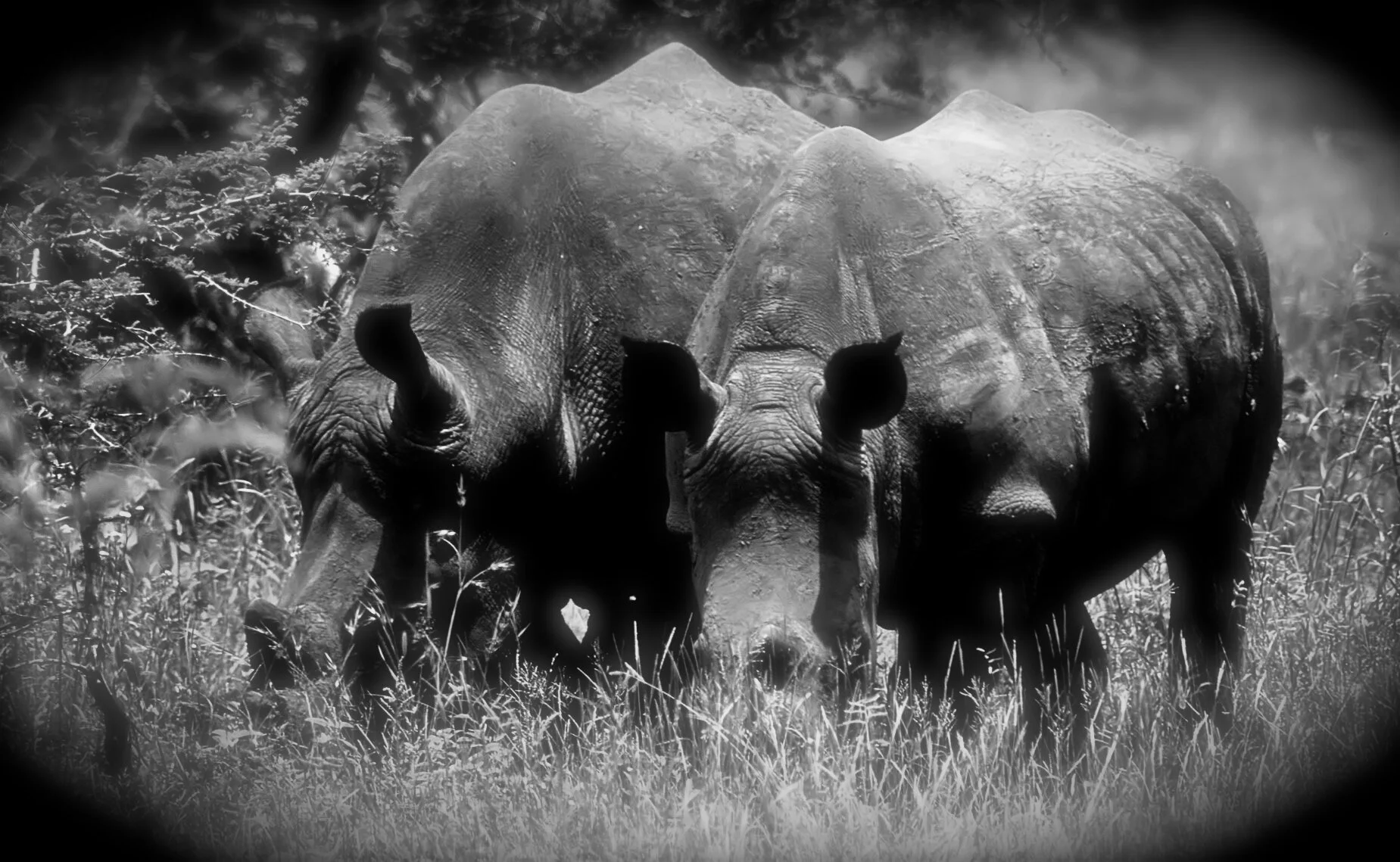
Getting to the Point About Rhino Horn

July 24, 2020
“The first priority for all rhino conservationists should be to ensure adequate anti-poaching monitoring and security (including intelligence-gathering) to protect rhino populations, and only then should dehorning be considered. For is a rhino really a rhino without its horn?”
— Save the Rhino, NGO website (SaveTheRhino.org)

Violent but bloodless, dehorning is considered a necessary evil by anti-poaching campaigners in South Africa, the heading in a 2018 essay, reprinted this past week in The Guardian, noted.

The idea is not new — it wasn’t even new in 2018 — but it has gained currency during the recent spike in poaching due to Covid lockdowns and the accompanying crash in conservation funding and cuts to law enforcement in national parks and private wildlife reserves throughout Africa.

The essay, by Durban-based environmental journalist Tony Carnie, is well-researched, fact-checked and covers a lot of bases — including, for example, the care taken to prevent pain to the rhino, in much the same way one needs to be careful when trimming a cats claws, and why de-tusking elephants can’t and won’t work the way it does with rhinos and their horns. It’s a solid, succinct article, and well worth reading, whether one is up-to-speed on the latest campaign to save one of Earth’s most striking living relics of a past age or just curious about an animal we’re all familiar with from childhood and its prospects for short-, mid- and long-term survival.

Trying to trim the illegal trade in rhino horn using education and basic common sense does not appear to be working; old prejudices, traditions, misconceptions and misinformation die hard. Certain cultures are determined to stockpile ivory and rhino horn, regardless of the cost to the environment and biodiversity, and they’re determined to kill every living elephant and rhino that they can to accomplish their goal.

Self-interest is a powerful motivator, though. And if a rhino doesn’t have a horn to begin with, the risk of being caught — the illegal wildlife trade is still, well, illegal and punishable by law, in theory anyway — outweighs the  gain.

South Africa, hard hit by the Covid-19 pandemic, is a special case because, despite the recent surge in poaching, it is still home to the world’s largest surviving population of wild rhinos. That means something, because the rhino isn’t just a prehistoric being — a living, breathing throwback to the Pleistocene Age — but it has fired the human imagination since Roman times, when Gaius Plinius Secundus — Pliny the Elder to you and me — penned his Natural History, believed by some to be the first encyclopedia ever written.

The rhinoceros, Pliny wrote, is a natural-born enemy of the elephant. “It prepares itself for … combat by sharpening its horn against the rocks.” 

Well, just not so, but Pliny was writing in AD 70. 

Besides, he got other parts right. “We learn from modern naturalists that the two-horned species is a native of the southern parts of Africa, while that with one horn is from Asia.”

Rhinos are a sworn enemy of the elephant, Pliny insisted.

“The other enemy is the dragon, as described in c. 11 and 12 of the present book,” Pliny continued.

The rhino is one of the so-called Big Five, the five African  animals traditionally considered by big-game hunters to be the most difficult animals to hunt, but this near-sighted,  short-tempered relic of a past age also has its admirers. The New Big 5 project, a campaign to name the five animals most sought after by nature photographers — boosting those animals’ prospects for survival in a world where wilderness habitat is dwindling by the day — shares some fascinating facts about rhinos on its website at newbig5.com.

In Africa, for example, rhinos are often found snoozing during the day on particularly hot days, lying in shade beneath a big tree or shrub. They come out at night, suggesting that, despite a reputation for poor eyesight, their night vision is not too shabby. The name ‘rhinoceros’ comes from the Greek, rhino (nose) and ceros (horn), or ‘nose horn.’ The white rhino is not white but rather grey; the name ‘white’ is a bastardization of the Afrikaans word for ‘wide’ (wye), and refers to the white rhino’s distinctly wide lower jaw. The black rhino, similarly, is not black but would be more accurately named the hook-lipped rhino, owing to its more pointed snout and overbite. Black rhinos have a reputation for being more irritable and short-tempered than white rhinos, and the two do not get along.

It’s worth noting that, not so long ago, there were many thousands of rhinos roaming the planet. Half a million rhinos are believed to have lived across Africa and Asia at the turn of the 20th century; today, fewer than 29,000 remain, spread across five species and sub-species in Africa and Asia.

Incredibly, rhino horn — basically, hardened keratin — is still used in traditional Chinese medicine, even though it has been shown time and time again that rhino horn has no medicinal properties whatsoever. Species extinction is an awfully high price to pay for superstition.

From that point of view, dehorning rhinos — while expensive, time consuming and inherently risky, to both animal and person — seems the right thing to do. In an imperfect world, there are rarely easy choices.

©Alex Strachan historia rhino.jpg

Tags: rhino horn, ivory, poaching, illegal wildlife trade, The Guardian, Tony Carnie, Ami Vitale, amivitale.com, Covid-19, SARS-CoV-2, lockdown, Pliny the Elder, Gaius Plinius Secundus, Natural History, Big Five, New Big 5, newbig5.com, white rhino, black rhino, species extinction, traditional medicine, dehorning rhinos, pandemic, keratin, rhinoceros
©Photographers Against Wildlife Crime-Wildscreen front cover.jpg

‘Photographers Against Wildlife Crime,’ the Chinese-Language Edition — Photographers Changing the Way We See Animals

July 18, 2020
“What I’m doing is not about photography; it’s about changing the world. I use photography as a tool to make a difference.”
— Britta Jaschinski, Photographers Against Wildlife Crime, in Vanity Fair (UK)

Photographers Against Wildlife Crime was published in 2018, and the idea was simple. Award winning photographers from around the world donated one of their images they thought best exposed the illegal wildlife trade, from critically endangered pangolins trapped for the alleged medicinal properties of their scales to baby chimpanzees trapped and caged for voyeurs’ entertainment. The accompanying captions were bold and brassy, large splashes of white an black block lettering set against a blood red backdrop, in bold, hard-to-miss fonts and short, pithy exhortations like “Dare to Know,” “Hunting on Thin Ice,” and “Blood Ivory”

A Guardian photo essay, titled “Photographers against wildlife crime — in pictures,” featuring images from the then soon-to-be-printed book Photographers Against Wildlife Crime, was printed on Oct, 16, 2017, as part of the Guardian’s newly stated aim to raise  awareness about the climate emergency, species extinction, and growing environmental degradation and destruction.

The Guardian photo essay was modified on March 26 of this year — and if you’re wondering why, two years later,  Photographers Against Wildlife Crime would be back in the news cycle, well, therein lies a tale.

The past few weeks has marked the publishing of a new edition — an edition printed entirely in Chinese. (An earlier, second edition featured the captions in both English and Chinese, but the new version is directed exclusively and  entirely to Chinese-language readers.)

While it’s only a matter of time before any conversation about the illegal wildlife trade — or coronavirus pandemics, for that matter, that originate in so-called “wet markets,” where wild animals are caged, killed and then butchered onsite for human consumption — turns to China. 

A Chinese-language edition of Photographers Against Wildlife Crime is not part of the international blame game, though.

It’s information, an eye-opener, with a simple message: This is what the illegal wildlife trade looks like, at ground level. This is what it is, warts and all. It is ugly and cruel and heartbreaking, and it stands against every ideal we humans hold dear about decency, morality and empathy toward all living things. Yes, Homo sapiens is the dominant species on the planet, but with that comes a special responsibility.

Consider: Tens of millions of sharks die each year, victims of fishing by-catch, and to satisfy the demand for shark fin soup.

Another image showed 4,000 pangolins defrosting after their seizure from hidden inside a shipping container at a port in Sumatra, Indonesia. 

Another image showed endangered ring-tailed lemurs crammed into a tiny cage at Whenzou Zoo, in Zhejiang, China. Conservationists say there may be as few as 2,000 lemurs remaining in the wild, due to habitat loss, poaching and hunting.

These are just a few examples.

Photographers Against Wildlife Crime co-editor Britta Jaschinski, a conservation photographer in her own right whose credits include Vanity Fair, included one of her own images, of a captive circus orangutang stepping from its cage into the limelight, dressed in a costume to accompany a clown, at Chimelong International Circus in Guangzhou, China. The orangutang is forced to go through the humiliating routine three times a day. 

So what, a cynic might say. The sad truth, though, is that  Borneo orangutans are critically endangered. Even if capturing them and parading them in costume for circus acts  were morally palatable, which it isn’t, when critically endangered species are captured from the wild for the illegal pet trade, it doesn’t bode well for the species’ long-term survival, let alone biodiversity or the health of the ecosystem at large. 

©Photographers Against Wildlife Crime:Wildscreen list of photogs.jpg

Audiences are often unaware of the level of cruelty these animals face – the brutal training, the neglect and abuse.

Photographers Against Wildlife Crime was in part an attempt to redress that balance. These images are hard to ignore.

Jaschinski, who produced the book together with longtime journalist Keith Wilson, who wrote the text, said via email that an exclusively Chinese-language edition only made sense. She’s justifiably proud of the bilingual edition, but a uniquely Chinese-language version is unique unto itself, and crucial if Photographers Against Wildlife Crime is to reach readers with a key role to play in ending the illegal wildlife trade.

“Our Chinese publisher liked our books,” Jaschinski explained, “but (they) wanted to create something specific for Chinese readers, and I just trusted that they know best.”

Jaschinski and Wilson put a lot of effort into Photographers Against Wildlife Crime but, even so, they were surprised at the positive reaction to the original edition. They knew it would be a tough sell. Deep down, they could be forgiven for fearing it would be an impossible sell, because of its sad and hard-to-take subject matter. In difficult times, people are looking for escapism, not more reason to feel depressed.

In fact, the opposite happened.

“Our first edition was a huge success, and we obviously wanted to draw attention to the subject in China. Honestly, Keith and me and most photographers and contributors are surprised that “our book made China look.”

The original, English-language book sold out in just a few months, and quickly became unavailable.

The second, dual-language edition served a double purpose, then, by reaching out to Chinese-language readers but also those English-language readers who missed out on the original. 

“We still promote our second edition to all people who have an interest in protecting wildlife,” Jaschinski said. “It really is a ground-breaking book, if I may say so myself.”

Despite the litany of bad news in the headlines, Jaschinski remains optimistic about the future.

“I have to be, otherwise I would not be able to create these books. The positive attention we received, and especially the response in China, gives me hope that we are heading in the right direction.”

Generation Greta has a huge role to play, and is already playing it to the hilt.

“If that generation can walk their talk and together we can change laws, we can just about turn things around. The planet is in bad shape, and if we don’t move fast to reverse our consumption, we are doomed. COVID-19 is a wake-up call. If we don’t change the next virus will be in-the-making, and the next pandemic could be even worse. These viruses are created by us. But people dig their heads in the sand, because it is too difficult to comprehend and too uncomfortable to deal with. If we ignore it, it will bite us in the ass. It could wipe out (all) humans. Some may say that’s a good thing” . . . but.

The world is moving at such a fast pace now that we need powerful photography to give us pause, even if only for a moment.

A picture can change the world, as we’ve seen in the past. There’s no reason to think it might not do so again.

©Photographers Against Wildlife Crime-Wildscreen back cover.jpg

Tags: Britta Jaschinski, Photographers Against Wildlife Crime, Keith Wilson, Chinese-language edition, traditional medicine, illegal wildlife trade, wildlife trafficking, The Guardian, blood ivory, Whenzou Zoo, Zhejiang, Chimelong International Circus, Guangzhou, Vanity Fair, orangutans, Generation Greta, COVID-19, viruses, pandemic
©Alex Strachan

©Alex Strachan

Everything You Always Wanted to Know About Hippos (But Were Afraid to Ask)

July 13, 2020
“There is an eagle in me that wants to soar, and there is a hippopotamus in me that wants to wallow in the mud.”
— Carl Sandburg

“The Nile produces a creature even mightier than the crocodile,” Pliny the Elder wrote in AD 77: “The hippopotamus.”

Think of the hippo as a river horse — social, but territorial, and notoriously short-tempered. .

“It has hooves like those of oxen; a horse’s back, mane and neighing sound; a turned-up snout; a boat’s tail and curved tusks, although less damaging; and an impenetrable hide used for shields and helmets, unless soaked in water. The hippopotamus feeds on crops, marking out an area in advance  for each day, so men say, and it makes its footprints lead out of a field so that no traps are prepared for its return.”

Pliny, writing in the 1st Century, was surprisingly accurate in many of his accounts of natural history, but he can be forgiven for missing the boat, if you will, on one of Nature’s oddest and — we now know — mercurial large mammals.

Those who claim to be in-the-know often say hippos kill more people than any other warm-blooded large mammal in Africa, and while technically true that statistic — like so many statistics — is misleading.

Hippos have a bad habit of flipping boats, especially if they feel threatened, and the plain fact is most villagers who live in Africa’s interior wilderness areas never learn how to swim. Why would they? It’s not like living by the sea, and Africa’s riverine waterways are widely known for their parasites, water-borne diseases, treacherous currents, and crocodiles. It’s not an ecosystem conducive to swimming lessons, by and large, unless of course you happen to be born a hippo.

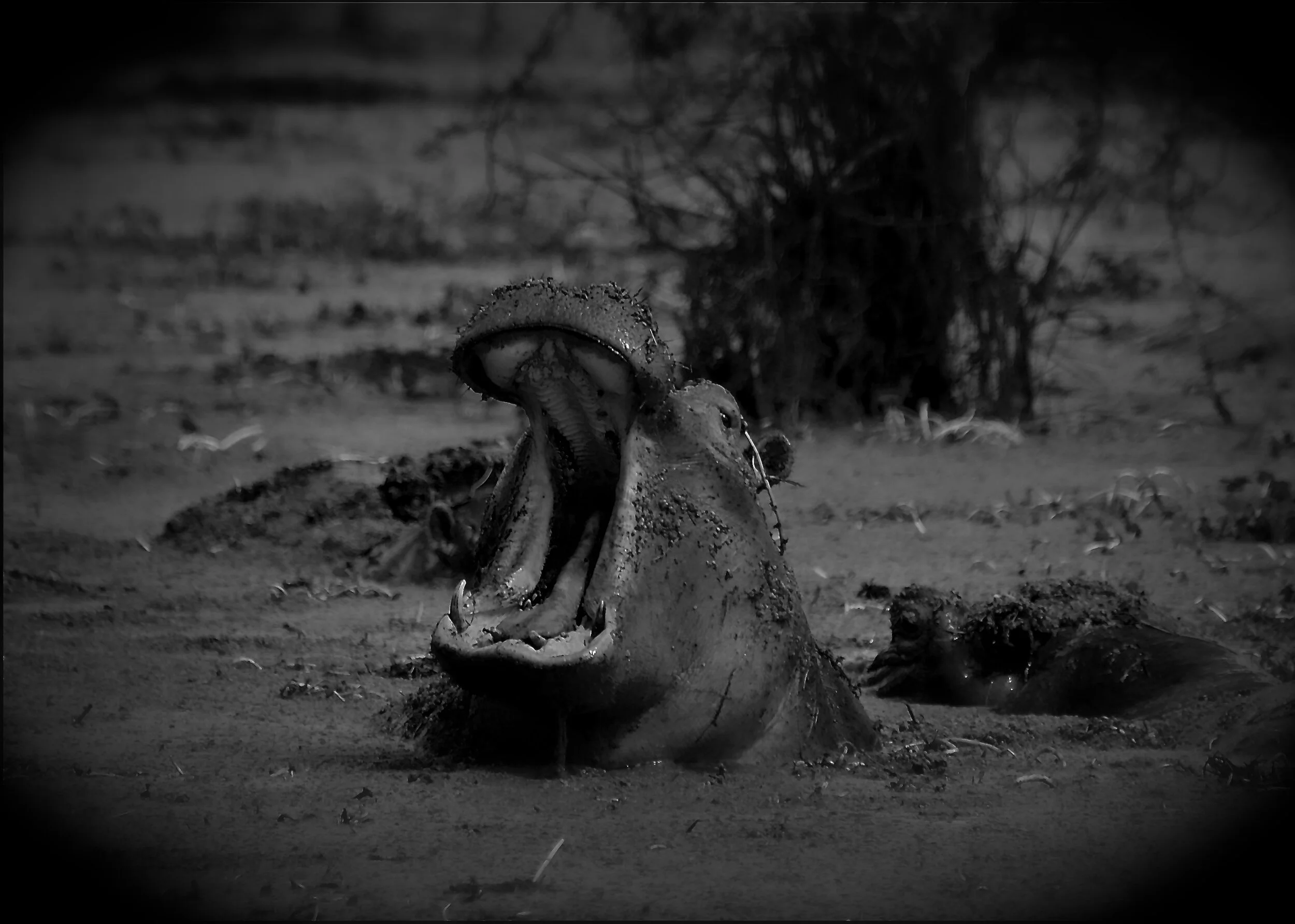
Hippos, with their life-lived, weather-worn facial expressions and massive maws, inlaid with giant tusks to rival those of many elephants, are genuinely photogenic —  provided, that is, the photographer catches them during one of the few moments of the day they’re not immersed in brown water, save for a pair of beady eyes and flaring nostrils.

Misunderstandings, misinformation and false facts about “river horses,” as they’re widely known, exist to this day. The truth, as is often the case, is more interesting than any fiction.

Hippos are semi-aquatic. They often stay in the water for up to 16 hours at a time, but they often emerge at night to feed.

©Alex Strachan pliny hippo.jpg

This is when they’re most vulnerable to human-wildlife conflict, and getting between a hippo and water, especially in the dark of night, is a bad idea.

Hippos mate and give birth in the water. This makes them virtually unique among amphibious animals, as most amphibious animals do the opposite. Infants suckle in the water.

Hard  as it may be to believe, hippos don’t often swim, even though they are good swimmers. Hippos usually stand on their feet in parts of the river or lake that are just deep enough to allow them to submerge themselves. In deep water they often walk on the riverbed or lakebed, on occasion leaping to the surface to breathe. A hippo can hold its breath for up to five minutes at a time.

Hippos can stretch their mouths to almost 180° when open. What may look like a yawn often isn’t: A wide-open yawn is a warning sign.

Hippos may appear to the human eye to suffer from sunburned backs — a reason for their perpetual ill temper, goes one theory — but in fact that seeming “sweat” of red and orange pigment is a natural sunscreen.

A 2004 study in the journal Nature and later reported in National Geographic found that the red pigment contains an antibiotic, while the orange pigment absorbs UV rays. Now you know.

Like nearly all of Africa’s large land mammals, the hippo’s future in the wild is uncertain. The IUCN Red List of threatened species lists hippopotamus amphibious as vulnerable, which the International Union for Conservation of Nature defines as being at high risk of unnatural, human-caused extinction without further intervention.

Pliny again:

“The hippopotamus stands out as a teacher in one branch of medicine. For when it lumbers ashore after excessive eating — in which it indulges all the time — to look for recently cut rushes, and sees a very sharp stalk, it presses its body on to it and pierces a vein in its leg, and so, by losing blood, lightens it body, which would otherwise become ill. Then it covers up the wound again with mud.”

We know that last part not to be true. Pliny may have been a polymath, and he got a lot right about hippos, but he couldn’t be right about everything.

©Alex Strachan

©Alex Strachan


Tags: hippopotamus, hippo, hippopotamus amphibious, river horse, Pliny the Elder, Gaius Plinius Secundus, nature, journal Nature, National Geographic, polymath, IUCN, International Union for Conservation of Nature, Red List, vulnerable, threatened species, riverine, Africa
©Andre Botha-AP.jpg

CITES warns: Regulate the Illegal Wildlife Trade, Or Expect More Covid-19s

June 26, 2020
“Pandemic is not a word to use lightly or carelessly. It is a word that, if misused, can cause unreasonable fear, or unjustified acceptance that the fight is over, leading to unnecessary suffering and death.”
— Tedros Adhanom, Director-General, World Health Organization, March 11

Ivonne Higuero is an environmental economist — or, in Trumper terms, a loser — with a decades-long career with international organizations that specialize in sustainable development. 

She has been Secretary General of CITES, the Convention on International Trade in Endangered Species of Wild Fauna and Flora, since October, 2018, around the time Trumpers decided that while they had never liked environmentalists much, now was the the time to get positively medieval on what’s left of Earth’s precious — and precarious — wilderness resources.

Trumpers look at the name “Higuero” — never mind the outré spelling of her Christian name “Ivonne” — and no doubt write her off as yet another uppity Mexican, leaving aside the fact that she’s actually from Panama and her post-secondary bona fides include Duke University (Durham, North Carolina) and Missouri University of Science and Technology — which, oddly enough, is based in the US midwest state of Missouri.

Since the unwelcome arrival of the Covid-19 coronavirus pandemic earlier this year, she has repeatedly gone on record as pointing out that the illegal trade in wildlife — everything from the bushmeat trade to so-called wet markets, where wild animals are served up as human food — has encouraged the spread of pathogens into the human population, directly, through the food chain, and indirectly, by eroding wildlife habitats which — crazily! — act as a natural barrier between zoonotic viruses and  spillovers from animals to people. Who knew?

Trumpers equate her to a loud, obnoxious bully who goes out of her way to terrorize the delicate sensibilities of the fossil fuel industry, at the same time questioning the manly fragility of trophy hunters. After all, what is Don Jr. to do if not cost US taxpayers $75,000 for Secret Service protection just so he could fly all the way to Mongolia to gun down a rare and endangered mountain sheep for the trophy wall? The Argali sheep, the largest of sheep species and renowned for their large horns, is listed as “near threatened” on the IUCN Red List of Endangered Species, which is another way of saying there are not that many of them.

Shooting defenceless mountain sheep partly on the taxpayers’ dime is one thing, and certainly worthy of CITES comment. 

With the Covid-19 pandemic showing every sign of growing, though, and not slowing — hey, Trumpers, could we please just start accepting facts as, well, facts — the issue of how, where and why a deadly virus jumped

from animals to humans has taken on an added, worldwide urgency.

This past week Higuero penned an essay in the South China Morning Post headed, ‘How regulation of endangered wildlife trade can prevent the next pandemic’ which — spoiler alert! — points out that if Covid-19 was caused even in part by the unregulated trade in animal parts, regulatingsaid trade might, just might help prevent pandemics in future.

Conveniently, Higuero wrote her opinion piece in English, not Chinese, so Trumpers can’t use the excuse that they don’t read Chinese and so, like, who cares if it’s in Chinese, if it’s in China-language it doesn’t mean anything, and so it doesn’t exist.

The South China Morning Post is an English-language newspaper in any event, and based in Hong Kong, not China, but pointing that out would only confuse Trumpers even more.

“We know zoonotic diseases emerge when pathogens carried by animals — wild or domesticated — spill over to humans and subsequently adapt for human-to-human transmission,” Higuero wrote, describing something eerily similar to the Trump campaign, though science itself has yet to pin down whether Trump himself is either wild or domesticated.

CITES, Higuero noted, is the global regulatory body that oversees the international trade in more than 36,000 species of wild animals and plants; the organization has no say in domesticated animals, but it does have jurisdiction over trade in wild animals that are farmed, ranched and/or bred in captivity.

CITES supports efforts to ensure that the international wildlife trade is legal, sustainable, and traceable — three things that Trumpers rank somewhere between their disdain for Alexandria Ocasio-Cortez and their obsessive hatred of Hillary Clinton.

Higuero supports the ‘One Health’ approach, which focuses on the links between human health and that of the planet. Through CITES, One Health envisions a world in which interactions between humans and wildlife are safe and sustainable, which in turn reduces the risks to nature, ecosystems, endangered species — and we human beings.

That’s a message even a Trumper can understand. Acceptance, on the other hand, is a whole other kettle of fish.

https://www.scmp.com/comment/opinion/article/3089832/how-regulation-endangered-wildlife-trade-can-prevent-next-pandemic

©South China Morning Post

©South China Morning Post

©Twitter - Ivonne Higuero

©Twitter - Ivonne Higuero


Tags: Ivonne Higuero, CITES, IUCN Red List, Covid-19, Convention on International Trade in Endangered Species of Wild Fauna and Flora, pandemic, coronavirus, One Health, Tedros Adhanom, WHO, World Health Organization, zoonotic viruses, wet markets, food chain, Trumpers, Argali sheep, Mongolia
Prev / Next

Journal

“Man is modifying the world so fast and so drastically that most animals cannot adapt to the new conditions. In the Himalaya as elsewhere there is a great dying, one infinitely sadder than the Pleistocene extinctions, for man now has the knowledge and the need to save the remnants of his past.”

— Peter Matthiessen


Featured Posts

Featured
1.bourdain hong kong.jpg.png
Aug 19, 2025
Bourdain in Hong Kong
Aug 19, 2025
Aug 19, 2025
1.ABPU_S11_Armenia3.jpg.png
Jul 21, 2025
Bourdain in Armenia
Jul 21, 2025
Jul 21, 2025
art1.jpg.png
Jun 25, 2025
Bourdain in Uruguay
Jun 25, 2025
Jun 25, 2025
1.bourdain congo2.jpg.png
Jun 8, 2025
8 June — Bourdain Remembered
Jun 8, 2025
Jun 8, 2025
1.Screen Shot 2025-05-27 at 5.41.13 AM.jpg.png
May 31, 2025
Bourdain in Southern Italy (with Francis Ford Coppola)
May 31, 2025
May 31, 2025
8.dsc09592.jpg.png
May 17, 2025
Bourdain in Puerto Rico
May 17, 2025
May 17, 2025
9.11216842-anthonybourdain-srilankajpg-c-web.jpg.png
May 4, 2025
Bourdain in Sri Lanka
May 4, 2025
May 4, 2025
b.art1.png
Apr 17, 2025
Bourdain in Lagos, Nigeria
Apr 17, 2025
Apr 17, 2025
1.art website.jpg.png
Apr 10, 2025
Bourdain in the French Alps (avec Eric Ripert)
Apr 10, 2025
Apr 10, 2025
1.art (2).jpg.png
Apr 2, 2025
Bourdain in Singapore
Apr 2, 2025
Apr 2, 2025