• Entr'acte
  • Living Landscapes
  • Dispatches
  • Natural History
  • Panthera
  • Elephantidae
  • Bibliothèque
  • About
  • Menu

Strachan Photography

  • Entr'acte
  • Living Landscapes
  • Dispatches
  • Natural History
  • Panthera
  • Elephantidae
  • Bibliothèque
  • About
©Sarah Blesener-The Washington Post, via Getty Images

©Sarah Blesener-The Washington Post, via Getty Images

Meet Generation Climate

June 30, 2019
“Climate change is the most politically divisive issue in America, more so than gun control and abortion. But young people have the social freedom to say it like it is.”
— Jamie Clarke, executive director, Climate Outreach
 

They’re too young to vote, but on their slender shoulders rests the future of the planet. Less than two months ago, for the second time in 2019, more than 1.5 million young people in more than 125 countries took to the streets in the most dramatic show of global climate action in human history.

And that’s not hyperbole.

Neither are the stakes. For the simple truth is that, while their young voices are belittled, demeaned, ridiculed, shouted down, set aside, forgotten and ignored, the already narrow window of opportunity to effect positive change is closing rapidly.

Some say that window has already closed, but — eternally optimistic — the youth of the planet cannot allow themselves to think in those terms.

Greedheads rule, and they know that. But they also know, all things considered  — and assuming nature is allowed to run its natural course, free of any sudden, world-ending cataclysm — they will outlive the greedheads.

That’s the one card they hold, after all. They will inherit the Earth, for good or for bad. And once the greedheads are dead and buried, long gone and long since forgotten, consigned to the dustbin of history like so many stanzas in Ozymandias, it will be down to the Greta Thunbergs and Alexandria Villaseñors of the world to clean up the mess and possibly — possibly — save the planet.

The burgeoning climate crisis is not the sole preserve of the white middle class from industrialized, developed — read: white — nations, either.

“I see the effects of climate change every single day,”  11-year-old Yola Mgogwana, of Khayelitsha, one of Cape Town, South Africa’s most impoverished townships, told The Guardian’s Anna Turns just days ago. “Our weather is not normal. One day it’s hot; the next day it’s raining heavily.”Just 18 months ago, Cape Town residents’ water consumption was limited to just 50 litres a day, and the city — pop. 3.7 million — was mere weeks away from “Day Zero,” the day taps would run dry.

“For me, that was a big sign that we need to change our ways and stand up for nature,” 11-year-old Mgogwana told the Guardian. “Because our government wants to profit from the environment, instead of implementing policies that protect it.”

She may be talking about South Africa, but she could just as easily have been talking about the US or UK — or Canada, for that matter.

Since January, Mgogwana has been volunteering with the Earthchild Project, an NGO pushing for climate and environmental awareness education in the world’s schools.

The school strike for climate is the 21st century equivalent of the 13th century’s Children’s Crusade, but it’s not about religion. The stakes are higher, and the outcome less certain.

In the meantime — part coda, part reason for hope — there’s this, from earlier today:

https://www.theguardian.com/environment/2019/jun/29/alexandria-ocasio-cortez-met-greta-thunberg-hope-contagious-climate

©Twitter

©Twitter


Tags: climate crisis, climate action, claimte emergency, Jamie Clarke, Climate Outreach, The Earthchild Project, The Guardian, Sunday Observer, Anna Turns, Greta Thunberg, Alexandria Villaseñor, Alexandria Ocasio-Cortez, Yola Mgogwana, Khayelitsha, township, Cape Town, South Africa, drought, water restrictions, climate strike, AOC, kidscansavetheplanet.com, earthchildproject.org, Extinction Rebellion, schoolstrike4climate.com, kidsagainstplastic.co.uk
©Andrey Atuchin

©Andrey Atuchin

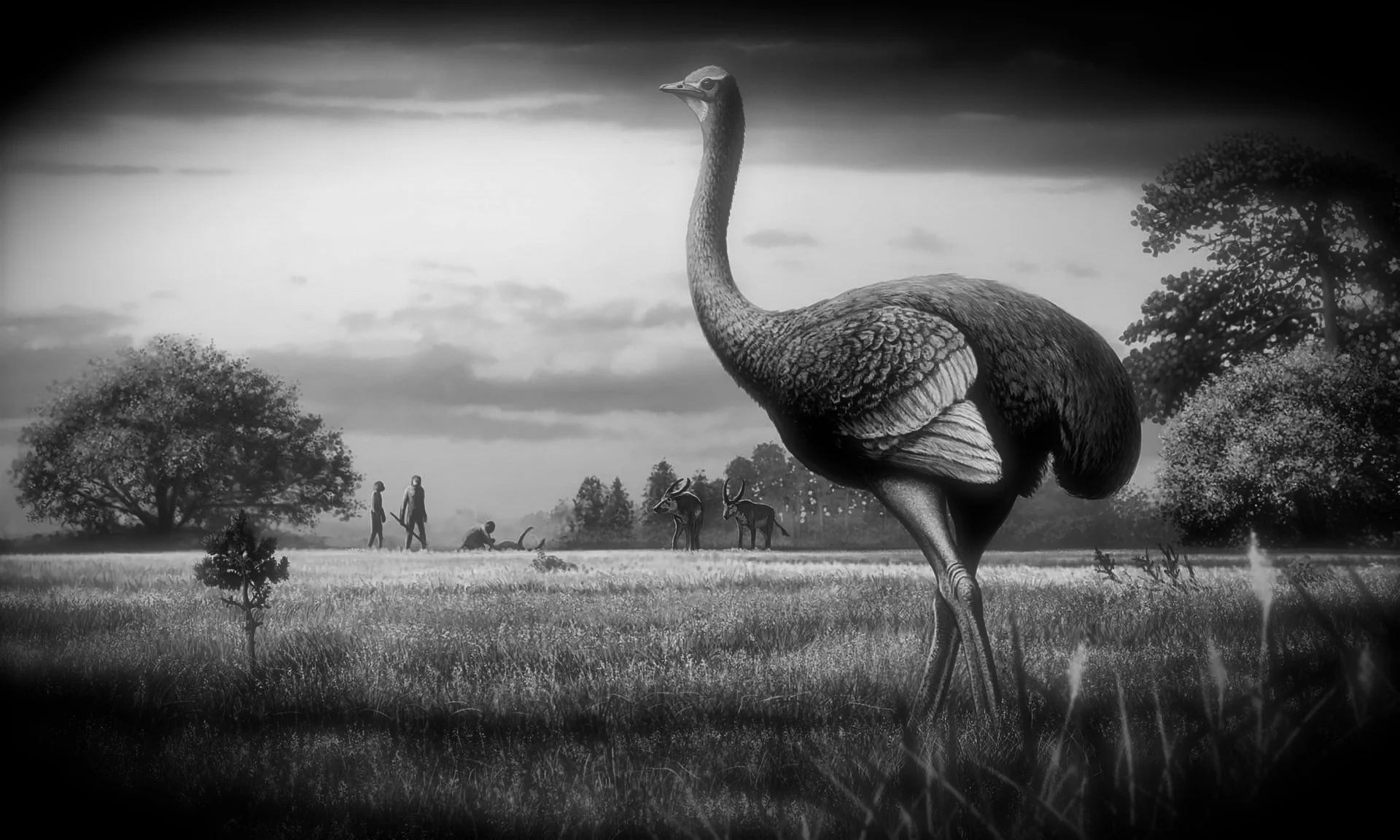
Big Bird Back from the Past

June 28, 2019
“When I first felt the weight of the bird whose thigh bone I was holding in my hand, I thought it must be a Malagasy elephant bird fossil, because no birds of this size have ever been recorded in Europe. However the structure of the bone told an unexpectedly different story.”
— Dr. Nikita Zelenkov, Russian Academy of Science

The present scientific consensus is that today’s birds are descended from a group of theropod dinosaurs that originated in the Mesozoic Era — which makes the recent discovery of the remains of a bird three times larger than an ostrich in a Crimean cave the cat’s miaow for palaeontologists and anthropologists alike.

But wait, there’s more.

The discovery of the prehistoric, flightless bird that in its heyday stood some 3.5 metres (12 ft) tall may not seem strange on the face of it, not when we have today’s ostriches and emus to compare it to.

Nor is the gigantic bird’s discovery in a cave in Europe is that big a deal, even if such “gigantism,” as  scientists call it, was previously believed to exist only in the Southern Hemisphere island continents of Madagascar, Australia and New Zealand.

No, the more striking fact is that this early bird lived among the first Europeans — feathered cheek by early-human jowl, if you will.

The terrestrial bird roamed the Earth near the dawn of the last ice age, about 2 million years ago.

The specimen in Taurida cave on the Black Sea’s northern coast suggests a bird the size of a Madagascan elephant bird or New Zealand moa. It  may well have been a source of meat, bones, feathers and eggshell for early humans.

Scientists have dubbed it Pachystruthio dmanisensis.

The discovery is the latest in a series of startling fossil finds on the Russian subcontinent, as global heating, retreating ice caps and increased human development uncover more evidence of the pre-contact world.

“We don’t have enough data yet to say whether it was most closely related to ostriches, or to other

birds, but we estimate it weighed about 450kg,” lead author Dr. Nikita Zelenkov of the Russian Academy of Sciences said, after study findings were published in the peer-reviewed Journal of Vertebrate Palaeontology. “This formidable weight is nearly double the largest moa, three times the common ostrich, the largest living bird, and nearly as much as an adult polar bear.”

A mighty big bird, in other words.

Pachystruthio dmanisensis may have been flightless, but it was fast, the evidence suggests. Elephant birds were hindered by their bulk when it came to running, but the relatively long and slim femur of the recently discovered bird suggests it was built more like a sprinter than a more sedentary bird. Interestingly, palaeontologists also found fossil evidence of highly-specialized large carnivores of the era alongside the bird’s remains, carnivores like the sabre-toothed cat and early, much larger ancestors of the cheetah and hyena. That suggests the bird’s speed was adapted over time to outrun predators — flight, rather than fight.

The Russian Science Foundation has been taking a lead role in paleontological science of late. The recent find suggests the giant bird, though previously neglected by science, was probably typical of wildlife found at the time the earliest hominids found their way to Europe during the early human migrations out of Africa.

Big Bird has gone mainstream: The Crimean findings have been reported in Scientific American, New Scientist, Smithsonian, Live Science and National Geographic in recent days, alongside mainstream news outlets CNN, BBC World, ITV, The Independent, Newsweek and The Guardian, among others.
Pachystruthio dmanisensis has come back to life.

https://www.smithsonianmag.com/science-nature/fossil-bird-three-times-size-ostrich-found-europe-180972508/

©Nikita Zelenkov-Society of Vertebrate Palaeontology

©Nikita Zelenkov-Society of Vertebrate Palaeontology


Tags: fossil finds, Big Bird, moa, palaeontology, Dr. Nikita Zelenkov, Russian Academy of Science, Russian Science Foundation, Pachystruthio dmanisensis, Pachystruthio, Taurida cave, Crimea, Black Sea, Mesozoic Era, Ice Age, Jurassic Park, elephant bird, ostrich, Scientific American, Smithsonian, Age of the Dinosaurs
©Emmanuel Kwizera-Rwanda Times

©Emmanuel Kwizera-Rwanda Times

Rhino Redux

June 26, 2019
“The scary thing is that in my lifetime, 95 percent of the world’s rhinos have been killed.”
— Mark Carwardine, zoologist

The relocation or five critically endangered eastern black rhinos from European zoos to a national park in Rwanda captured the attention of the world’s media last weekend, and with good reason. The successful relocation of any large animal — and rhinos, one of Africa’s “Big Five,” are among the largest — is cause for excitement, and not just because of the stakes involved, and logistics.

This particular operation — a 30-hour journey in all — required a specially modified Boeing 747-400F, numerous specially designed overland tractor-trailer trucks and the cooperation of four countries: the UK, Czech Republic, Iceland and Rwanda.

The rhinos had to be sedated, fussed over by veterinarians and transported as delicate cargo, like so much breakable china.

They arrived at their destination happy and healthy, if accounts in the local Rwandan media — and the testimony of the accompanying veterinarians and rhino wranglers — are to be believed.

Once the physical operation was successfully completed, the international media moved on to other stories, naturally enough.

Now, though — no pun intended — is when the heavy lifting begins.

The time-consuming, unsexy mission of acclimatizing the zoo-bred rhinos to a life in the wild will take weeks, even months. Though the rhinos are technically inside the boundaries of their new home, Akagera National Park, a protected area of savannah,  montane and swamp in eastern Rwanda covering some 1,120 km² (435 sq mi), they will be kept in a holding pen until park authorities and zoologists decide the time has come to release the rhinos back into the wild for good.

Akagera is part of a complex system of lakes and papyrus swamps that forms the largest protected wetland in Eastern-Central Africa — but life in Rwanda is hard, even for a rhino. Rwanda, still beset by political problems, is not immune from the sudden spike in rhino poaching that has driven an already endangered species to the brink.

There is precedent for the successful relocation of wild animals to Rwanda. In 2015 seven lions from South Africa’s Phinda Private Game Reserve and Tembe Elephant Park were reintroduced into Akagera, making them the first wild lions in

Rwanda in more than 15 years.

The lions have since formed a pride of 20-plus cats.

Similarly, in May, 2017, 20 Eastern black rhinos — the same subspecies as the newly relocated animals — were successfully reintroduced from South Africa. Black rhinos had been absent from Rwanda for 10 years or more.

What makes the new project unique — ground-breaking, you might say — is that it’s the first time a project of this scale has been tried between Europe and Africa.

Interestingly, the rhinos — from Dvūr Králové Safari Park in the Czech Republic, Flamingo Land Resort in North Yorkshire in the UK and Ree Park-Ebeltoft Safari on the Jutland peninsular in Denmark — are the direct descendants of rhinos taken from Africa during the German colonial era of the late 19th century. (Belgium was handed dominion over Rwanda at the end of the First World War, as part of the post-war League of Nations mandate.)

The new rhinos are being imported in part to bolster the genetic diversity pool — i.e. gene pool — of the eastern black rhinos that were reintroduced into Akagera in  2017.

According to the International Union for Conservation of Nature, just 5,000 eastern black rhinos remain, which makes them one of the most critically endangered species left on planet Earth.

The project’s accompanying zoologists insist there’s cause for optimism.

“We’ve done a (successful) translocation of rhinos in the past,” Dvūr Králové’s special projects coordinator Jan Stejskal told Czech state radio earlier this week, “and we know that rhinos born in captivity and taken to wild areas actually (reclaim) their instincts very fast.”

The rhinos landed at Kigali International Airport at 2:45 am on Monday. Offloading the rhinos “kicked off,” Rwanda’s New Times newspaper reported, as soon as the plane landed.

Days later, by all accounts, Jasiri, Jasmina, Manny (from the Czech Republic), Olmoti (the UK) and Mandela (Denmark) are doing just fine.

©ČTK-David Taneček

©ČTK-David Taneček

©Twitter

©Twitter


Tags: eastern black rhino, Rwanda, Big Five, rhinos, Akagera National Park, Eastern-Central Africa, African Parks, animal relocation, lions, Tembe Elephant Park, South Africa, Phinda Private Game Reserve, Dvūr Králové Safari Park, Czech Republic, Flamingo Land Resort, North Yorkshire, Ree Park Ebeltoft Safari, Jutland peninsular, International Union for Conservation of Nature, IUCN, IUCN Red List
©Sebastian Ganso-Pixabay

©Sebastian Ganso-Pixabay

Turning the Page on Where Time Began

June 24, 2019
“Newts are such primitive creatures that watching them was like looking into time itself.”
— Tim Flannery

From that seemingly innocuous — and hardly earth-shaking — observation, Australian palaeontologist Tim Flannery began a 30-year long study of Europe’s natural history. 

In his just-published book Europe: The First 100 Million Years (Penguin paperbacks), Flannery opens our eyes onto a bold and rich panorama of Europe’s pre-history, 100 million years distilled into 300 pages of mesmerizing fact and detail — not exactly beach reading, perhaps, but the perfect antidote for society’s deadly affliction of short-term memory loss.

Natural histories encompass both the natural and the human worlds, Flannery writes, and this one seeks to answer three defining questions: How was Europe formed? How was its prehistory unearthed? And why did Europe, of all the continents, play such a key role in our present-day civilization?

“For those like me, seeking answers, it is fortunate that Europe has a great abundance of bones — layer upon layer of them, buried in rocks and sediment that extend all the way back to the beginning of bony animals.”

That may not be the ideal visual image to rival Jurassic Park, but then Europe: The First 100 Million Years is not fiction.

Flannery’s account of Earth’s origins opens some 100 million years in the past, give or take a millennium here or there, at that moment in time when the first distinctly European organisms evolved during a time of imperceptibly shifting tectonic plates moving across the Earth’s surface, upon which the continents ride. Most continents originated as so-called supercontinents that split into smaller pieces: Europe, on the other hand, began as an island archipelago, long before Britain — and Brexit — threatened to tear the continent apart.

Europe, as it happened, would be a place where evolution developed rapidly by prehistoric standards — a place in the vanguard of change from the very beginning. From the time of the dinosaurs, Flannery writes, Europe displayed unique signature marks that shaped the evolution of its animal — and human —  inhabitants. Europe’s diversity, evolutionary history and ever-changing boundaries, geological and political, “make the place almost protean” — and yet, the continent is instantly recognizable. “With its distinctive human landscapes,”
 Flannery writes, “once-great forests, Mediterranean coasts and alpine vistas, we all know Europe when we see it.”

Not quite like this, though. Flannery paints a portrait of a zoo-geographic region with “groves of palms and ferns overtopped by ginkgoes,” or maidenhead trees, a terra nova populated by newts, salamanders and midwife toads. Today’s newts and salamanders are living fossils of that past time.

Europe is “where the investigation of the deep past began,” which is why this book is such an illuminating, eye-opening journey.

It’s full of revelations and surprises, too, that stand up to the scrutiny of time and are relevant — and fascinating — to this day. There’s the amazing revelation, for example, that there are today more wolves in Europe than in the US. Wildlife species are constantly arriving and adapting, helping make Europe, if not great again, “make Europe anew.”

Worth reading.

©Adrian Malec-Pixabay

©Adrian Malec-Pixabay


Tags: Europe: The First 100 Years, Tim Flannery, newts, palaeontology, palaeonbiology, Penguin paperbacks, natural history, European prehistory, Jurassic Park, zoo-geographic, gingkoes, midwife toads
©Obst-Pixabay

©Obst-Pixabay

It’s About Time, Except When It Isn’t

June 22, 2019
“The idea is to chill out. I have seen people suffering from stress because they were pressed for time.”
— Sommarøy resident Kjell Ove Hveding

They say the best things take time — but does that mean they’re right?

In a time when the planet is starved for light-hearted news, word that an island off the far northern coast of Norway is fed up with time — from the very concept of time to its day-to-day use in daily life, word that the islanders are mad as hell and not going to take it anymore is like a breath of fresh air.

The 350 residents of Sommarøy island in Norway want to escape the tyranny of the clock. Instead of just kvetching about it, though — or klagging about it, to be more geographically and linguistically precise — they’ve decided to do something about it.

Residents on the island of Sommarøy have voted to do away with “conventional time-keeping” — i.e. traditional business hours — during the midnight sun. The idea is to go “time-free” during the 69 days of the year when the sun doesn’t set, so islanders can keep more flexible school and work hours, if only to make the most of those long summer days.

The Land of the Midnight Sun experiences a midnight sun — literally — from May 18 to July 26 every year.

Norway is still a liberal democracy, even democracy has fallen out of favour across the democratized world. So when dozens of irate islanders signed a petition demanding a “time-free zone,” hapless politicians — specifically local MP Kent Gudmundsen — had little choice but to follow along.

Sommarøy lies north of the Arctic Circle. The flip side of those long, lazy summer days is that every year the island is immersed in darkness — total, round-the-clock darkness — from November to January. Islanders don’t want to be cheated out of a single waking moment in midsummer if they can avoid it.


Sommarøy is west of Tromsø, pop. 75,500, Norway’s ninth largest city. Fishery and tourism are the main industries, and long daylight hours are good for both.

Time is becoming a pressing issue throughout much of Scandinavia, and small wonder, given just how intolerable the winters really are. Last year, Finland lobbied for the abolition of Daylight Saving Time on the heels of a citizen’s initiative that collected some 75,000 signatures — or one signature for each resident of Tromsø.

When winter means three months of not seeing daylight, island residents say that, during the summer anyway, they want to do “what we want, when we want.”

Hveding, the campaign’s unofficial organizer, went on  Norwegian TV to sound off about the sheer unfairness of it all.

“All over the world,” he told Norway’s NRK, “people’s lives are characterized by stress and depression. In many cases this is linked to feeling trapped by the clock. We will be time-free zone now where everyone can live their lives to the fullest. The goal is to be fully flexible, 24/7.

“If you want to cut the lawn at 4am, then do it.”

Before you say, oh, those wacky Norwegians are at it again, wait. Philosophy professor Truls Egil Wyller, of Trondheim’s Norwegian University of Science and Technology (NUST), noted that we have been slaves to the clock for only the past 200 years or so.

“Before that you worked mostly as long as was necessary,” he told Norwegian public TV. “You ate when you were hungry and you lied down when you were tired. In modern society, everything we do is dictated by the clock, from the moment we get up.”

Not no more. Not during the summer, anyway.

©Twitter.jpg
©Pavlo-Pixabay

©Pavlo-Pixabay


Tags: Sommarøy, island, time, Tromsø, Kjell Ove Hveding, Kent Gudmundsen, Truls Egil Wyller, Norwegian University of Science and Technology, NUST, Trondheim, Norwegian Public Television, NRK, Arctic Circle, time-free zone, midnight sun, midsummer night's dream, summer solstice, Land of the Midnight Sun
Prev / Next

Journal

“Man is modifying the world so fast and so drastically that most animals cannot adapt to the new conditions. In the Himalaya as elsewhere there is a great dying, one infinitely sadder than the Pleistocene extinctions, for man now has the knowledge and the need to save the remnants of his past.”

— Peter Matthiessen


Featured Posts

Featured
1.bourdain hong kong.jpg.png
Aug 19, 2025
Bourdain in Hong Kong
Aug 19, 2025
Aug 19, 2025
1.ABPU_S11_Armenia3.jpg.png
Jul 21, 2025
Bourdain in Armenia
Jul 21, 2025
Jul 21, 2025
art1.jpg.png
Jun 25, 2025
Bourdain in Uruguay
Jun 25, 2025
Jun 25, 2025
1.bourdain congo2.jpg.png
Jun 8, 2025
8 June — Bourdain Remembered
Jun 8, 2025
Jun 8, 2025
1.Screen Shot 2025-05-27 at 5.41.13 AM.jpg.png
May 31, 2025
Bourdain in Southern Italy (with Francis Ford Coppola)
May 31, 2025
May 31, 2025
8.dsc09592.jpg.png
May 17, 2025
Bourdain in Puerto Rico
May 17, 2025
May 17, 2025
9.11216842-anthonybourdain-srilankajpg-c-web.jpg.png
May 4, 2025
Bourdain in Sri Lanka
May 4, 2025
May 4, 2025
b.art1.png
Apr 17, 2025
Bourdain in Lagos, Nigeria
Apr 17, 2025
Apr 17, 2025
1.art website.jpg.png
Apr 10, 2025
Bourdain in the French Alps (avec Eric Ripert)
Apr 10, 2025
Apr 10, 2025
1.art (2).jpg.png
Apr 2, 2025
Bourdain in Singapore
Apr 2, 2025
Apr 2, 2025