• Entr'acte
  • Living Landscapes
  • Dispatches
  • Natural History
  • Panthera
  • Elephantidae
  • Bibliothèque
  • About
  • Menu

Strachan Photography

  • Entr'acte
  • Living Landscapes
  • Dispatches
  • Natural History
  • Panthera
  • Elephantidae
  • Bibliothèque
  • About
©Hasrabal-Pixabay

©Hasrabal-Pixabay

Live Via Streaming, It’s Stonehenge

June 21, 2019
“Stonehenge was built to align with the sun, and to Neolithic people, the skies were arguably as important as the surrounding landscape. At solstice we remember the changing daylight hours, but the changing seasons, the cycles of the moon and the movements of the sun are likely to have underpinned many practical and spiritual aspects of Neolithic life.”
— Susan Greaney, English Heritage senior historian

It’s summer solstice — and you know what that means. Stonehenge! The place, and the song. Raise your eyes to the heavens at first light — and give it up for Spinal Tap.

In ancient times/Hundreds of years before the dawn of history/Lived a strange race of people, the Druids.

No one knows who they were or what they were doing/But their legacy remains/Hewn into the living rock, of Stonehenge.

For thousands of years — after the dawn of history, you might say, but before the dawn of the internet — countless pilgrims have made the journey to the prehistoric monument in Wiltshire, Wales, to pay their respects to the ring of standing stones, each one some four metres (134 feet) high and two metres (seven feet) wide, set in the middle of the most dense collection of Neolithic and Bronze Age monuments in the UK, not to mention several hundred burial mounds.

And now, in acknowledgement of the Northern Hemisphere’s longest day of the year — the day the sun reaches its highest position in the sky, relative to the North Pole, and the Earth’s maximum axial tilt toward the sun is 23.44° — the charity English Heritage, responsible for some 400 historic monuments throughout England and Wales, has established a round-the-clock live feed from a camera close to the stones, so anyone anywhere in the world can tune in whenever they like to see the sun and shadows play against the monolithic stones virtually in real time, as it’s happening. 

After dark, the image is replaced by a computer-generated image of the night sky as it would be

the moment a visitor clicks on the link to the website.

The Stonehenge Skyscape project, as it’s being called, will allow those who can’t make the pilgrimage in person to experience sunrise, sunset and the ever-changing night sky as it’s happening, more or less, and make them feel closer to — if not David St. Hubbins, Nigel Tufnel and David Smalls exactly — perhaps the ancient people who created the stone circle in the first place.

Stonehenge Skyscape is not a live feed precisely but rather a composite representation of the past 24 hours of the sky above the stones, accurate to within a window of roughly five minutes.

After dark, it switches from a photography-based image to a computer-generated image which depicts the live location of the stars and visible planets.

https://www.stonehengeskyscape.co.uk

London-based science educator and space scientist Dr. Maggie Aderin-Pocock will co-sponsor a star- and moon-gazing event next month, timed to coincide with 50th anniversary of the Apollo 11 moon landing, on July 24, 1969.

To hear Spinal Tap call it,

Stonehenge! ’Tis a magic place/Where the moon doth rise with a dragon’s face

Stonehenge! Where the virgins lie/And the prayers of devils fill the midnight sky.

Live, online.

©English Heritage/Stonehenge Skyscape

©English Heritage/Stonehenge Skyscape

solstice feedback.png

Tags: Stonehenge, summer solstice, Spinal Tap, English Heritage, Stonehenge Skyscape, Susan Greaney, Maggie Aderin-Pocock, University College London, Apollo 11, 50th anniversary, moon landing, science education, North Pole, David St. Hubbins, Nigel Tufnel, David Smalls, July 24 1969
©Alexas Fotos-Pixabay

©Alexas Fotos-Pixabay

Climate Crisis: Words Matter

June 20, 2019
“The art of communication is the language of leadership.”
— James C. Humes, presidential speechwriter

Words matter — and so does wording.

A starving, disoriented polar bear wanders into a town in Siberia, hundreds of miles from where it should be at this time of year.

A new survey reports the glacial ice cap in the Himalayas is melting twice as quickly as climate scientists predicted just 10 years ago.

Other climate scientists are startled to find Arctic permafrost thawing 70 years sooner than predicted.

The term “climate change” no longer suffices, The Guardian editor-in-chief Katharine Viner decided earlier this year. From now on, she announced, the Guardian would use more pointed, up-to-date terminology.

Semantics? Possibly, but in a sit-down this past week with Guardian readers editor Paul Chadwick, Viner elaborated on the reasons for her five changes to the Guardian’s in-house style guide. The old terms are not banned, she stressed: It’s simply that the new terms are preferred, wherever possible.

Only the most hardened climate denier, after all, would argue that the climate crisis hasn’t precipitated a conversation crucial to our future.

On the use of climate emergency, crisis or breakdown for climate change, for example, Viner noted that immediate action is needed to combat carbon emissions — right now — and yet emissions continue to grow. “That’s an emergency or crisis,” she said.  “Extreme weather is increasing; and climate patterns established (over) millennia are changing. (That’s) breakdown.”

Global heating is more accurate than global

warming. “Global heating is more scientifically accurate . . .  Greenhouse gases form an atmospheric blanket that stops the sun’s heat escaping back into space.”

The use of “wildlife” is preferred to biodiversity. “Biodiversity is not a common or well-understood term, and is a bit clinical when you’re talking about all the creatures that share our planet.”

“Fish populations” are preferred to fish stock. “Fish do not exist solely to be harvested by humans — they play a vital role in the natural health of the oceans.”

“Climate sceptics” — the word “sceptic” gives them too much credit when confronted with empirical evidence that we can all see with our own eyes: The ice caps are melting, and polar bears are starving. The more scientifically accurate handle, Viner says, is “climate-science denier” or the shorter, simpler  “climate denier.”

Said Viner: “Very few experts are, in good faith, truly sceptical of climate science, or of the necessity for strong climate action.”

Those who argue that the climate crisis isn’t a crisis, are flying in the face of overwhelming evidence to the contrary.

Much like the climate, language is in constant state of flux and constantly evolving, whether, as Chadwick pointed out, it’s language as description or language as exhortation.

Language in the service of a greater good is about harnessing the power of words to focus minds on an urgent global issue.

Semper fidelis, semper vera.


Tags: Katharine Viner, Paul Chadwick, The Guardian, style guide, climate change, climate crisis, climate emergency, climate action, climate deniers, global heating, language, words, wildlife, biodiversity, fish populations, permafrost, ice melt, greenhouse gases, carbon emissions, Siberia, Himalayas, Arctic
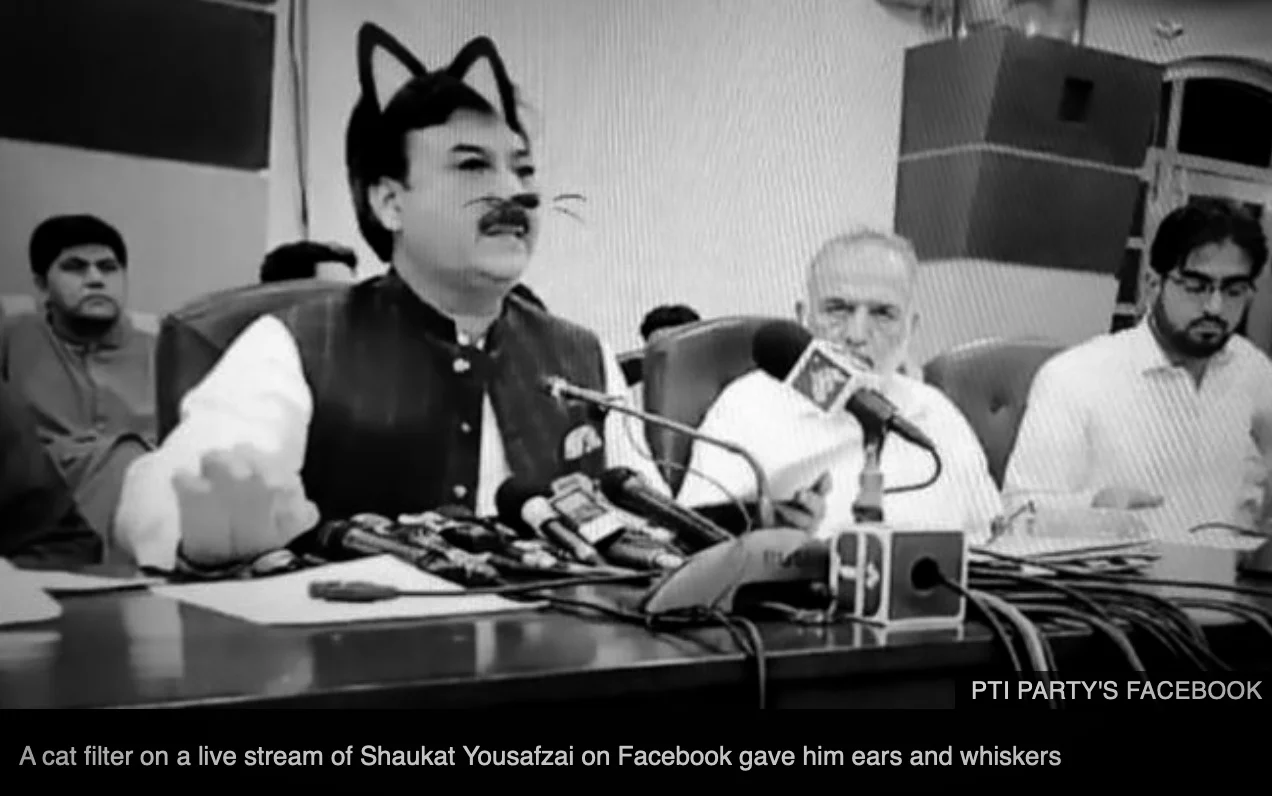
©PTI-Facebook.jpeg

Who Let the Cats Out?

June 19, 2019
“The cat filter was turned on by mistake. Let’s not take everything so seriously.”
— Pakistan regional minister Shaukat Yousafzai

On this day of all days, please spare a thought, if you can, for Anthony Noto, the now-former CFO of Twitter, who, in 2014, registered social media’s first-ever M&A DM fail.

Said CFO accidentally sent out a public tweet, you see, that was intended to be a direct message (DM) about  a hostile-takeover plan — standard operating procedure in the world of mergers and acquisitions, but not exactly material for public dissemination on Twitter.

And if the Chief Financial Officer of Twitter can be confused about social-media technology with a mind of its own, what chance does a Pakistan politician have when one of his minions — an unpaid intern, no less — triggers the wrong switch on Facebook’s DIY filters during a live-streamed media conference?

Pakistani regional minister Shaukat Yousafzai — no relation — was addressing his adoring public during his weekly conference via Facebook, when a volunteer on his team accidentally activated the cat filter, causing said minister to appear with digital cat ears, whiskers and puffed out cheeks.

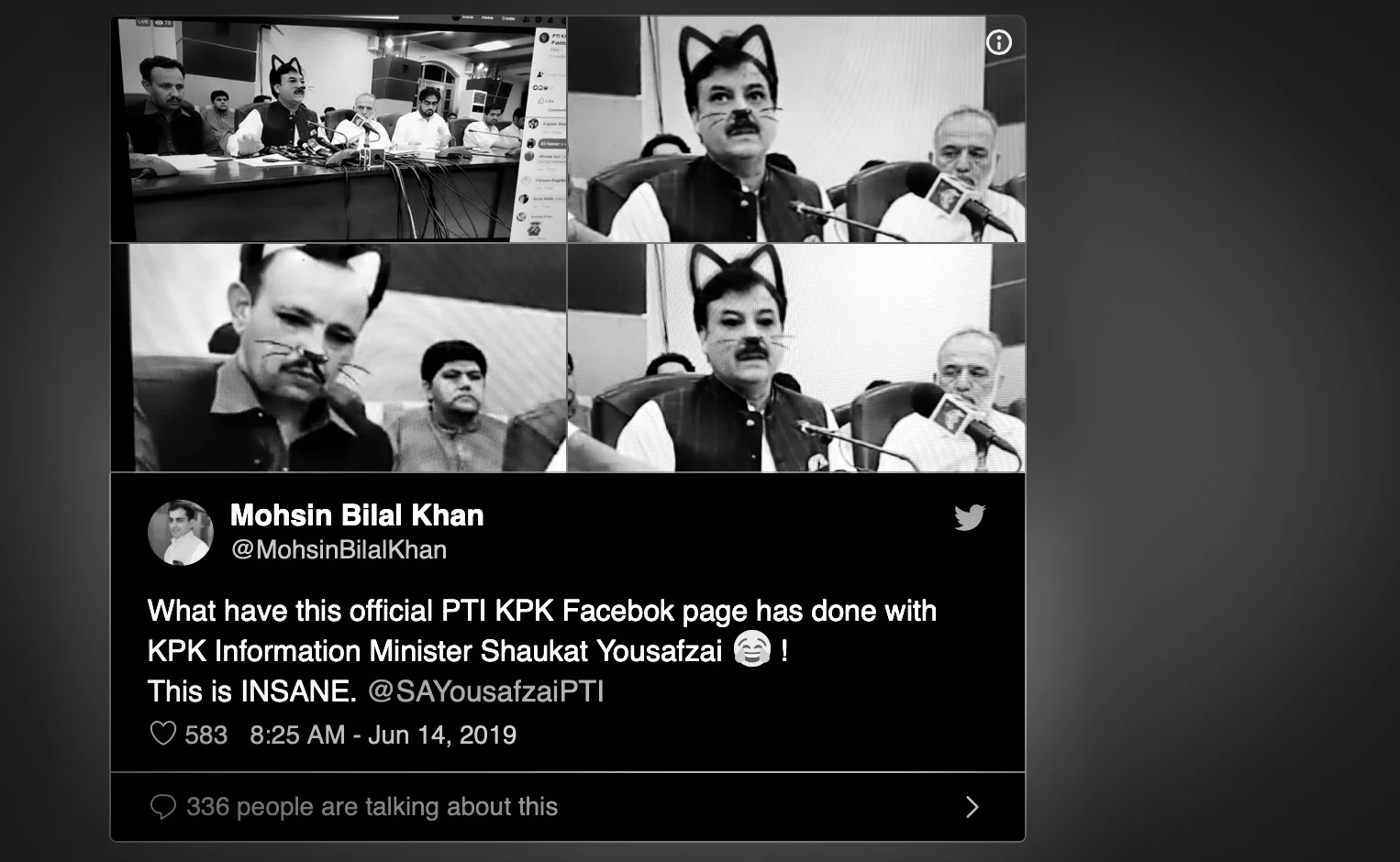
Live viewers were quick to spot the gaffe, but in their haste to correct it, officials somehow managed to add the effect to officials sitting on either side of the minister. The Pakistan Tehreek-e-Insaf (PTI) party, which hosted the stream, deleted the video the moment the conference ended, but of course this is social media: You can delete all you want, but what appears on social media stays on social media.

Rumours of a fatwa on cats have proved to be unfounded — so far — but it’s always good to have a laugh, especially when world tensions are as high as they are right now: the climate crisis, looming conflict over shipping lanes in the Persian Gulf, a deficit of leadership in the industrialized world, etc., etc. Social media is often decried as  forum for semi-literate grotesques to gather and throw insults at one another, and yet many of the comments responding to the Pakistan TI party’s official statement — it was “human error” — were kind and giving, along the lines of, ‘Anything that helps lighten tension in a dark global political climate’ is catnip for the soul.

A later statement by the PTI party took some of the bloom off the rose — “All necessary actions have been taken to avoid such incidents in future” — but the cat was already out of the bag.

Who knew Shaukat was a cat person? His official biography prefers to cite his credentials for public office as: veteran journalist, a former regional health minister of the Khyber Pakhtunkhwa government, official representative of the ruling PTI party, and a senior advisor to Pakistan Prime Minister Imran Khan.

It may not always be possible to make lemonade out of lemons, but it’s always worth a try. A later statement — yes, another one! — said the PTI party felt proud to have brought Pakistani politics to the internet.

Not to mention cats.

©PTI-Twitter.jpeg

Tags: social media, cats, cat person, Shaukat Yousafzai, Khyber Pakhtunkhwa, Facebook, Twitter, Imran Khan, Agence France-Presse, AFP, Pakistan, Pakistan Tehreek-e-Insaf party, PTI, Anthony Noto
©Moshe Harosh-Pixabay

©Moshe Harosh-Pixabay

The Eyes Have It: How Dogs Evolved

June 18, 2019
“I might say it’s sad, but in another case I’ll say, ‘He’s really paying attention.’ It can look wry, like a questioning or unbelieving look. . . . In some ways, it’s discovering something about ourselves.”
— Alexandra Horowitz, senior research fellow, Barnard College (NY), Dog Cognition Lab

Evolution is about adaptability, not survival-of-the-fittest as widely believed. Which is why the recent study that suggests dogs developed “puppy eyes” to manipulate our emotions touched a hidden nerve in the public at large.

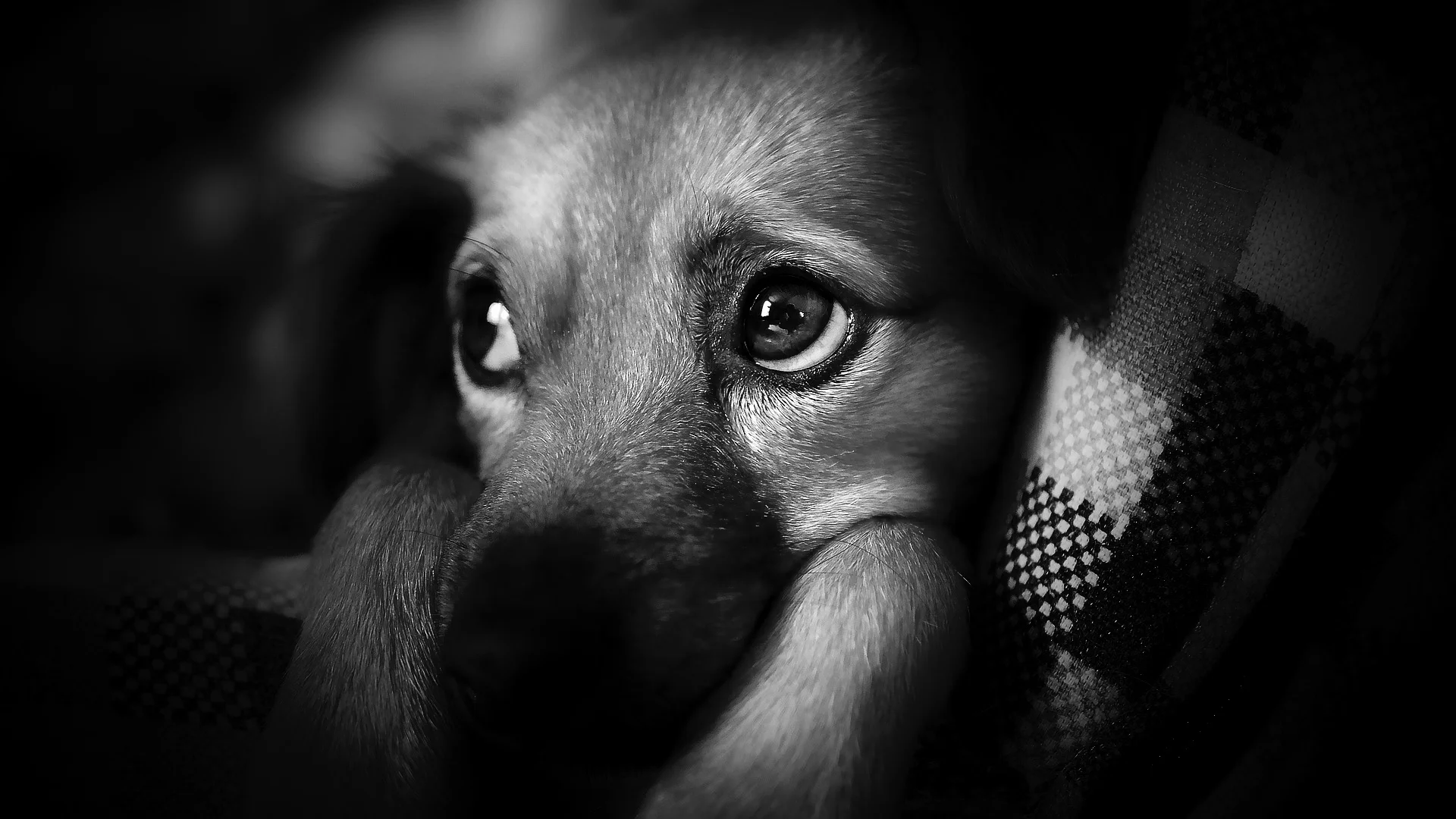
The research paper, authored by the University of Portsmouth (UK) Centre for Comparative and Evolution Psychology, found that over the 33,000 years canines have been domesticated, man’s best friend has developed a facial muscle that exercises emotional power over humans, a sad, imploring look best described as “puppy dog eyes.”

The technical term for the muscle is the levator anguli oculi medialias, or LAOM, but “puppy dog eyes” sounds better, and is easier to sell.

Dogs may have evolved from wolves, but part of what has made them so adaptable to human contact — unlike wolves — is that the puppy-dog look, which involves raising the inner eyebrows, enabled them to more easily capture our hearts. Home sapiens pay a lot of attention to faces — all apes do — and our more empathetic emotions have been conditioned to  respond to any expression that reflects sadness or loneliness. This is only natural for a social mammal that relies on group cooperation to survive.

The study involved detailed autopsies on six kinds of dogs — a labrador, a German shepherd, a Siberian husky. a bloodhound, a chihuahua and a mutt — nearly all of which showed the LAOM muscle. (The Siberian husky was the exception, perhaps owing to it being the least distant relative of the wolf). 

The study also focused on autopsies of several grey wolves, none of which displayed the LAOM

muscle. 

(No animals were harmed in the conducting of this experiment, the study’s authors insisted; the autopsies were conducted on previously deceased animals.)

This isn’t junk science, by the way, though any self-respecting cynic could be forgiven for thinking that anything to do with man’s best friend that is “science-based” is motivated at least in part by popular appeal and the desire to boost donations and gin up  funding. The study’s findings were reported in the peer-review journal Proceedings of the National Academy of Sciences, which is about as dry and sentiment-free as they come.

Proceedings, often abbreviated PNAS, is what they call a “multidisciplinary scientific journal” that publishes research, scientific reviews, op-ed commentaries, and letters. It was established in 1915. It is the world’s second most-often cited scientific journal, with some 2 million cumulative citations in a 10-year period between 2008-2018. It is not Pets Magazine.

The puppy eyes look is not just for show. It has a practical purpose, too — also evolution-based, you might say. 

In an earlier study, Portsmouth University Prof. Bridget Waller — lead author of the new study — found that the more often and openly shelter dogs showed what the scientists call “high intensity expressions,” the more quickly they tended to be adopted. The puppy eyes look was shown to be more effective than wagging tails and the speed at which dogs bounded over to visiting, would-be adoptees. Imagine that.


Tags: University of Portsmouth, dogs, facial expressions, puppy eyes, levator anguli oculi medialias, LAOM, Barnard College, Alexandra Horowitz, Dog Cognition Lab, Bridget Waller, Centre for Comparative and Evolution Psychology, evolutionary biology, Proceedings of the National Academy of Sciences, PNAS, National Academy of Sciences, shelter dogs, pet adoptions
©Joel Sartore-National Geographic/Photo Ark

©Joel Sartore-National Geographic/Photo Ark

The Photo Ark: Capturing Animals, One by One.

June 17, 2019
“It is folly to think we can destroy one species and ecosystem after another and not affect humanity. When we save species, we’re actually saving ourselves.”
— Joel Sartore

Just as some things are worth remembering and bear being reminded of, some things are worth repeating. It was Fathers Day, and the CBS newsmagazine 60 Minutes reprised a segment from last fall about National Geographic photographer Joel Sartore — or, more accurately, Sartore’s Photo Ark project.

Sartore sides with those scientists who believe that half the animal species today may well be extinct by the end of this century.

To that end, he’s trying to photograph every species — every animal, bird, fish, reptile, and insect, in captivity.

“On this ark,” Whitaker said, in introducing his 60 Minutes segment, “the animals go in one by one.”

As Sartore explained to Whitaker, photographing species in the wild would be too time-consuming and labour intensive — and, more to the point, many species, more than you’d think, survive solely in captivity. It is one of the main selling points of zoos’ continuation, and one of the arguments you hear least often. The irony, of course, is that as zoos fall out of favour with modern thinking, from a practical, survival-of-the-species point of view, now may be the most practical time to keep them going.

Sartore’s work may not be wild, taken in the wilderness, but it just might be the literal definition of conservation photography. Sartore wants to photograph each one of 12,000 species before some vanish forever. He is 55, and estimates he is halfway through his project.

Mortality is on his mind in more ways than one. His wife Kathy contracted breast cancer a number of years ago, forcing him to reconsider his outlook

on life, and the imprint he’d leave behind.

“It really does make you appreciate how limited time is.”

His wife has since recovered; their grown daughter Ellen now follows Sartore to zoos around the world, putting in time as his assistant.

Sartore is captive to photographing animals under captive conditions for another, practical reason: He’s focusing on solo portraits, taken against a plain white or black backdrop — the better, he says, to bring out each animals unique expression and inner soul.

What makes a great picture?

“Emotion,” Sartore said. “That’s what you look for in any great photograph.”

Sartore spends half the year travelling the world, often putting in 12-hour days in stifling, humid 100-degree heat — 38 degrees in English money — as he did that day photographing a Palawan stink badger at a zoo in the Philippines.

“There’s nobody else coming along to photograph a stink badger,” Sartore explained on 60 Minutes. “I’m the only one. And that’s the case for 90 percent of the species I photograph, maybe 95 percent. These are things that nobody else will ever know existed if it weren’t for the Photo Ark. If they could see how beautiful this thing is, they would care.”

Time’s running out.

“It is,” Sartore told 60 Minutes. “But you know, at least my life’ll be spent doing something that’s hopefully mattered to the world.”

©Joel Sartore-National Geographic/Photo Ark

©Joel Sartore-National Geographic/Photo Ark

©Joel Sartore-National Geographic/Photo Ark

©Joel Sartore-National Geographic/Photo Ark

©CBS News-60 Minutes

©CBS News-60 Minutes


Tags: Joel Sartore, Photo Ark, National Geographic, 60 MInutes, Bill Whitaker, endangered species, IUCN Red List, zoological gardens, zoos, conservation photography, Palawan stink badger
Prev / Next

Journal

“Man is modifying the world so fast and so drastically that most animals cannot adapt to the new conditions. In the Himalaya as elsewhere there is a great dying, one infinitely sadder than the Pleistocene extinctions, for man now has the knowledge and the need to save the remnants of his past.”

— Peter Matthiessen


Featured Posts

Featured
1.bourdain hong kong.jpg.png
Aug 19, 2025
Bourdain in Hong Kong
Aug 19, 2025
Aug 19, 2025
1.ABPU_S11_Armenia3.jpg.png
Jul 21, 2025
Bourdain in Armenia
Jul 21, 2025
Jul 21, 2025
art1.jpg.png
Jun 25, 2025
Bourdain in Uruguay
Jun 25, 2025
Jun 25, 2025
1.bourdain congo2.jpg.png
Jun 8, 2025
8 June — Bourdain Remembered
Jun 8, 2025
Jun 8, 2025
1.Screen Shot 2025-05-27 at 5.41.13 AM.jpg.png
May 31, 2025
Bourdain in Southern Italy (with Francis Ford Coppola)
May 31, 2025
May 31, 2025
8.dsc09592.jpg.png
May 17, 2025
Bourdain in Puerto Rico
May 17, 2025
May 17, 2025
9.11216842-anthonybourdain-srilankajpg-c-web.jpg.png
May 4, 2025
Bourdain in Sri Lanka
May 4, 2025
May 4, 2025
b.art1.png
Apr 17, 2025
Bourdain in Lagos, Nigeria
Apr 17, 2025
Apr 17, 2025
1.art website.jpg.png
Apr 10, 2025
Bourdain in the French Alps (avec Eric Ripert)
Apr 10, 2025
Apr 10, 2025
1.art (2).jpg.png
Apr 2, 2025
Bourdain in Singapore
Apr 2, 2025
Apr 2, 2025