
• Entr'acte
  • Living Landscapes
  • Dispatches
  • Natural History
  • Panthera
  • Elephantidae
  • Bibliothèque
  • About
  • Menu

Strachan Photography

  • Entr'acte
  • Living Landscapes
  • Dispatches
  • Natural History
  • Panthera
  • Elephantidae
  • Bibliothèque
  • About
©Pixabay

©Pixabay

Nature + [Peace + Quiet] = Mental Wellbeing

June 15, 2019
“My wish is to stay always like this, living quietly in a corner of nature.”
— Claude Monet

We know being around nature, even for short periods time, boosts health and mental wellbeing, not to mention resulting in a more relaxed state-of-mind and sense of self-worth.

Recent research in the UK has quantified the amount of time needed to attain a natural nirvana, though, if the research — conducted by the University of Exeter Medical School in Devon, England, and based on a sample of 20,000 adults from all walks of life — is to be believed.

That number, researchers say, is two hours a week.

If the figure holds up to peer review — and further studies — a two-hour-dose-of-nature-a-week may soon join five-fruits-and-vegetables-a-day and 150-minutes-of-exercise-a-week as the signposts to a good, healthy life.

With talk of the growing climate crisis and ever-higher levels of pollution all around us, accentuating the positive, even if it will strike some as being obvious, may be a better path to environmental awareness.

The numbers show being around nature, even something as simple as a walk in the park, has an immersive effect.

The research also showed, for example, that thosewho spend little to no time in nature lead generally unhappier lives, based on their measure of life  satisfaction — a standard measure of wellbeing.

Again, this may sound obvious. People who are less active are less likely to venture outdoors, which in turn is reflected by poor health and self-esteem.

What surprised the researchers most, however, as study author Dr. Matthew White told The Guardian newspaper, is that the survey results were true for every group they studied: wealthy or poor, young or old, rural or urban, fit and healthy or facing long-term illnesses and disabilities.

“Getting out in nature seemed to be good for just about everybody,” White said.

It doesn’t have to be physical exercise, either. “It could be just sitting on a bench,” White said.

In other words, it’s not doing something that matters but rather just been surrounded by something.

That’s as good a selling point for a green, healthy, environment — not to mention stable climate — as any argument you’re likely to hear all week.



Tags: green environment, climate crisis, wellness, University of Exeter Medical School, The Guardian, Dr. Matthew White, Devon England, health research, mental wellbeing, nature, wilderness, outdoors
©Pixabay

©Pixabay

Meet the Extinction Deniers

June 14, 2019
“Biological diversity is messy. It walks, it crawls, it swims, it swoops, it buzzes. But extinction is silent, and it has no voice other than our own.”
— Paul Hawken

The epigram on my Facebook page is, coincidentally enough, Mit der Dummhelt kämpfen Götter selbst vergebens. “Against stupidity, the Gods themselves battle in vain.

Which naturally brings me, in a roundabout way, to the rise of the “extinction deniers.”

Yes, believe it or not — and you could be forgiven for thinking “not” — extinction deniers, much like climate deniers, are a thing.

They’re the quasi-experts who point to the relatively low low number of confirmed extinctions to insist that there’s no such thing as an extinction crisis. The sixth mass extinction, is a figment of the doomsayers’ imagination, they argue, no more real than snow in July or flying Ryanair in comfort. They do stop short of calling it a Chinese hoax, though. Thank the Gods themselves for small mercies.

Never mind that wildlife populations have more than halved since 1970 — verifiable fact, backed up by empirical evidence — even as the human population has doubled. Only five times earlier in our planet’s history have so many species — and so much biodiversity — been lost in such a short period of time.

The last mass extinction was when the dinosaurs were wiped out. This is why more than a few  anthropologists and palaeontologists have named the human age the Anthropocene epoch, after human beings.

The official geological name given to the last 11,700 years of Earth’s history is the Holocene — the time since the end of the last major ice age — which is why the sixth mass extinction is often referred to in official scientific circles as “the Holocene extinction.

Don’t tell the extinction deniers, though. The present mass extinction is a figment of snowflakes’ imagination, remember. It’s not happening. It’s Fake News.

The right-wing blogosphere and oh-so-legitimate news sites like Breitbart know the truth, as posited by climate deniers Patrick Moore and Marc Morano, among others: The recent United Nations IPBES (Intergovernmental Science-Policy Platform on Biodiversity and Ecosystem Services) report that warned that the world faces a possible million extinctions in the coming decades due to human activity proves that “the two biggest human threats to wildlife in the last century have been a) Communists and b) environmentalists.”

Oh, and wind power kills birds. Unlike, you know, electric power lines.

Extinction deniers point, too, to the relatively low number of extinctions recorded by the official IUCN Red List over the past 40 years — on average, just two per year.

Never mind that species don’t go extinct very quickly, or that the IUCN Red List is reliably cautious in its findings: Scientific American science writer John R. Platt noted in The Revelator just this past month that of the 23 confirmed mussel extinctions in the American Southwest, the IUCN still lists seven species as “critically endangered,” not extinct, and another four don’t appear on the Red List at all.

Never mind Mit der Dummhelt, et al. Remember the famous line from King Lear: “’Tis the time’s plague when madmen lead the blind.”

Shakespeare may have been a 17th century kind-of-dude, but that’s as good a description of 21st-century Fake News as any.


©RawPixel-Pixabay

©RawPixel-Pixabay


Tags: extinction deniers, climate deniers, Paul Hawken, Scientific American, John R. Platt, Patrick Moore, Marc Morano, verifiable fact, empirical evidence, Holocene extinction, sixth mass extinction, Anthropocene, Holocene, Breitbart, IPBES, Intergovernmental Science-Policy Platform on Biodiversity and Ecosystem Services, King Lear
©Samir Hussein-Redferns-Glastonbury

©Samir Hussein-Redferns-Glastonbury

OK Radiohead XR

June 12, 2019
“So for £18 you can find out if we should have paid that ransom.”
— Radiohead guitarist Jonny Greenwood

Never mind shelter, gimme money, the thieves told Radiohead. Hackers had somehow purloined 16 hours of unheard demos, outtakes, live performances and behind-the-scenes cussin’ ’n swearin’ from Radiohead’s seminal 1997 album OK Computer. Frontman Thom Yorke had stored the files on MiniDiscs — a throwback to the days when floppy discs were a thing and MiniDiscs were briefly considered an existential threat to CDs — and forgotten about them.

The thieves threatened to release the files on the file-sharing site Bandcamp unless Radiohead paid a ransom of $150,000. The thieves assumed Radiohead would be frantic to keep a lid on the music files, which lead guitarist Jonny Greenwood was on record as saying were never meant to be made public in the first place. Even if they were, the thieves reasoned, Radiohead would lose out on lucrative royalties if the files were dumped on an unsuspecting public first.

Radiohead had the last laugh, though. Bigly so. The alt-rockers have long been associated with the battle to save the environment. The band willingly signed off on the rights to their 2011 song Bloom from the album The King of Limbs so that film composer Hans Zimmer could use is as the signature theme for Blue Planet II; Yorke himself said Bloom was inspired by the original Blue Planet series.

So Radiohead hosed the thieves, and hosed them but good.

Yorke, Greenwood and their Radiohead bandmates Colin Greenwood, Ed O’Brien and Phil Selway elected to release the 16 hours of stolen music files themselves — £18 buys you the wholeshot — and donate the proceeds, everything, every last penny, to the climate-

activist group Extinction Rebellion.

You can stream it all for free for the next two weeks, or download it for £18 — roughly $35 in Canadian money. And you’ll be helping the planet while doing it.

As if that weren’t enough reason to like Radiohead, frontman Yorke has been bluntly — and refreshingly — candid about how not-wonderful the music is. No misplaced ego here.

“It’s not very interesting,” he told the media, deadpan.

But wait, there’s more.

“There’s a lot of it,” he added.

He’s not completely wrong, a music critic for the music site pitchfork.com noted: “Contextless recordings put out under duress in an unwieldy and unabridged format do not make for an ideal listening experience.”

Ah, yes, but now you can help save the planet.

“As it’s out there,” Yorke said,

“It may as well be out there

“Until we all get bored

“And move on

“Thmx.” [sic]

June 11, 2019.

That is all

https://radiohead.bandcamp.com

https://pitchfork.com/thepitch/radiohead-ok-computer-leak-best-songs/

©Radiohead-Bandcamp

©Radiohead-Bandcamp


Tags: Radiohead, OK Computer, Bandcamp, pitchfork.com, Thom Yorke, Jonny Greenwood, MiniDiscs, Hans Zimmer, Blue Planet II, Blue Planet, Bloom, The King of Limbs, Extinction Rebellion, XR
Little Visuals-Pixabay

Little Visuals-Pixabay

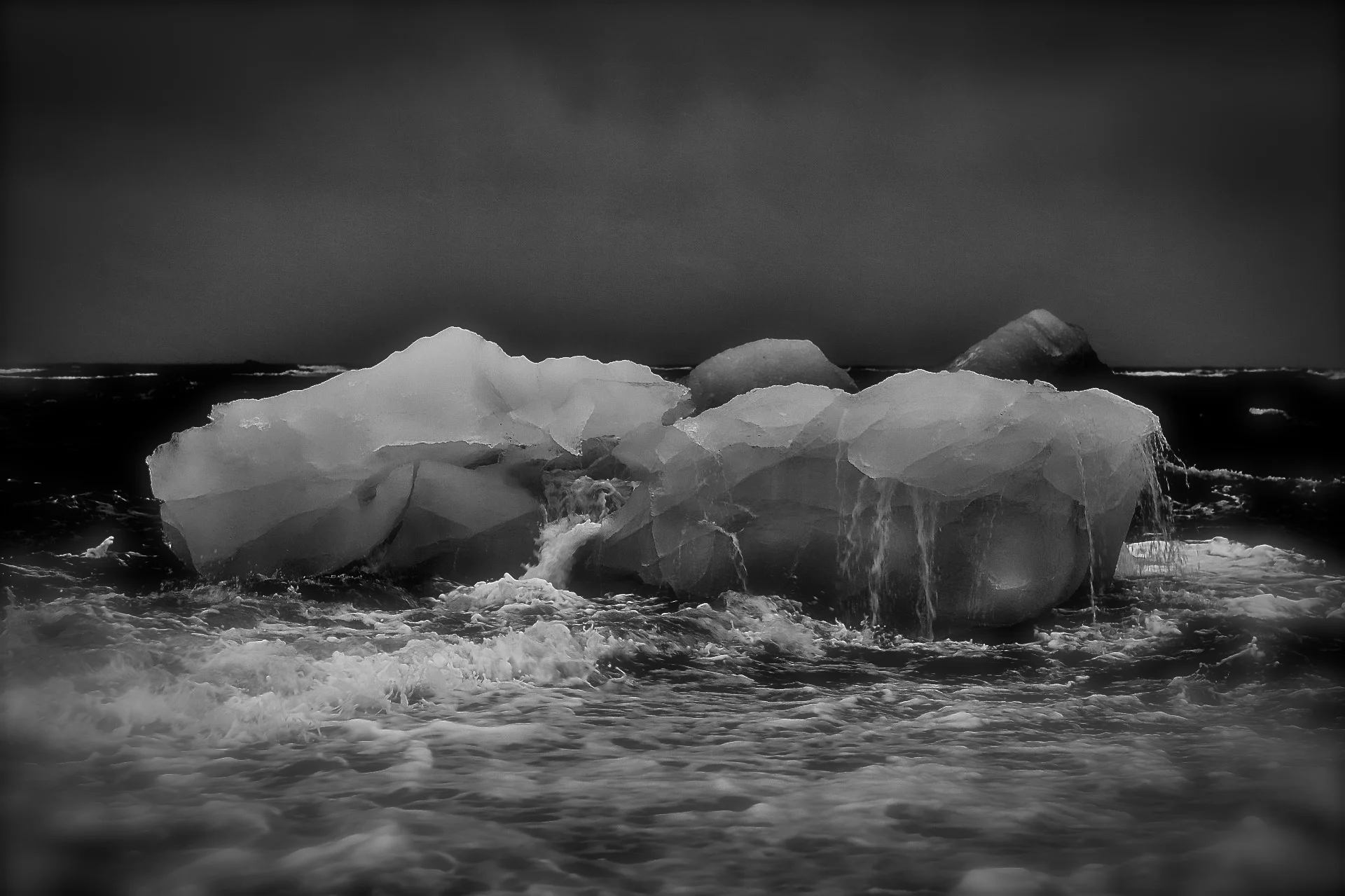
A Chip Off the Old Block

June 10, 2019
“Twenty or 30 years from now, I think towing icebergs will be a regular thing.”
— Nicholas Sloane, marine-salvage master

At the end of Rapa-Nui, a not-very-well-received but interesting nonetheless Hollywood movie from 1994 about the original inhabitants of Easter Island, the Bird-Man, Ariki-Mau — aka Island King — spots an iceberg at sea, in the middle of the South Pacific. Ariki-Mau believes the iceberg is the Great White Canoe of ancestors’ lore, sent to carry him to the Gods. He swims out to it with several of his followers, and is never seen again.

It was hard not to think of Rapa-Nui — an iceberg in one of the most remote corners of the South Pacific? — when hearing of a marine-salvager’s  proposal to tow a giant iceberg from Antarctica all the way to South Africa, to solve Cape Town’s water crisis.

A 125-million ton iceberg could conceivably supply 20% of Cape Town’s annual water consumption.

On the other hand, while humankind’s ingenuity seemingly knows no bounds, the practical challenges could well prove insurmountable, starting with the cost and ending with the ethical question of who owns Antarctica’s natural resources in the first place.

Then there are the potential perils if, for example, the iceberg were to tip over in rough seas (unlikely, given the vast percentage of an iceberg’s mass that lies beneath the ocean’s surface) or — more likely, if not inevitable — were to splinter and crack along the way.

Enough stakeholders are taking this proposal seriously that accredited glaciologists were willing to talk to the aggregate-news site Live Science, however, with Ted Scambos, senior

researcher with the University of Colorado’s Earth Science Observation Center, telling the site, “The issues are going to be how massive it is and the fact that it’s going to start melting as they go along.

“There are ways for the iceberg to break once it does start to get warm that are difficult to control.”

Bloomberg Businessweek profiled the marine-salvage master in question, Nicholas Sloane, and found that he does have a credible record in marine rescues, from saving a colony of rockhopper penguins soaked in fuel from a shipwreck off the remote south Atlantic archipelago of Tristan da Cunha to helping refloat the Costa Concordia, the Italian passenger liner that capsized off Tuscany in January, 2012, drowning 32 passengers.

The plan sounds goofy as all get-out, but no doubt many thought the same when, on May 25, 1961, then-US President John F. Kennedy stood before Congress and vowed to land a man on the moon and return him safely to Earth.

“I promise you,” Sloane told Bloomberg Businessweek, “the water situation in some parts of Africa is getting worse all the time. It’s certainly not getting better.

“Twenty or 30 years from now, I think towing icebergs will be a regular thing.”

https://www.bloomberg.com/news/features/2019-06-06/towing-an-iceberg-one-captain-s-plan-to-bring-drinking-water-to-4-million-people


Tags: iceberg, Antarctica, water shortage, marine salvage, Rapa-Nui, Cape Town, South Africa, Live Science, Bloomberg Businessweek, University of Colorado (Boulder), Ted Scambos, Nicholas Sloane, Costa Concordia, rockhopper penguins, Tristan da Cunha
©Naoki Suzuki-NAO Foundation/Siberian Times

©Naoki Suzuki-NAO Foundation/Siberian Times

Decoding the ancient wolf

June 09, 2019
“The idea of an ordered and elegant universe is a lovely one. It’s not just an idea, it’s reality. We’re discovering the hidden orders of the universe every day.”
— Adam Savage

Perhaps, one day in the not-too-distant future, someone will deduce a meaning from the disorderly jumble of scientific findings from the Anthropocene epoch, in that paradoxical corner of science where romanticism meets empirical evidence. 


The recent discovery in the Russian federal republic of Sakha — northeastern Siberia to you and me — of the severed head of a Pleistocene-era wolf, believed to be some 40,000 years old, is an attention grabber, in no small part because this early ancestor of Canis lupus — the tundra wolf, close cousin of the timber and grey wolf — was found in more-or-less intact condition. That’s a first, by any measure.


The wolf was aged between two- and four-years-old when it died, back in the age of the earliest cave paintings, in the Upper Palaeolithic or Old Stone Age. The wolf’s rich, mammoth-like fur and sharp fangs were found to be in surprisingly good condition, considering the passage of time.

As the ice shrinks owing to global heating, more Pleistocene-era finds are being discovered all the time, 

from woolly mammoth tusks to, now, the remains of one of present-day wolves’ earliest predator ancestors.

The Pleistocene wolf’s head is 40cm long, roughly half the length of many adult modern-day wolves, which range in length from 105-160cm. 

The find was announced in Tokyo at an exhibition organized by Russian and Japanese scientists. Dr. Naoki Suzuki, a professor of palaeontology and medicine at Tokyo’s Jikei University School of Medicine, has dated the remains as being 40,000 years or older. Scientists with the Swedish Museum of Natural History will now examine the Pleistocene predator’s DNA for further clues of its evolutionary biology.

Why does any of this matter? Quite apart from the romanticism and feel-good factor of finding a near-perfectly preserved specimen of one of wolves’ earliest ancestors, scientists hope to understand how species respond to environmental change, including the evolution of parasites, cancer research and the evolution of antibiotic resistance. How can we help save endangered species, and will we one day need that knowledge to save our own species? Human minds need to know.


©Creative Commons

©Creative Commons


Tags: Pleistocene, Anthropocene, Upper Palaeolithic, Old Stone Age, tundra wolf, wolves, Canis lupus, Naoki Suzuki, palaeontology, Tokyo Jikei University School of Medicine, ice melt, Sweden Museum of Natural HIstory, global heating, evolutionary biology, Sakha Academy of Sciences, Siberian Times, Yakutia, woolly mammoth
Prev / Next

Journal

“Man is modifying the world so fast and so drastically that most animals cannot adapt to the new conditions. In the Himalaya as elsewhere there is a great dying, one infinitely sadder than the Pleistocene extinctions, for man now has the knowledge and the need to save the remnants of his past.”

— Peter Matthiessen


Featured Posts

Featured
1.bourdain hong kong.jpg.png
Aug 19, 2025
Bourdain in Hong Kong
Aug 19, 2025
Aug 19, 2025
1.ABPU_S11_Armenia3.jpg.png
Jul 21, 2025
Bourdain in Armenia
Jul 21, 2025
Jul 21, 2025
art1.jpg.png
Jun 25, 2025
Bourdain in Uruguay
Jun 25, 2025
Jun 25, 2025
1.bourdain congo2.jpg.png
Jun 8, 2025
8 June — Bourdain Remembered
Jun 8, 2025
Jun 8, 2025
1.Screen Shot 2025-05-27 at 5.41.13 AM.jpg.png
May 31, 2025
Bourdain in Southern Italy (with Francis Ford Coppola)
May 31, 2025
May 31, 2025
8.dsc09592.jpg.png
May 17, 2025
Bourdain in Puerto Rico
May 17, 2025
May 17, 2025
9.11216842-anthonybourdain-srilankajpg-c-web.jpg.png
May 4, 2025
Bourdain in Sri Lanka
May 4, 2025
May 4, 2025
b.art1.png
Apr 17, 2025
Bourdain in Lagos, Nigeria
Apr 17, 2025
Apr 17, 2025
1.art website.jpg.png
Apr 10, 2025
Bourdain in the French Alps (avec Eric Ripert)
Apr 10, 2025
Apr 10, 2025
1.art (2).jpg.png
Apr 2, 2025
Bourdain in Singapore
Apr 2, 2025
Apr 2, 2025