• Entr'acte
  • Living Landscapes
  • Dispatches
  • Natural History
  • Panthera
  • Elephantidae
  • Bibliothèque
  • About
  • Menu

Strachan Photography

  • Entr'acte
  • Living Landscapes
  • Dispatches
  • Natural History
  • Panthera
  • Elephantidae
  • Bibliothèque
  • About

Netflix Media

Don’t Look Up

December 26, 2021

In a cutting New Yorker cartoon by the writer-editor Robert Mankoff, a corporate CEO addresses his rapt audience of business associates by singing the virtues of a cataclysmic natural disaster. “And so,” he concludes, “while the end-of-the-world scenario will be rife with unimaginable horrors, we believe that the pre-end period will be filled with unprecedented opportunities for profit.”

And so it goes.

The early reviews for Don’t Look Up, filmmaker Adam McKay’s tart satire for Netflix about a pair of astronomers who try to warn humanity about an impending, world-ending meteor strike on planet Earth — by going on a media tour of breakfast-TV shows — have been unkind.

“‘Don’t Look Up’ … or you might see one bomb of a movie hurtling right toward you,” a heading reads in Rolling Stone. Reviewer David Fear goes on to dismiss Don’t Look Up as “a blunt instrument in lieu of a sharp razor … while [filmmaker] McKay may believe that we’re long past subtlety, it doesn’t mean that one man’s wake-up-sheeple howl into the abyss is funny, or insightful, or even watchable.” Don’t Look Up, he huffs, is a disaster movie in more ways than one, adding, “Should you indeed look up, you may be surprised to find one A-list bomb of a movie, all inchoate rage and flailing limbs, falling right on top of you.”

Well … yes, and no.

The plot is simple, if not exactly original, and will remind anyone familiar with impending end-of-the-world tales like those depicted in Michael Bay’s Armageddon, Roland Emmerich’s The Day After Tomorrow and perhaps especially Mimi Leder’s Deep Impact.

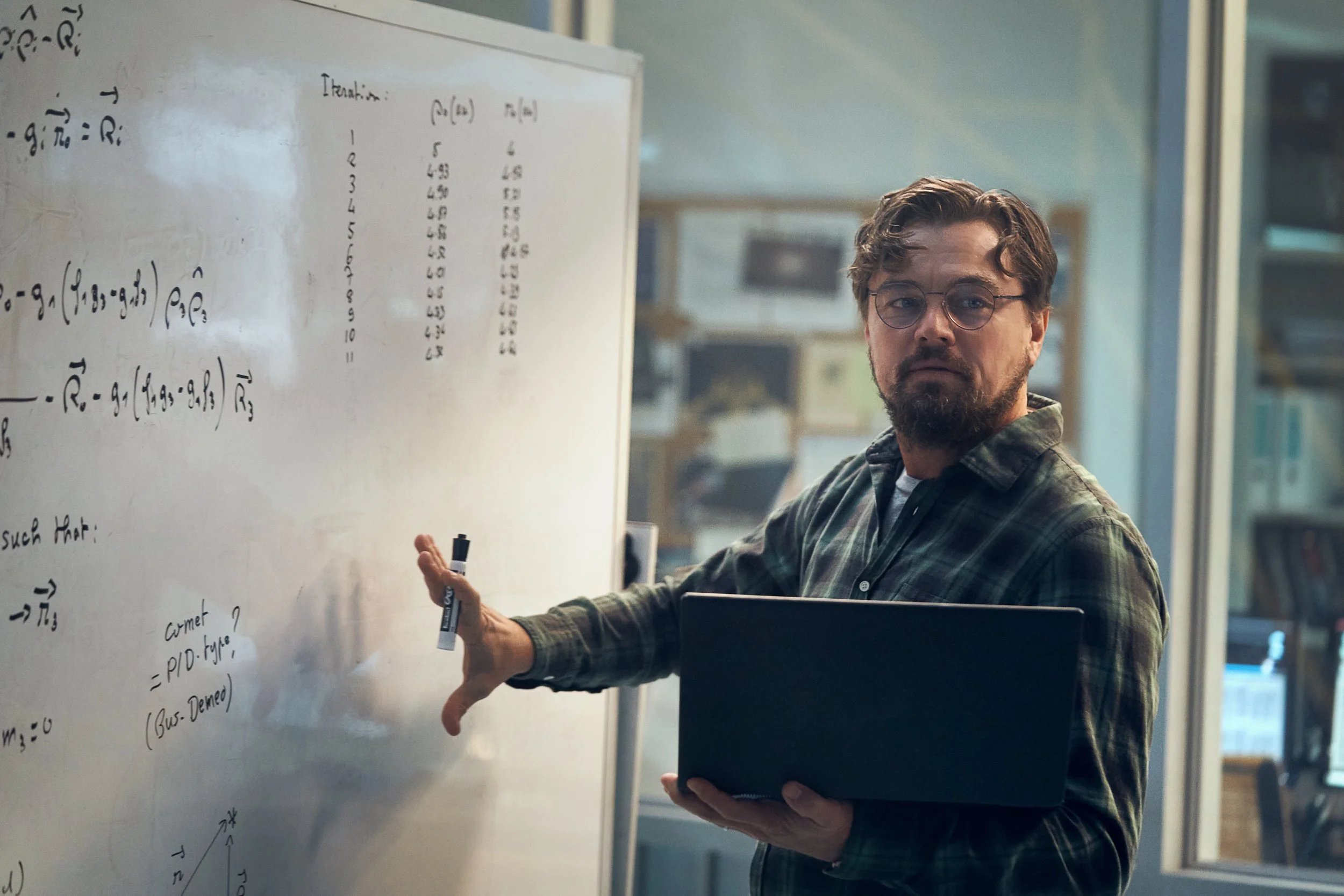
The story opens with a pair of idealistic scientists, played here by Leonardo DiCaprio and Jennifer Lawrence, who discover a 5-km wide comet — about the size of Mt. Everest — on a direct track to hit Earth in just six months’ time. The comet is bigger, wider and heavier than the one that destroyed the dinosaurs, which doesn’t portend a terrific future for humanity.

The astronomers try to warn the serving US president, played by Meryl Streep, and are discouraged to find a leader who cares more about her public image and the fast approaching midterm elections than a potential extinction event.

In an effort to get their message out to the wider public more directly, the reluctant pair hit the breakfast-TV circuit, where they find themselves fitted in between an A-list singer fretting over her recent relationship breakup and a neurotic, reclusive tech billionaire — is there any other kind? —  who sees the comet as an opportunity to mine rare minerals and boost his company’s stock price.

McKay, who co-wrote and directed the media savvy Anchorman and Talladega Nights, is more angry than funny here, though Netflix is pitching Don’t Look Up as a feel-good comedy for the holidays, and more than a few reviewers have grumbled about the heavy-handed, obvious tone. Perhaps it’s the cutting — vicious, even — way McKay lays bare the inner workings of today’s media, where vacuous publicists, fey media managers and obsequious personal assistants have an outsized sense of themselves and everything is about controlling the message — “I think these people need media training” — than the message itself.

Social media, another favourite whipping post of today’s intellectual class, has presented a more interesting theory than what the traditional film reviewers have been writing, about Don’t Look Up’s real meaning. Followers of several Facebook climate groups and the campaign to warn the wider world about the effects of climate change have said Don’t Look Up isn’t about a comet but rather a larger allegory about the climate emergency and how today’s mainstream media is all too quick to buy into climate denialism.

That may or may not be true — I, for one, think the climate campaigners are onto something, and most if not all film reviewers are stuck in the cycle of reviewing exactly what’s in front of them — but one thing is certain: Don’t Look Up is a furious and cutting look at today’s media landscape and how it’s constantly shifting, from the way breakfast-TV shows shape and manipulate the message of the day to fit their own ends, to the people who work in media, both in front of and behind the camera. For that reason alone, it’s worth a look.


— Netflix


Tags: Don't Look Up, Adam McKay, Netflix, Leonardo DiCaprio, Jennifer Lawrence

National Geographic Documentary Films for Disney+

Becoming Cousteau

December 24, 2021

“I am miserable out of the water," Jacques Cousteau explains in the the opening moments of Becoming Cousteau, filmmaker Liz Garbus’ lovely, heartfelt paean to a kinder, gentler, more idealistic time.

“It’s as though you’ve been introduced to heaven,” Cousteau continues, in his lilting, lives-lived accent, “and forced back to Earth.”

First, prologue. The life aquatic came to Cousteau naturally and early, and this film is made in a cheerful, naturalistic style in keeping with its affection for natural history and the wonders of the sea.

There’s no artifice or empty bombast here. The film is made in English, with occasional French and English subtitles, but in look, tone, sentiment and feel, it’s very, very French. There are moments when Becoming Cousteau sings — literally. The choice of music is inspired throughout, and puts to shame the “wall-to-wall" computer-generated sound of so many cheaply made, quickie TV docuseries.

Cousteau himself speaks very quickly, like a French Martin Scorsese, as though he can barely get the words out in time before they disappear. You get the feeling his words are trying to catch up with his brain, and failing.

In 1956, long after Cousteau had invented and then refined his  scuba technique, he made a film of his own, Le Monde du silence — the Silent World — in locations as far flung as the Persian Gulf off Sudan, Yemen, Eritrea and Saudi Arabia, a region of the world riven today by war and geo-global religious conflict, but back then an untouched underwater paradise. Cousteau and his fellow travellers saw themselves as guardians of an underwater cathedral. Cousteau was an early ecologist and one of the first filmmakers to recognize how precious reefs are, and how they need to be protected. This was long before virtue signalling became fashionable. 

Cousteau was a pragmatist, too.

Penniless and broke at the time, his research vessel Calypso in dire need of funding, he made a pact that today, with the benefit of hindsight, looks like a pact with the devil: He agreed to search the sea bed for signs of “black gold” on behalf of deep-pocketed Arab emirates in the Arabian Gulf, in exchange for the funding to keep his research and dream of underwater discovery afloat.

Filmmaking came to him honestly. He made his first film at 13 — but films cost money.

“Our films are not documentaries,” he famously said. ”They are true adventures.“

Cousteau was, and remains, a national hero in his native France, and not just among would-be oceanographers and future conservationists. It may be hard to imagine anyone doing this today but Cousteau cut across all social and socioeconomic boundaries. He was inevitably pulled and tugged at by politics and politicians, but he was never himself a political animal.

He was well-spoken and as easy to understand in English as in his native French. He was a man of the world and the voice of a planet, and it’s fair to say he opened the eyes of tens of millions of people from innumerable countries and different regions around the world. He was gatekeeper and holder of secrets of the ocean depths. He hailed from a generation before David Attenborough, but his impact on the global consciousness was equally profound.

“What's it like down there?” a little girl asks Cousteau, at the beginning of this lovely, blue and green film, her voice shaking with awe and childlike curiosity.

“It’s fantastic, “ he says, in thickly accented English. “Imagine.”

Imagine indeed.

                      — Disney+


Tags: Becoming Cousteau, Liz Garbus, Jacques Yves Cousteau, National Geographic Documentary Films, The Cousteau Society

National Geographic Documentary Films,

The Rescue

December 24, 2021

What a breath of fresh air The Rescue is.

An honest, unblinking documentary about the 2018 Tham Luang cave rescue in Thailand can’t help but be uplifting, but there’s a subtlety and understated beauty to Elizabeth Chai Vasarhelyi and Jimmy Chin’s film all too rare in documentaries today.

First of all, The Rescue is remarkable for what Vasarhelyi and Chin, 2019 Academy Award winners for the climbing film Free Solo, chose to leave out, as much as what they chose to include.

There’s no bullying, hectoring narration, for starters.

The cave divers, the rescued children — the Tham Luang cave rescue involved the hair-raising, life-and-death rescue of a dozen 11- to 16-year-old juvenile rep soccer players and their 25-year-old assistant coach — first responders, rescue teams and panic-stricken parents at the heart of The Rescue are allowed to tell their own stories, in their own voices, in their own way, in their own languages. It is a harrowing tale, too, as the children, and they are children, remain trapped for days in an underwater cave threatened by heavy rains and a series of catastrophic underground floods that block their way out and threaten their very lives.

The Rescue uses subtitles — no bad dubbing here — rather than relying on shouty actors’ voices to holler their way through the often noisy, obvious voice-over of so many “foreign” films. The music, by composer and Critics’ Choice nominee Daniel Pemberton, is nuanced and understated, and avoid the usual clichés of loud, so called “wall-to-wall” music, that awful ‘You’re-too-dumb-to-get-it-on-your-own’ noise common to so many documentaries.

Listening to UK rescue divers John Volanthen and Richard Stanton talk about “an underwater wrestling match” and the dawning realization that divers needed to work fast — dangerously fast — in increasingly hairy conditions before the next wave of monsoon rains hit wiped out the few underground air pockets that remained.

“We were talking about a group of children we didn’t think was possible for us to dive them out. Even if they are still alive, it can’t be done. So, now what? What the hell are we going to do now?”

As people on the outside — us, in other words —now know, they found a way.

The Rescue shows how modern-day technology, coupled with local beliefs and the capriciousness of fate — good and bad — can create a miracle, even where none is expected, and even as armchair experts predict the worst.

“Wish us luck in bringing the boys back home,” a rescue worker says, early in the film, but hardly anyone in the outside world looking on from afar believes it. A US military team, flown in from Japan, expect to find a rank rabble of amateurs in flip-flops when they arrive; instead, a US military team leader later admits, they find hard-ass professionals who are hardcore about what they do.

Why dive into underwater caves in the first place? 

“It’s like being in space,” a diver explains. “Probably the purest adventure you can have.”

What makes someone want to be an explorer?

“I think it’s two parts ego,” another diver replies, “one part curiosity, one part” — he pauses, searching for the right words — “lack of confidence in yourself and the need to prove yourself.”

The Rescue is poignant, profound and well-worth the effort to find. It’s top class, to the very end.

                                                           — Disney+


Tags: The Rescue, Tham Luang cave rescue, Elizabeth Chai Vasarhelyi, Jimmy Chin, National Geographic Documentary Films

National Geographic for Disney+

Welcome to Earth

December 24, 2021

There’s a grace and dignity to Welcome to Earth, the Will Smith hosted six-hour love letter to our blue planet, that transcends the usual celebrity-driven guided tour through the world’s wild places.

Scientists, adventurers and career explorers — many of them persons of colour who’ve overcome personal travails and handicaps to achieve their collective dream of exploring the darkest, most hidden reaches of planet Earth — guide Smith up the sides of active volcanoes, surrounded by deadly clouds of ash that both create and can take life in the blink of an eye; and down to the bottom of the sea, from Bio Bay, Puerto Rico to Bimini in the Bahamas.

“We set out to find a hidden world in the depths,” Smith explains in the second episode in the series, Descent Into Darkness, “and I discovered that there’s more light in the darkness than I ever imagined.”

We, too.

Smith is in safe hands, despite his assertion at the outset that, when he was a child, his grandmother warned him that all the best things in life are lived “on the other side of fear.”

If that set-up sounds suspiciously contrived — Smith is never going to be in real danger, and we know that — it doesn’t matter: What emerges is a sense of wonder and an innate curiosity about the things in nature that really matter, things we don’t know and yet we somehow take for granted.

The program, a more disciplined, better focused and more meaningful follow-up to 2018’s One Strange Rock is produced by National Geographic for Disney+, together with former BBC and Discovery executive Jane Root and Oscar-nominated filmmaker Darren Aronofsky — includes looks at the behaviour of large groups of animals when they come together, such as the annual Serengeti wildebeest migration across Africa’s Great Rift Valley; the power of scent and smell, and how certain scents link ecosystems around the world; and the nature of movement and how everything in life is a study in motion, from life on Earth to Earth itself, and the cosmos beyond.

Welcome to Earth was filmed in 34 countries on all seven continents, and it shows: from Tanna in the South Pacific to Öran in Sweden, from Hanifaru Bay’s Baa Atoll in the Indian Ocean Maldives to Vatnajökull Glacier in Iceland.

This is no idle travelogue, but neither is it a scold about how the natural world is going to hell in a hand-basket and it’s all your fault.

The tone is light-hearted and yet weighty in content. Somehow the balance works. It’s easy to imagine how many ways Welcome to Earth could have gone wrong, and yet the threads hold together in the end.

It’s easy to listen to and emboldening to watch. This is nature programming of the highest order.

Inevitably, it’s the people who make the strongest impression— and not just Smith but the explorers themselves, whether it’s polar adventurer Dwayne Fields talking about how kayaking an ice river looks scary — “but it’s an important step because having the confidence to navigate the dangerous and unfamiliar is at the heart of what is to be an explorer” — or marine biologist and conservation photographer Cristina Mittermeier talking about how sharks use their acute sense of smell — “hundreds of times more potent and accurate than that of humans” — to navigate the vast expanse of the world’s oceans.

Welcome to Earth holds to the promise of its name. It takes viewers to the ends of the Earth, and beyond. These days, that’s a welcome trip indeed.

— Disney+


Tags: Welcome to Earth, National Geographic, Will Smith, Disney+, Disney Plus, Darren Aronofsky, Jane Root, Nutopia, Protozoa Pictures, Westbrook Studios, Erik Weihenmayer
Prev / Next

Journal

“Man is modifying the world so fast and so drastically that most animals cannot adapt to the new conditions. In the Himalaya as elsewhere there is a great dying, one infinitely sadder than the Pleistocene extinctions, for man now has the knowledge and the need to save the remnants of his past.”

— Peter Matthiessen


Featured Posts

Featured
1.bourdain hong kong.jpg.png
Aug 19, 2025
Bourdain in Hong Kong
Aug 19, 2025
Aug 19, 2025
1.ABPU_S11_Armenia3.jpg.png
Jul 21, 2025
Bourdain in Armenia
Jul 21, 2025
Jul 21, 2025
art1.jpg.png
Jun 25, 2025
Bourdain in Uruguay
Jun 25, 2025
Jun 25, 2025
1.bourdain congo2.jpg.png
Jun 8, 2025
8 June — Bourdain Remembered
Jun 8, 2025
Jun 8, 2025
1.Screen Shot 2025-05-27 at 5.41.13 AM.jpg.png
May 31, 2025
Bourdain in Southern Italy (with Francis Ford Coppola)
May 31, 2025
May 31, 2025
8.dsc09592.jpg.png
May 17, 2025
Bourdain in Puerto Rico
May 17, 2025
May 17, 2025
9.11216842-anthonybourdain-srilankajpg-c-web.jpg.png
May 4, 2025
Bourdain in Sri Lanka
May 4, 2025
May 4, 2025
b.art1.png
Apr 17, 2025
Bourdain in Lagos, Nigeria
Apr 17, 2025
Apr 17, 2025
1.art website.jpg.png
Apr 10, 2025
Bourdain in the French Alps (avec Eric Ripert)
Apr 10, 2025
Apr 10, 2025
1.art (2).jpg.png
Apr 2, 2025
Bourdain in Singapore
Apr 2, 2025
Apr 2, 2025