• Entr'acte
  • Living Landscapes
  • Dispatches
  • Natural History
  • Panthera
  • Elephantidae
  • Bibliothèque
  • About
  • Menu

Strachan Photography

  • Entr'acte
  • Living Landscapes
  • Dispatches
  • Natural History
  • Panthera
  • Elephantidae
  • Bibliothèque
  • About
©Agence France-Presse/PA

©Agence France-Presse/PA

New Fossils Filling Out the Face on the Human Family Tree

September 30, 2019
“I thought to myself, ‘Oh my goodness — am I seeing what I think I’m seeing?’ All of a sudden I was jumping up and down. That was when I realized that this is what I had dreamt.”
— Prof. Yohannes Haile-Selassie

Everything we thought we knew about early humankind may need to be tossed out like yesterday’s news. “All bets are now off,” researchers looking into humankind’s early ancestors are saying. Lucy is out and Anamensis is in.

Research published last month in the journal Nature pointed to the recent discovery of a nearly complete 3.8-million-year-old skull of an early, ape-like human ancestor in Ethiopia as evidence that not all is what it seems when it comes to decoding the genetic origins of modern humans.

The prevailing view that an ape-like hominid named Lucy was a member of the species that first gave rise to early humans may have to be reconsidered.

Prof. Yohannes Haile-Selassie, a palaeoanthropologist affiliated with the Cleveland (Ohio) Museum of Natural History,  discovered the fossil at Miro Dora, an archeological site in Mille District, in Ethiopia’s fossil-rich Afar State. Prof. Haile-Selassie says the specimen is the most well-preserved specimen yet of the ape-like human ancestor named Australopithecus anamensis, the oldest known australopithecine whose kind may have — emphasis on the “may” — existed as long ago as 4.2 million years.

It’s now thought that anamensis is the director ancestor of a later, more advanced species called Australopithecus afarensis, the earliest human in the grouping known as Homo, which includes all humans alive today. “Lucy” was the first afarensis to be discovered, in 1974. Researchers nicknamed her Lucy after the Beatles song, Lucy in the Sky with Diamonds, which had been playing on a transistor radio at the excavation site at the time of the skeleton’s discovery. Lucy was hailed as “the first ape to have walked,” and captured the public imagination.

Researchers now believe anamensis and afarensis overlapped in time, because of the dates involved.

This is important because it means the former could not have evolved into the latter in neat, linear evolutionary terms, as researchers believed until recently. 

They were separate species, living at much the same time, and may even have encountered one another, much as scientists have confirmed Neanderthals lived among early Homo sapiens, the direct ancestors of modern humans. It was once thought Neanderthals and sapiens were separated by thousands of years; now it appears they have rubbed elbows, as it were, and quarrelled over territory. Anamensis and afarensis co-existed for at least 100,000 years.

This matters because it means additional overlapping between advanced ape-like species probably happened, which in turn increases the probability that many different roots fed into modern humanity’s family tree, and not just the one-size-fits-all branch model.

Anthropologists have never cared for the term “missing link” to describe a fossil that is part-ape and part-human. These new findings suggest there is not one missing link, but rather dozens, even hundreds of links that are not missing so much as undiscovered. Yet.

Anamensis is only the latest in a recent string of discoveries that suggests there was no smooth, direct line of ascent in human evolution. The picture books may have to be redrawn completely.

Far from discouraging scientists, this excites them. It means there is so much more we can learn, and established research organizations can’t help but be galvanized and re-energized by the new findings. What we assumed to be true is no long that. 

https://www.sciencemag.org/news/2019/08/stunning-ancient-skull-shakes-human-family-tree

https://www.nytimes.com/2019/04/10/science/hominins-human-evolution.html

©Cleveland Museum of Natural HIstory

©Cleveland Museum of Natural HIstory


Tags: Australopithecus afarensis, afarensis, anamensis, human evolution, Homo sapiens, Neanderthals, Yohannes Haile-Selassie, paleoanthropology, Cleveland Museum of Natural History, journal Nature, the Beatles, Lucy, Ethiopia, Miro Dora, Mille District, Afar Regional State, Lucy in the Sky with Diamonds
©PHA Zambia

©PHA Zambia

‘Show Me the Money!’ How Trophy Hunting Lost the Plot

September 28, 2019
“There’s a lot of controversy around the issue of hunting as there is around gambling, and I like these stories where there is a moral dimension, stories that force you to think about your prejudices about a subject and explore the extent to which they are justified.”
— Louis Theroux

Always read between the lines, even if the headline is a grabber.  Trophy hunting has been put on hold — temporarily — in the southern African country of Zambia, prompting some excitable and over-excited conservation NGOs to hail the end of trophy hunting completely.

Only . . . that’s not entirely true.

Local communities in Zambia have called for the immediate suspension of trophy hunting in all designated hunting blocks. That part is true.

A suspension is not a ban, though — and the reason for the suspension actually highlights a larger issue that speaks to one of the big-picture arguments used to justify trophy hunting in the first place.

The hunting lobby is forever lecturing environmentalists, preservationists and nature lovers that the money generated by trophy hunting goes to support local communities, giving them a vested interested in conservation and maintaining wilderness areas. Trophy hunting generates jobs, the argument goes, in the form of hunting guides, trackers and camp workers, not to mention the money generated for government coffers by hunting licences.

If local communities gain financially from the harvesting of the wildlife in their area — a polite way of describing killing big-game animals for sport — they have a bigger stake in protecting that wildlife, the argument goes.

If local communities have nothing to gain from animals like elephants that would just as soon raid their crops, drink the rivers and streams dry and flatten their trees, local communities are more inclined to treat wild animals as unwanted pests and kill them off. “If it pays, it stays,” the argument goes.

What’s happened in Zambia is a little messier though.

“Follow the money” is another time-worn saying, and in this case — surprise! — no one seems to know where the money has gone, least of all the local communities that were supposed to benefit from it.

A local NGO, the Zambia National Community Resources Board Association (ZNCRBA) has demanded the immediate suspension of trophy hunting — all trophy hunting — until the government releases all funds owed to local communities under the agreement.

Incredibly — or not so incredibly, depending on your level of cynicism — according to a statement issued to the international media by a number of individual community

resource boards in Zambia, they haven’t received any concession fees since 2016, and no hunting revenue since 2018.

They haven’t been paid, in other words. Whether the money has disappeared — be less cynical! — or whether it’s simply being held in escrow while minor bookkeeping details are being sorted out, will presumably come out eventually. Or not, as the case may be.

Trophy hunting has not been banned, in other words. The local communities simply want to be paid. Which is only fair, since — remember how often the trophy hunting lobby lectures us weak-kneed snowflakes and sob-sister bunny huggers about proper conservation practices — paying local communities is one of the financial pillars underpinning the whole argument in favour of shooting rhinos and elephants for the trophy wall.

Who knew that money would go missing? Why, you could knock me over with a feather. Please forgive me while I take a moment to clutch my pearls.

This isn’t just a one-off controversy over some missing dollars and cents in a somewhat obscure African country hardly anyone outside the immediate area has heard of, even those in developed countries who donate to wildlife conservation and environmental organizations. The supposed incentive to local communities has to be transparent and tangible if it’s to convince anyone that hunting provides benefits.

The Zambia Professional Hunters Association, on its website, argues that, and I quote, “With dwindling resources and loss of habitat for wildlife, we believe that hunting is one of the main pillars of conservation and the management and utilization of wildlife is one of the most important tools in conserving wildlife for our children and future generation.”

Which is true — to a point — though there’s an argument to be made, and I’ve made it often, that wildlife tourism generates far more revenue than hunting. That’s because, hard as it may be to believe, an elephant that’s alive today can be presented before another group of sightseeing tourists and nature lovers tomorrow, and the day after. That living elephant is worth more than an elephant that is killed today, once, never to be seen again.

Where did the money go, anyway? Pay the man! Or, in this case, pay the community.   

https://africageographic.com/blog/trophy-hunting-zambia-suspended-non-payment-hunting-fees-communities/

©Vinayak Harshvardhan-Pixabay

©Vinayak Harshvardhan-Pixabay


Tags: trophy hunting, Zambia, Zambia National Community Resources Board Association, ZNCRBA, Professional Hunters Association of Zambia, www.phazambia.com, hunting concessions, sustainability, community resources, conservation, wildlife management, Africa Geographic
©Ian Lindsay-Pixabay

©Ian Lindsay-Pixabay

Hey, Wanna Buy 1,700 rhinos? Serious Question.

September 26, 2019
“Our client has accordingly not yet been paid for the said [rhino] horns and the horns therefore remain his lawful and rightful property.”
— Ulrich Roux, attorney for South African rhino farmer John Hume

Now here’s a weird one. What to do with 1,700 white rhinos?

Little more than a week after World Rhino Day, John Hume, the South African farmer and owner of the world’s largest private collection of living rhinos, put his Mpumalanga nature reserve up for auction in one last, final, likely futile bid to keep his herd — some 1,700 rhinos in all — in the lifestyle to which they have become accustomed.

The auction was a flop. The die is cast. The would-be entrepreneur and self-described conservationist — conservation groups would call him by any other name — dreamed up a get-rich-quick scheme for the ages. Sadly, it turned out to be more likely a scheme out of a Carl Hiaasen novel: wacky, ill-thought through and not entirely on the level.

Hume’s idea was to farm rhinos — instead of, say, cattle —  breed them and then sell the rhinos’ horns on the open market for bucketloads of money.

Instead, Hume has been left with bucketloads of something else, and no way to pay for it all.

Hume gambled that the sale of rhino horn would eventually be made legal and the worldwide ban lifted — God damn you, CITES; God damn you, IUCN. South Africa was one of the loudest voices to get the worldwide ban on ivory lifted, for a one-off-sale of stockpiled elephant tusks, but CITES, IUCN and other UN and NGO weanies voted that down, a mere fortnight ago. Rhino horn is even more precious, because as everyone in China, Laos, Vietnam and Thailand knows, ground powder made from rhino horn cures cancer and improves one’s sex drive. But wait, there’s more. Dagger handles made from rhino horn are hot stuff on the Arabian peninsular; if only the desert sheiks in Yemen had been allowed to burnish their daggers with handles made of ivory horn, that little business with Saudi Arabia might never have happened. But the bureaucrats got in the way, backed by lefties, liberals, Commies, pinkos, weak-

kneed sob-sisters and social workers from Western countries, and 16-year-old climate activists from Sweden, and well, the whole scheme fell apart and went to hell.

Now what to do?

Well, not that. Earlier this year, Hume confirmed he legally sold 181 rhino horns to a Port Elizabeth, SA buyer said to be linked to one of the largest reported seizures of illegal rhino horn in South African history.

Much is at stake, if you will.

There is an argument to be made that, with the world’s rhino population heading headlong into a crash — the rhino may well prove to be one of the first casualties of an iconic “Big Five” animal species during our lifetimes, as the long-predicted 6th Mass Extinction looks more and more like a growing reality — private herds may be one way to save them. Private herds are better protected than those in national parks, no small consideration given the present poaching onslaught. As the Northern white rhino is now all but extinct, South Africa is now home to the world’s largest surviving population of remaining African white rhinos, and half of those are in private hands. Hume’s herd represents some 7% of the total.

That might not sound like much, but if the rhinos should perish because no one has the funds to feed them, that would be an  unspeakable tragedy. All the more so because it’s so preventable.

If ever there was time for one of those tech titans with more money than they know what to do with to step in, this is it.

https://www.iol.co.za/saturday-star/sas-largest-private-rhino-breeder-john-hume-says-seized-rhino-horns-are-his-property-22221195

https://www.dailymaverick.co.za/article/2019-09-25-top-rhino-rancher-running-out-of-options-after-property-auction-flop/

©Twitter.jpg


Tags: World Rhino Day, white rhino, Northern white rhino, rhino horn, rhinos, John Hume, Mpumalanga, South Africa, CITES, IUCN, endangered species, Saturday Star, Business Maverick
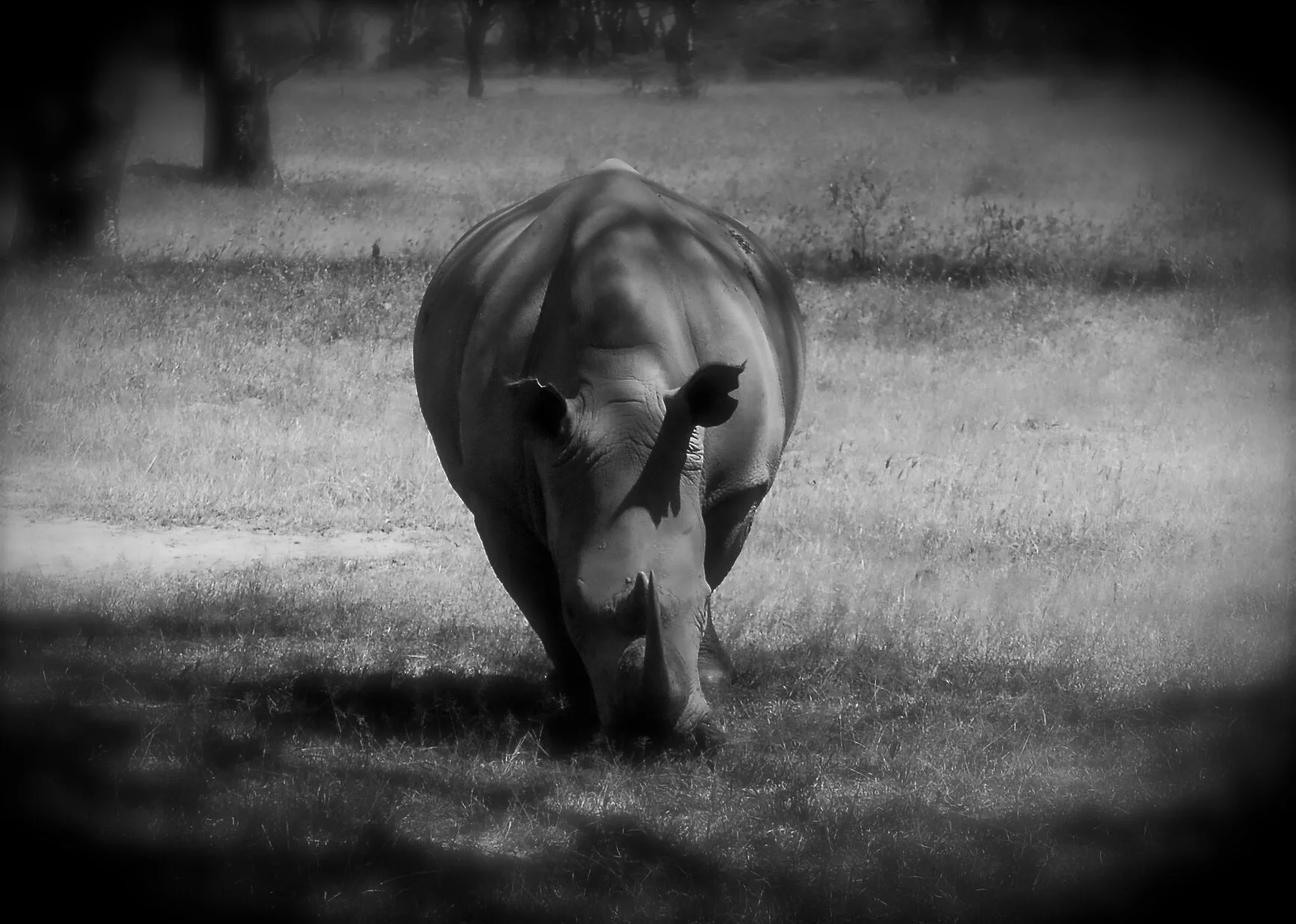
©Alex Strachan/Lake Manyara National Park, Kenya

©Alex Strachan/Lake Manyara National Park, Kenya

A “Crash” of Rhinos for World Rhino Day

September 22, 2019
“These magnificent species of Africa — elephants, rhino, lions, leopards, cheetah, the great apes — this is a treasure for all humanity, and they are not for sale. They are not for trade. They need to be valued and preserved by humanity. We need a global commitment to that.”
— Patrick Bergin

Curious fact: The collective noun for a group of rhinos is a “crash” of rhinos.

I don’t believe that for a second, mind you, but that’s what the excellent research assistants at Google tell us. Perhaps that should be a factoid rather than a fact, or even fake news, but either way, it’s worth noting.

It’s World Rhino Day today, and the word “crash” is worth picking up on if for no other reason than rhino numbers have crashed — figuratively, if not literally — since industrialization and colonization of Africa by Western powers.

Here’s what we are losing should rhinos go the way of the mastodon, another apex mammal that no one in its day could have imagined might vanish from the face of the Earth.

Since it’s evident to anyone with a working brain why rhinos are in trouble, I’ve decided to acknowledge rhinos’ existence by sharing some curious facts — or factoids, if you prefer — about the rhino’s unique place in the ecosystem.

The climate marchers the other day probably know more about rhinos than many of the world leaders who claim to represent them do. They certainly care more. This is one generation gap where knowledge favours the young.

There are five species of rhino, the endangered white and black (found in Africa) and critically endangered if not already extinct Indian, Javan and Sumatran, found, oddly enough in India, Java and Sumatra, where they are to be found at all.

The white rhino is not white but a kind of slate grey, or brown, depending on the last thing it was rolling in — the word “white” is an Afrikaans bastardization of the word “wide,” for its wide nose and snout. Now you know.

Similarly, the black rhino is not really black; a more apt name, sometimes used, is the hook-lipped rhino, for obvious reasons to anyone who has seen one.

Rhinos have good hearing and an uncanny sense of smell, but poor eyesight. This can make them suspicious and paranoid, and they tend to charge anything they don’t quite understand or perceive as a possible threat. 

All rhinos are endangered; the black rhino is under particular threat. Black rhinos are browsers, and favour twigs and leaves. White rhinos are grazers, and prefer grass. Black rhinos tend to be temperamental, short-tempered and quick to take offence to just about anything; white rhinos,

though not exactly housetrained, tend to be more sedate and circumspect about their lot in life.

Rhino horn is valued in the usual places by the usual suspects, for everything from its supposed aphrodisiac properties to its use as a cure in traditional medicine. It’s all bunk — rhino horn is made from keratin, the same organic substance human fingernails are made of, but the international crime syndicates have found a way to make money from it.

The sheer unfettered stupidity and ignorance of some cultures would be enraging if it weren’t so sad: Just about everyone, except a handful of world leaders, will admit the Earth is a better place with rhinos than without them.

Rhinos enjoy wallowing, especially in mud. The dirtier and wetter the mud, the better. The mud dries on their skin and protects it from the harsh equatorial sun, hence the phrase, “a skin as thick as rhino hide.” Rhinos like to rub their bodies against inanimate objects, such as rocks and trees, to rid their bodies of parasites such as ticks, which get stuck in the dried mud on their skin. That’s why tick birds — the clue is in the name — can often be found on a rhino’s back, or around its head and ears. Rhinos instinctively understand the tick bird, or oxpecker, is not a pest but a friend. The bird, for its part, is grateful for the occasional snack and mindful that it can relax and eat without having to worry about being nailed by a snake or a large raptor.

A rhinos’ gestation period lasts roughly 15 months, after which time it will give birth to a single calf. (Twins are virtually unheard of.) Young rhinos remain with their mothers until they are two- or three-years-old.

You don’t need an advanced degree in mathematics — just a cognitive function slightly higher than that of Donald J. Trump — to realize that these numbers weigh against rhinos’ chances of long-term survival: A low birth rate, coupled with the extended period of parenting before the calf is old enough to be able to look after itself, lessens the odds for a long and prosperous life, even at the best of times.

And these are not the best of times.

Rhinos live roughly 40 to 50 years. There are some 5,000 black rhinos left, if that.

Perhaps, by the next World Rhino Day, their numbers will improve. That’s one New Year’s resolution we can — and should — get behind.

©Save the Rhino Trust

©Save the Rhino Trust

©Twitter.png

Tags: World Rhino Day, black rhino, white rhino, rhino horn, endangered species, 6th Mass Extinction, biodiversity, #ClimateChangeIsReal, #ClimateActionSummit, Fridays for Future, #SundayThoughts, #SavingRhinos
Global strike for climate0.jpg

Speaking Truth to Greed

September 20, 2019
“My role is to be one of many, many activists who are pushing for climate action. I donʼt see myself as a leader, or icon, or the face of a movement.”
— Greta Thunberg

From London to Lyon and from Perth to Paris, climate activists are taking part in a general general strike today, in what is already expected to be the biggest day of climate protests in planet Earth’s history.

Some of the first protests were staged overnight in Australia; organizers have said “well over” 300,000 people gathered in more than 100 cities and towns across the country. Melbourne, which has experienced unusually dry weather this past winter, hosted the largest march in terms of numbers, with 100,000 demonstrators; 80,000 rallied in Sydney,  and 30,000 in Brisbane.

The Global Climate Strike is the third in a worldwide series of climate rallies organized by school students and led by 16-year-old climate activist and Nobel Peace Prize nominee Greta Thunberg. Here is what she has said.

©Press Association

©Press Association

“For 25 years, countless people have come to the U.N. climate conferences begging our world leaders to stop emissions, and clearly that has not worked as emissions are continuing to rise. So I will not beg the world leaders to care for our future. I will instead let them know change is coming whether they like it or not.”

©Press Association

©Press Association

“We have gathered today because we have chosen which path we want to take, and now we are waiting for the others to follow our example. We will never stop fighting for this planet, for our futures, and for the futures of our children and grandchildren.

”We need to get angry and understand what is at stake. And then we need to transform that anger into action and to stand together united and just never give up. We are striking to disrupt the system, to create attention. I just hope that it will turn out well.” 

©Press Association

©Press Association

“It feels like we are at a breaking point. Leaders know that more eyes are on them, much more pressure is on them, that they have to do something, they have to come up with some sort of solution. I want a concrete plan, not just nice words.” 

©Press Association

©Press Association

“Many people say that Sweden is just a small country, and it doesnʼt matter what we do. But I have learned you are never too small to make a difference.

“If a few children can get headlines all over the world just by not going to school, then imagine what we could all do together if we really wanted to.” 

This story is part of Covering Climate Now, a global collaboration of more than 250 news outlets to strengthen coverage of the climate story. 

©Press Association

©Press Association


Tags: Global Climate Strike, climate crisis, climate change is real, Fridays for Future, Greta Thunberg, climate protests, schoolstrike4climate.com, School Strike for Climate, #FridaysForFuture, #Friday, #FridayMotivation, Covering Climate Now
Prev / Next

Journal

“Man is modifying the world so fast and so drastically that most animals cannot adapt to the new conditions. In the Himalaya as elsewhere there is a great dying, one infinitely sadder than the Pleistocene extinctions, for man now has the knowledge and the need to save the remnants of his past.”

— Peter Matthiessen


Featured Posts

Featured
1.bourdain hong kong.jpg.png
Aug 19, 2025
Bourdain in Hong Kong
Aug 19, 2025
Aug 19, 2025
1.ABPU_S11_Armenia3.jpg.png
Jul 21, 2025
Bourdain in Armenia
Jul 21, 2025
Jul 21, 2025
art1.jpg.png
Jun 25, 2025
Bourdain in Uruguay
Jun 25, 2025
Jun 25, 2025
1.bourdain congo2.jpg.png
Jun 8, 2025
8 June — Bourdain Remembered
Jun 8, 2025
Jun 8, 2025
1.Screen Shot 2025-05-27 at 5.41.13 AM.jpg.png
May 31, 2025
Bourdain in Southern Italy (with Francis Ford Coppola)
May 31, 2025
May 31, 2025
8.dsc09592.jpg.png
May 17, 2025
Bourdain in Puerto Rico
May 17, 2025
May 17, 2025
9.11216842-anthonybourdain-srilankajpg-c-web.jpg.png
May 4, 2025
Bourdain in Sri Lanka
May 4, 2025
May 4, 2025
b.art1.png
Apr 17, 2025
Bourdain in Lagos, Nigeria
Apr 17, 2025
Apr 17, 2025
1.art website.jpg.png
Apr 10, 2025
Bourdain in the French Alps (avec Eric Ripert)
Apr 10, 2025
Apr 10, 2025
1.art (2).jpg.png
Apr 2, 2025
Bourdain in Singapore
Apr 2, 2025
Apr 2, 2025